

Two Actives, Two Markers: Standardising a Misai Kucing + Roselle Women’s Wellness Pouch Beverage — the Rosmarinic Acid and Anthocyanin Specs a Malaysian Brand Owner Must Specify
October 13, 2026 | by supersuper
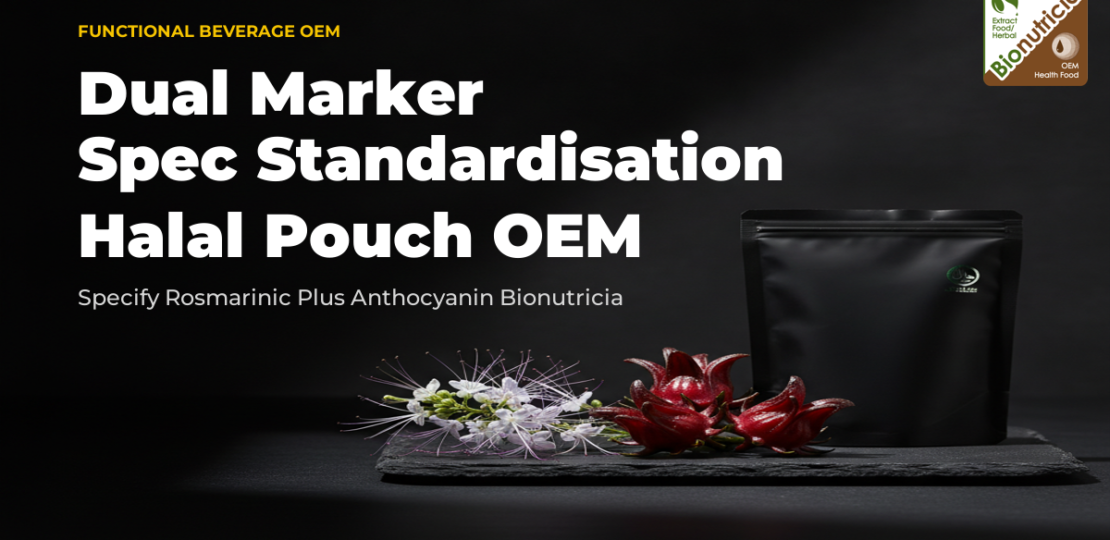
Direct answer: For a misai kucing and roselle wellness pouch beverage, a brand owner must specify two assay markers in the certificate of analysis: rosmarinic acid at 2.0% or higher on the misai kucing leaf extract by HPLC, and the anthocyanin markers of the roselle calyx, delphinidin-3-sambubioside and cyanidin-3-sambubioside, measured by the AOAC 2005.02 pH-differential method, with sinensetin as fingerprint.
Two botanical actives in one finished pouch means two independent specification questions. The misai kucing leaf contributes a polyphenolic profile anchored by rosmarinic acid; the roselle calyx contributes the anthocyanin pigments that give the drink its colour and its tart character. Each active has its own identity, its own marker chemistry and its own assay method, and a certificate of analysis that treats the pair as a single “herbal blend” row cannot lock batch-to-batch consistency. This guide sets out exactly which two markers to specify, which methods to name, and which documents should carry them.
Why a Two-Marker CoA Is the Only Reliable Specification for This Pair
A single marker per ingredient is routine in extract supply, but a finished pouch beverage carrying two botanicals needs both markers confirmed on the same document set. Rosmarinic acid tracks the polyphenol content of the misai kucing leaf and is measured by HPLC; sinensetin is carried alongside it as an authenticity fingerprint that confirms the leaf is Orthosiphon stamineus or aristatus rather than a substituted botanical. On the roselle side, the anthocyanin markers delphinidin-3-sambubioside and cyanidin-3-sambubioside track both the calyx grade and the colour the drink will carry, and are measured by the AOAC 2005.02 pH-differential method.
The two markers answer two different questions. Potency is answered by the rosmarinic acid assay; identity and colour contribution are answered by the sinensetin fingerprint and the anthocyanin profile. Specifying them as separate rows on the certificate of analysis means a batch that fails one marker is rejected on that marker alone, rather than hidden inside an averaged blend figure.
The Finished-SKU Specification Table
The table below sets out the two extract grades a brand owner should name on the specification, with the values a conforming lot should carry.
| Parameter | Misai kucing leaf extract | Roselle calyx extract |
|---|---|---|
| Botanical identity | Orthosiphon stamineus / aristatus, leaves | Hibiscus sabdariffa, calyx |
| Assay markers | Rosmarinic acid ≥2.0% (HPLC); sinensetin fingerprint | Delphinidin-3-sambubioside and cyanidin-3-sambubioside; total anthocyanin 30–50 mg/100 g (AOAC 2005.02) |
| Extraction ratio | 100:1 | 5:1 |
| Solubility | Soluble in water | Soluble in water |
| Heavy metals | As <0.1, Pb <0.2, Hg <0.05 ppm | As ≤0.1, Pb ≤0.2, Cd ≤0.3, Hg ≤0.05 ppm |
| Microbial | APC <10⁴, Y&M <10³, coliforms <10² cfu/g, E. coli absent | APC ≤10⁴, Y&M ≤10³, coliforms ≤10² cfu/g, E. coli absent |
| Shelf life | 24 months sealed, cool and dry | 24 months sealed, cool and dry |
A conforming lot should carry these values on its certificate of analysis. The house specification for the misai kucing extract also lists a 250–750 mg use level and a 100:1 extraction ratio; the roselle specification lists a 2–8% formulation share. Other grades are available on request, but the ratio actually used in the batch must be stated on the lot CoA — that is what ties the finished pouch back to a defined extract.
Where the Markers Come From: Extract CoA, Finished-SKU CoA and Retained Samples
Batch-to-batch consistency is verified at three levels, and a brand owner should ask for all three. The first is the extract CoA for each lot of misai kucing and roselle, confirming both markers and the heavy-metal and microbial limits. The second is the finished-SKU CoA for the pouch batch, confirming the two markers at the serving level after blending and processing. The third is the retained-sample and stability program, which confirms the markers hold to the end of the declared shelf life.
The finished-pouch question matters because the markers are specified on the extract, but the consumer drinks the finished beverage. A brand owner should therefore require that the two markers be confirmed after processing, not only on the raw extract — the retained-sample plan verifies that what is declared on the label is what is in the pouch at the end of shelf life. The extract fraction for both botanicals is produced under Bionutricia’s patented enzymatic ultrasonic extraction (MY-188945-A), and the finished pouch specification is agreed with the buyer before first production.
Format and Processing: What the Pouch Beverage Adds to the Specification
Choosing a pouch beverage rather than a powder format puts both actives in solution for the product’s life. That makes the finished-format specification a processing specification as well as a composition one: the declared markers must survive the manufacturing step, and the stability program must confirm them at the declared shelf life. Whether the roselle colour is carried as a natural colour contribution and the misai kucing extract as the polyphenol fraction, the two-marker CoA is what keeps the finished SKU honest across production runs.
The pouch beverage is one of several formats available for this combination; the same two markers apply identically whether the finished product is a pouch beverage, a powder sachet or a liquid bottle, because the markers describe the actives, not the packaging. What changes between formats is the stability program and the processing controls, not the assay chemistry.
The JAKIM-Halal Chain and the Documents a Brand Owner Should Hold
A JAKIM-halal claim on the finished pouch is only as strong as the chain behind it. The document set a brand owner should hold covers the halal certificate for each extract lot, the per-lot certificates of analysis, and the JAKIM halal certificate that covers the finished pouch under contract manufacturing. These food-classified formats are notified under MeSTI and do not require NPRA health-supplement MAL registration, which is a separate route for products classed as medicinal rather than food. Bionutricia’s JAKIM-certified facility in Sungai Buloh holds the finished-product certification alongside FSSC 22000, GMP, HACCP and US FDA registration.
Manufacturing a Misai Kucing + Roselle Pouch Beverage Under Your Own Brand
Bionutricia formulates and manufactures finished misai kucing + roselle products under the brand owner’s own label, as an OEM or ODM partner. The route covers formulation development, private-label and own-brand manufacturing for brand owners and distributors, and the extract fractions are produced under Bionutricia’s patented enzymatic ultrasonic extraction (MY-188945-A). The formats that suit this subject are the pouch beverage, powder sachet and liquid bottle. Manufacturing runs in a JAKIM-certified, FSSC 22000, GMP, HACCP, US FDA-registered and MeSTI-notified facility in Sungai Buloh, with the finished-SKU specification agreed with the buyer before first production. Functional beverage OEM for convenience and modern-trade retail is documented in our functional beverage guide.
FAQs
Which two assay markers must a misai kucing + roselle pouch beverage CoA carry?
Rosmarinic acid at 2.0% or higher, measured by HPLC on the misai kucing leaf extract, and the roselle anthocyanin markers delphinidin-3-sambubioside and cyanidin-3-sambubioside, measured by the AOAC 2005.02 pH-differential method. Sinensetin should also be carried as an authenticity fingerprint for the misai kucing leaf.
Is a single marker per ingredient enough for batch consistency?
No. A potency marker alone cannot confirm identity, and an identity marker alone cannot confirm strength. Rosmarinic acid confirms the polyphenol content of the misai kucing leaf while sinensetin confirms the leaf identity; the anthocyanin markers confirm both the roselle grade and the colour contribution. Specifying them as separate CoA rows means a failing batch is rejected on the exact marker that failed.
What extraction ratio should a brand owner specify for the misai kucing extract?
The house specification for the misai kucing extract is a 100:1 ratio, with a 250–750 mg use level. Other grades are available on request. The ratio actually used in the batch must be stated on the lot CoA so the finished pouch can be traced to a defined extract.
What are the anthocyanin specifications for the roselle calyx extract?
The standard 5:1 roselle calyx extract carries a total anthocyanin content of 30–50 mg/100 g, with delphinidin-3-sambubioside and cyanidin-3-sambubioside as the profile markers, and a 2–8% formulation share. The anthocyanin measurement uses the AOAC 2005.02 pH-differential method.
Does a finished pouch beverage require NPRA MAL registration in Malaysia?
No. Food-classified formats such as this pouch beverage are notified under MeSTI and do not require NPRA health-supplement MAL registration. MAL registration applies to products classed as medicinal rather than food, which is a different regulatory route from the food-classified OEM formats used here.
Related Guides
- Misai Kucing (Orthosiphon / Java Tea) Extract OEM: Actives & Applications
- Roselle (Hibiscus) Extract: Standardised Anthocyanin Content for Supplement & Beverage OEM
- Hawthorn Berry + Roselle Powder Sachet OEM: Which Flavonoid and Anthocyanin Assay Markers a Brand Owner Must Specify
Request a Quotation
Request a quotation from Bionutricia’s integrated facility in Sungai Buloh: email ng@bio-nutricia.com or submit an enquiry through our website.
Article by Bionutricia R&D Team. Last updated: 2026-10-13.
RELATED POSTS
View all

OEM vs In-House Supplement Manufacturing: The Decision Founders Get Wrong
July 13, 2026 | by supersuper