


Liposomal Black Turmeric OEM: Standardisation, Bioavailability & Specs
August 2, 2026 | by supersuper
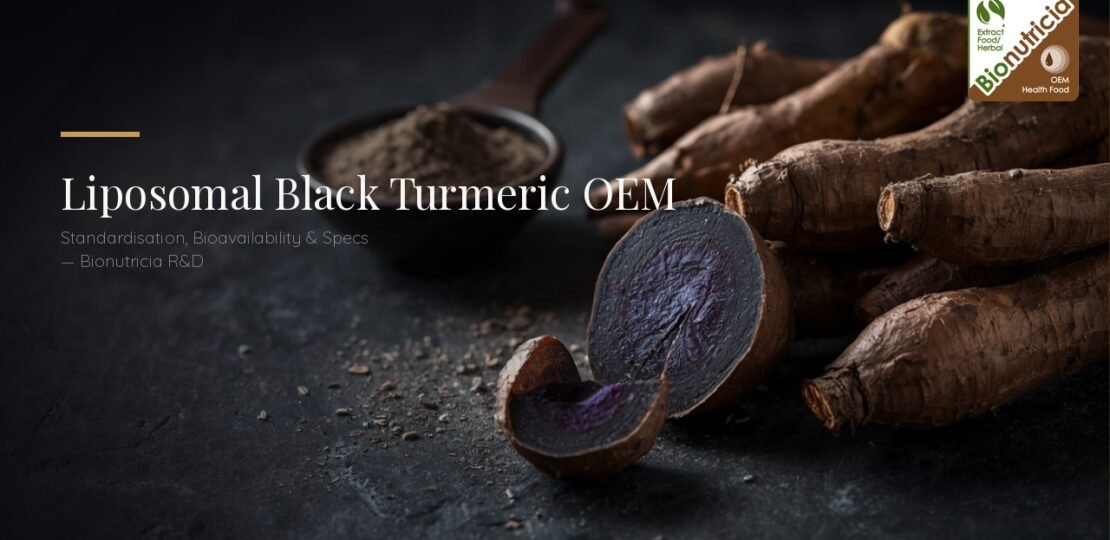
Direct answer: “Black turmeric” is Curcuma caesia Roxb. — a rhizome with a striking bluish-black to slate-grey interior and a camphoraceous aroma, botanically distinct from the bright orange-yellow Curcuma longa that supplies ordinary turmeric/curcumin. Black turmeric extract is standardised to a three-marker profile — total phenolic acid content, tannin content, and camphor — not to curcumin, which is the marker used for ordinary yellow turmeric. Because phenolics and tannins are prone to oxidative degradation and camphor is volatile and prone to loss during processing, black turmeric suits liposomal delivery well: encapsulating the extract in a phospholipid carrier helps protect these actives and improve how the extract disperses in an aqueous matrix. Bionutricia offers contract extraction of black turmeric rhizome in standardised form, with Herbosomal® — Bionutricia’s proprietary liposomal encapsulation and sustained-release technology (registered trademark; patent-pending PI2023005773) — available for brands wanting an enhanced-delivery finished SKU. The contract specification should cover all three markers: total phenolic content (Folin-Ciocalteu, mg GAE/g), tannin content, and camphor by GC/GC-MS — a curcumin assay alone will not confirm authentic Curcuma caesia.
Black turmeric vs yellow turmeric: two different plants, two different actives
The name “black turmeric” causes more supplier confusion than almost any other rhizome in the ginger family, so settle the botany before you brief an extractor.
Different species, different rhizome colour. Curcuma longa — ordinary culinary and supplement turmeric — has a bright orange-yellow flesh driven by a high curcuminoid content (commonly standardised to 95% curcuminoids in commodity extracts). Curcuma caesia has a bluish-black to dark slate-grey flesh and a completely different marker profile. A correct CoA states the botanical name and rhizome colour; “turmeric extract” alone, without the species and a colour description, is not enough to confirm which plant you are buying.
The actives that matter are different too. Where C. longa is standardised almost entirely to curcumin, C. caesia is standardised to a different marker triad: total phenolic acid content, tannin content, and camphor. A supplier who defaults to a curcumin assay for black turmeric — the way they would for yellow turmeric — is testing for a compound that isn’t the defining marker of this species at all.
Regional names. Black turmeric is also known as kunyit hitam (Malay/Indonesian), kali haldi (Hindi), and black zedoary in older pharmacognosy literature — not to be confused with Curcuma zedoaria (white/yellow zedoary), a related but separate species. Confirming the Latin binomial on the CoA is the only reliable way to avoid a name-driven substitution.
Why phenolic acid, tannins and camphor are the specification that matters
Black turmeric extract is standardised to three markers, not one, because each captures a different part of what makes the material both authentic and functional.
Total phenolic content (Folin-Ciocalteu assay, expressed as mg gallic acid equivalents per gram) captures the antioxidant-active phenolic acid fraction — a meaningful potency marker independent of curcumin. Tannin content, measured separately (commonly by a vanillin-HCl or Folin-Denis-based method), reflects the astringent, polyphenolic fraction traditionally associated with black turmeric’s use in folk and Ayurvedic preparations, and should be reported as its own figure rather than assumed to track with total phenolics. Camphor, quantified by GC or GC-MS, is the volatile-oil marker that gives black turmeric its characteristic aroma and is the authenticity signature separating genuine Curcuma caesia from a yellow-turmeric substitution — a curcumin assay would not catch this substitution, since C. caesia is not standardised to curcumin in the first place.
Ask for all three, not one. A CoA reporting only a curcumin percentage cannot confirm authentic black turmeric. Requiring total phenolic content, tannin content, and camphor together is what confirms both authenticity and potency.
Why liposomal (Herbosomal®) encapsulation suits black turmeric actives
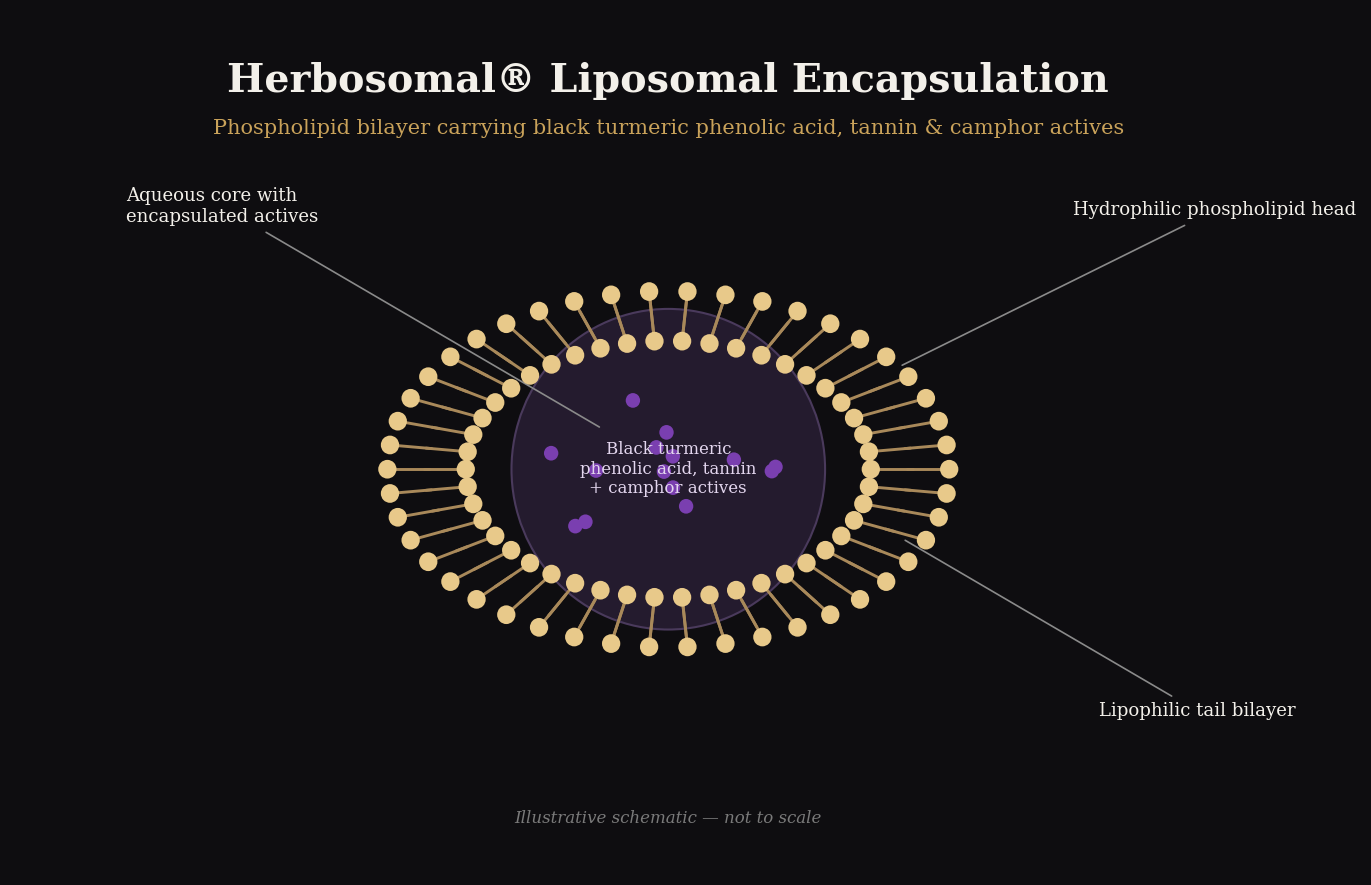
Black turmeric’s marker actives each present a different formulation challenge: phenolic acids and tannins are prone to oxidative degradation over shelf life, and camphor is volatile and prone to evaporative loss during spray-drying and storage. Liposomal encapsulation addresses both at once by wrapping the extract in a phospholipid bilayer that mimics a cell membrane — shielding the phenolic and tannin fraction from oxidation, helping retain the volatile camphor fraction, and helping the payload disperse in an aqueous matrix more readily than an unencapsulated powder blended into water.
Bionutricia’s Herbosomal® platform — a registered trademark, with the underlying liposomal encapsulation and sustained-release process under patent application PI2023005773 (pending, not yet granted) — pairs botanical actives such as black turmeric with a phospholipid carrier at the formulation stage, before spray-drying or liquid-filling into the finished format. This is distinct from Bionutricia’s separately granted patent, MY-188945-A, which covers the enzymatic ultrasonic extraction process used to produce the standardised rhizome extract itself — the two technologies are sequential (extract, then encapsulate) but are separate IP assets and should never be conflated on a spec sheet.
Standardisation specification: what to put in your contract
For a black turmeric extract procurement — encapsulated or not — include all of the following in the CoA requirement:
Identity & authenticity
- Botanical name: Curcuma caesia Roxb. (not Curcuma longa or Curcuma zedoaria)
- Plant part: rhizome (dried), with a stated bluish-black/slate-grey internal colour on visual inspection
- Country of origin and traceable, cultivated supply chain
Active marker assay
- Total phenolic content by Folin-Ciocalteu assay, expressed as mg gallic acid equivalents (GAE) per gram — set the floor to your positioning
- Tannin content by a validated assay (e.g. vanillin-HCl or Folin-Denis-based method), reported as its own figure, not assumed to track with total phenolics
- Camphor content by GC or GC-MS — the volatile-oil authenticity marker for genuine Curcuma caesia
Physical parameters
- Appearance: free-flowing grey-brown to purplish-brown powder (spray-dried extract) — the dried powder loses the vivid blue-black of the fresh rhizome, so colour should be described precisely rather than assumed
- Moisture: ≤5.0%
- Particle size: ≥90% passing 80 mesh
Microbiological limits
- Total plate count: ≤10,000 CFU/g
- Yeast and mould: ≤1,000 CFU/g
- E. coli: absent/25g · Salmonella spp.: absent/25g · S. aureus: absent/25g
Heavy metals
- Lead (Pb) ≤2.0 ppm · Cadmium (Cd) ≤1.0 ppm · Mercury (Hg) ≤0.1 ppm · Arsenic (As) ≤1.5 ppm
Solvent residuals
- Ethanol extraction: ≤5,000 ppm residual ethanol; water-only extraction: not applicable
Formats Bionutricia manufactures with black turmeric
Only the OEM formats Bionutricia actually offers apply here — no capsules, softgels, gummies, hard tablets or effervescent tablets.
Powder sachet (10–20g): standardised or Herbosomal-encapsulated black turmeric powder blended with a delivery matrix, for an instant-mix functional powder positioned on phenolic-acid, tannin and camphor-driven “traditional rhizome” claims.
Liquid sachet (30–50ml) and liquid bottle (100–250ml): a liposomal liquid concentrate suits brands building an enhanced-delivery tonic or wellness shot around black turmeric’s traditional positioning.
Chewable tablet: for a practitioner-dispensed or clinic-channel SKU where a measured, chewable dose is preferred to a powder mix.
Pouch beverage (200–500ml): where the camphoraceous, slightly bitter profile is balanced into a functional RTD formulation rather than taken neat.
Related guides
- Phytosome vs Liposomal Delivery: Which Absorption Tech Wins for Botanicals?
- Liposomal Supplement OEM: What Brand Owners Should Know Before Choosing a Manufacturer
- Bentong Ginger Extract for Functional Food & Beverage OEM
Ready to develop a black turmeric SKU?
Contract extraction of standardised black turmeric (Curcuma caesia) rhizome, with optional Herbosomal® liposomal encapsulation, under FSSC 22000, GMP and JAKIM halal certification. Powder sachet, liquid sachet, liquid bottle, chewable tablet and pouch beverage formats, full CoA stack, and formulation consultation on phenolic-acid, tannin and camphor-authenticated material.
Request a quotation · See our OEM services · View our certifications
WhatsApp: +60 16-661 8510
Frequently asked questions
Is black turmeric the same plant as regular turmeric?
No. Black turmeric is Curcuma caesia Roxb., a separate species from Curcuma longa (ordinary yellow turmeric). Black turmeric has a bluish-black to slate-grey rhizome interior and is standardised to phenolic acid content, tannin content and camphor, whereas C. longa is bright orange-yellow and standardised to curcumin.
What should I standardise a black turmeric extract to?
Total phenolic content (Folin-Ciocalteu assay, mg GAE/g), tannin content (a separate validated assay), and camphor by GC or GC-MS. A curcumin assay alone cannot confirm authentic Curcuma caesia, since curcumin is not this species’ defining marker.
Why encapsulate black turmeric in a liposomal (Herbosomal®) system?
Black turmeric’s phenolic acid and tannin fraction is prone to oxidative degradation, and its camphor fraction is volatile and prone to processing loss. Liposomal encapsulation wraps the extract in a phospholipid carrier to help protect these actives and improve how the extract disperses in an aqueous matrix, which is the formulation rationale for pairing black turmeric with Herbosomal® rather than a claim specific to any single published black-turmeric bioavailability trial.
Is Herbosomal® liposomal encapsulation patented?
Herbosomal® is a registered trademark for Bionutricia’s proprietary liposomal encapsulation and sustained-release technology, with patent application PI2023005773 currently pending (not yet granted). Bionutricia’s separately granted patent, MY-188945-A, covers the enzymatic ultrasonic extraction process used to produce the standardised rhizome extract itself.
Is black turmeric extract halal-certified?
Yes. Black turmeric is a plant-derived botanical with no haram inputs, and Bionutricia’s extraction and finished-product manufacturing are covered under JAKIM facility-level halal certification, so finished SKUs carry halal status through to export.
Article by Bionutricia R&D Team. Last updated: July 23, 2026.
RELATED POSTS
View all

Phytosome vs Liposomal Delivery: Which Absorption Tech Wins for Botanicals?
July 3, 2026 | by supersuper
Liposomal Glutathione OEM: Encapsulation, Formulation & Specs
September 24, 2026 | by supersuper