

Liposomal Glutathione OEM: Encapsulation, Formulation & Specs
September 24, 2026 | by supersuper
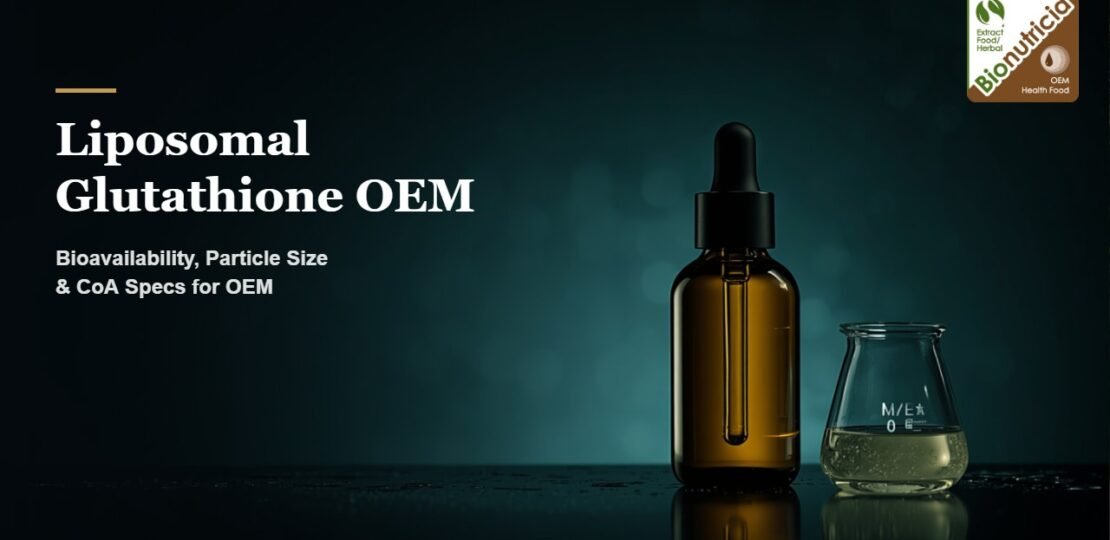
Direct answer: Liposomal glutathione is glutathione encapsulated within phospholipid vesicles — microscopic lipid bubbles that protect the active ingredient during passage through the gastrointestinal tract. For OEM formulation, a brand owner should understand what liposomal encapsulation does, why it is used for glutathione specifically, what formulation considerations apply to functional beverage and sachet formats, and how to verify that a manufacturer’s liposomal process is genuine through particle-size characterisation and Certificate of Analysis documentation. Bionutricia applies Herbosomal® — its proprietary liposomal encapsulation and sustained-release technology (registered trademark; patent-pending PI2023005773) — to glutathione and other water-soluble actives in its JAKIM Halal-certified, FSSC 22000, GMP, HACCP, US FDA-registered and MeSTI-certified facility in Sungai Buloh, Malaysia.
What Is Liposomal Glutathione?
Glutathione is a tripeptide composed of three amino acids: glutamic acid, cysteine and glycine. It is naturally present in the human body and is one of the most abundant low-molecular-weight thiols in cells. In supplement formulations, glutathione is available as a free-form powder or as an encapsulated ingredient.
Liposomal glutathione is glutathione that has been encapsulated within phospholipid vesicles — microscopic lipid bubbles called liposomes. The phospholipid bilayer forms a protective shell around the glutathione molecule, creating a water-soluble delivery system that carries the active ingredient through the digestive environment. The liposomal shell is formed from food-grade phospholipids, typically sunflower lecithin or soy lecithin, which are compatible with halal manufacturing requirements.
Why Liposomal Encapsulation for Glutathione?
Glutathione in its free, unencapsulated form is susceptible to degradation in the acidic environment of the stomach and during storage. Liposomal encapsulation is designed to protect the glutathione molecule from environmental stress — both during shelf-life storage and during transit through the gastrointestinal tract.
The phospholipid bilayer creates a physical barrier around the active ingredient. This encapsulation is intended to preserve the integrity of the glutathione until it reaches the site of absorption. The liposomal carrier itself is composed of phospholipids that are compatible with cell membrane structures.
For OEM formulation, the decision to use liposomal encapsulation is driven by the formulator’s objective: to protect a sensitive active from degradation and to deliver it in a lipid-compatible carrier. Whether this results in a measurable improvement in clinical outcomes for any specific finished product is a question that must be evaluated through appropriate studies on that specific formulation — not assumed from the encapsulation method alone.
OEM Formats Suitable for Liposomal Glutathione
Bionutricia manufactures liposomal glutathione products in the following approved formats:
- Liquid sachets: Single-serve liquid formats where liposomal glutathione is delivered as a ready-to-consume liquid in a convenient sachet. The liposomal dispersion is homogenised and filled into single-serve sachets with appropriate barrier properties.
- Pouch beverages: Ready-to-drink functional beverages where liposomal glutathione is incorporated into a liquid formulation with flavour, sweetener and other functional ingredients. Pouch formats are suitable for retail and HORECA channels.
- Liquid bottles: Bottled liquid supplements in amber glass or PET, where liposomal glutathione is formulated as a multi-dose liquid with appropriate preservative and stability considerations.
Bionutricia does not manufacture capsules, softgels, gummies, hard tablets, effervescent tablets or stick-packs. Liposomal glutathione formulations are limited to the formats above.
Formulation Considerations for Brand Owners
Phospholipid Selection
The phospholipid used to form the liposomal shell must be food-grade, halal-compliant and compatible with the active ingredient. Sunflower lecithin is the most common halal-compliant phospholipid for liposomal formulations, as it is plant-derived and does not carry the allergen-labelling requirements of soy lecithin. The supplier should confirm the phospholipid origin and provide a halal certificate for the specific material.
Glutathione Form
Glutathione is available in reduced (GSH) and oxidised (GSSG) forms. The reduced form (L-glutathione reduced) is the active form typically used in supplement formulations. The CoA should specify which form is present, the assay purity, and the method of analysis used.
Stability and Shelf Life
Liposomal dispersions are sensitive to temperature, light and oxygen. Formulation must consider the choice of antioxidant, pH control and packaging barrier properties. The finished product should undergo stability testing under ICH climate zone conditions appropriate to the target market — Zone IVb (hot and humid) for most ASEAN and GCC markets. Brand owners should request stability data or a stability testing protocol from the manufacturer before committing to a production run.
Flavour and Palatability
Glutathione has a characteristic sulphurous taste and odour that can affect palatability in liquid formats. Flavour masking or flavour pairing should be evaluated during formulation development. Natural flavour systems compatible with halal certification should be used.
Preservative System
For multi-dose liquid bottle formats, a preservative system must be validated to prevent microbial growth during the shelf-life period. For single-serve sachet and pouch formats, the preservative requirement may be reduced depending on the water activity and filling process.
How Liposomal Encapsulation Is Verified
For a liposomal glutathione product, the following verification methods are commonly used to confirm that the liposomal dispersion is genuine:
- Dynamic Light Scattering (DLS): Measures the particle-size distribution of the liposomal dispersion. A genuine liposomal formulation should show a defined particle-size population in the sub-micron to low-micron range. DLS is a standard quality control test for liposomal products and is part of the verification process at Bionutricia’s facility.
- Transmission Electron Microscopy (TEM): Provides visual confirmation of the liposomal vesicle structure. TEM is a research-grade technique that can confirm the presence of intact vesicles.
- Encapsulation efficiency: The percentage of glutathione entrapped within the liposomal vesicles versus free glutathione in the external solution. This is determined by a separation method (e.g., dialysis or centrifugation) followed by assay of the entrapped and free fractions.
- NanoVerify certification: Bionutricia’s facility holds NanoVerify certification, which verifies nano-processed ingredients. This certification is relevant to liposomal and Herbosomal® product lines.
Brand owners should request DLS data and encapsulation efficiency results on the CoA for each production batch. A manufacturer that cannot provide particle-size characterisation data should be questioned on the authenticity of their liposomal process.
CoA Checklist for Liposomal Glutathione
When commissioning a liposomal glutathione OEM formulation, request the following on every batch CoA:
- Active ingredient identity: L-glutathione (reduced) confirmed by appropriate identity test
- Assay: Glutathione content per serving or per unit volume, with the analytical method stated
- Particle-size distribution: DLS data showing the mean particle size and polydispersity index
- Encapsulation efficiency: Percentage of glutathione entrapped within liposomal vesicles
- Phospholipid content: Amount and type of phospholipid used in the formulation
- Heavy metals: Pb, Cd, Hg, As with specific ppm values
- Microbial panel: Total plate count, yeast & mould, E. coli, Salmonella
- pH: Of the finished liquid formulation
- Appearance: Description of the finished product (e.g., opaque liquid, homogeneous dispersion)
- Batch number and manufacture date: For traceability
Confirm the specific values with the supplier for each batch. The CoA should show actual measured values, not just “pass/fail” statements.
Halal Chain for Liposomal Glutathione
Glutathione itself is a naturally occurring tripeptide and is inherently halal. The halal status of a liposomal glutathione product depends on:
- Phospholipid origin: Sunflower lecithin or other plant-derived phospholipids are halal-compliant. Animal-derived lecithin would require specific halal certification.
- Manufacturing facility: The production line must be covered by JAKIM Halal certification.
- Carrier and excipients: All carriers, preservatives, flavourings and processing aids must be halal-compliant.
- Cleaning and sanitation: Cleaning agents used on the production line must be halal-compliant.
Bionutricia’s facility operates under JAKIM Halal certification, and the Herbosomal® liposomal process uses plant-derived phospholipids compatible with halal requirements. Brand owners should request the halal certificate covering the specific product line.
Frequently Asked Questions
Is liposomal glutathione more bioavailable than regular glutathione?
Liposomal encapsulation is designed to protect the glutathione molecule from degradation in the gastrointestinal tract and to deliver it in a phospholipid carrier. Whether this translates to improved absorption for any specific finished product depends on the formulation, dose and delivery format — and must be evaluated through appropriate studies on that specific product. Do not assume a bioavailability advantage from the encapsulation method alone.
What is Herbosomal®?
Herbosomal® is Bionutricia’s proprietary liposomal encapsulation and sustained-release technology (registered trademark; patent-pending PI2023005773). It is applied to water-soluble actives including glutathione, vitamin C and other ingredients where liposomal delivery is desired.
What formats can Bionutricia manufacture for liposomal glutathione?
Bionutricia manufactures liposomal glutathione as liquid sachets, pouch beverages, liquid bottles and powder sachets. Capsules, softgels, gummies, hard tablets, effervescent tablets and stick-packs are not manufactured in Bionutricia’s facility.
How is the liposomal dispersion verified?
Particle-size distribution is measured by DLS (dynamic light scattering), and encapsulation efficiency is determined by separating entrapped from free glutathione and assaying each fraction. Bionutricia’s facility also holds NanoVerify certification for nano-processed ingredients. Request DLS data and encapsulation efficiency results on the CoA for each batch.
How do I request a liposomal glutathione OEM quotation?
Contact the Bionutricia team with your target glutathione content per serving, desired format, estimated order volume and target markets. The team will provide a formulation proposal and quotation based on your specific requirements. Visit bionutricia.com to start the conversation.
Related Guides
- Liposomal Supplement OEM: What Brand Owners Should Know Before Choosing a Manufacturer
- Phytosome vs Liposomal Delivery: Which Absorption Tech Wins for Botanicals?
- Liposomal Vitamin C OEM: Bioavailability Evidence, Particle-Size Verification, and What to Specify on the Contract
Request a Quotation
Bionutricia Manufacturing Sdn Bhd is a JAKIM Halal-certified, FSSC 22000, GMP, HACCP, US FDA-registered, MeSTI-certified and NanoVerify-certified OEM contract manufacturer based in Sungai Buloh, Malaysia. Founded in 2006, Bionutricia has manufactured supplements and functional beverages for 239+ brand partners across Southeast Asia, the GCC and beyond. The in-house authority team includes a registered pharmacist, a nutritionist, a dietitian and a PhD biomedical scientist.
To discuss your liposomal glutathione OEM formulation, contact the team at bionutricia.com or message us on WhatsApp for a prompt response.
Article by Bionutricia R&D Team. Last updated: 24 September 2026.
RELATED POSTS
View all

Liposomal Black Turmeric OEM: Standardisation, Bioavailability & Specs
August 2, 2026 | by supersuper
Phytosome vs Liposomal Delivery: Which Absorption Tech Wins for Botanicals?
July 3, 2026 | by supersuper
Liposomal vs Nano-Encapsulation vs Standard Delivery: Which Wins for OEM Customers in 2026?
June 3, 2026 | by supersuper