


A Pinch Is Not a Dose: How “Proprietary Blends” Hide What You’re Really Paying For
August 13, 2026 | by supersuper
A “proprietary blend” only has to disclose one number — the blend’s total weight. That single labelling loophole lets a famous active sit on a supplement label at a dose too small to matter. Here is how fairy-dusting works, the quiet commercial failure it causes, and the one question that exposes it.
A Pinch Is Not a Dose
Pick up almost any trend-driven supplement and the front of the pack names an impressive hero ingredient. Turn it over, though, and you often cannot tell how much of that hero is actually inside. On a surprising number of products, the honest answer is: barely any. The ingredient is real, the claim is technically true — and the dose is a pinch.
Fairy-Dusting: A Famous Name, a Tiny Amount
The industry has a name for it: fairy-dusting (or pixie-dusting). It means adding just enough of a fashionable active to justify printing it on the label, while the working amount — the level studies actually used — is nowhere in the product. It is cheaper, and it lets more marketing ingredients share one serving. The buyer pays for a headline and receives a trace.
Where It Hides: “Proprietary Blend”
Where does the missing amount hide? Usually behind two words: proprietary blend. Labelling rules let a manufacturer group several ingredients under one blend and disclose only the blend’s combined weight — not the amount of each ingredient inside it. So “1,500 mg Energy Blend” tells you the total, and nothing about how that total is split.
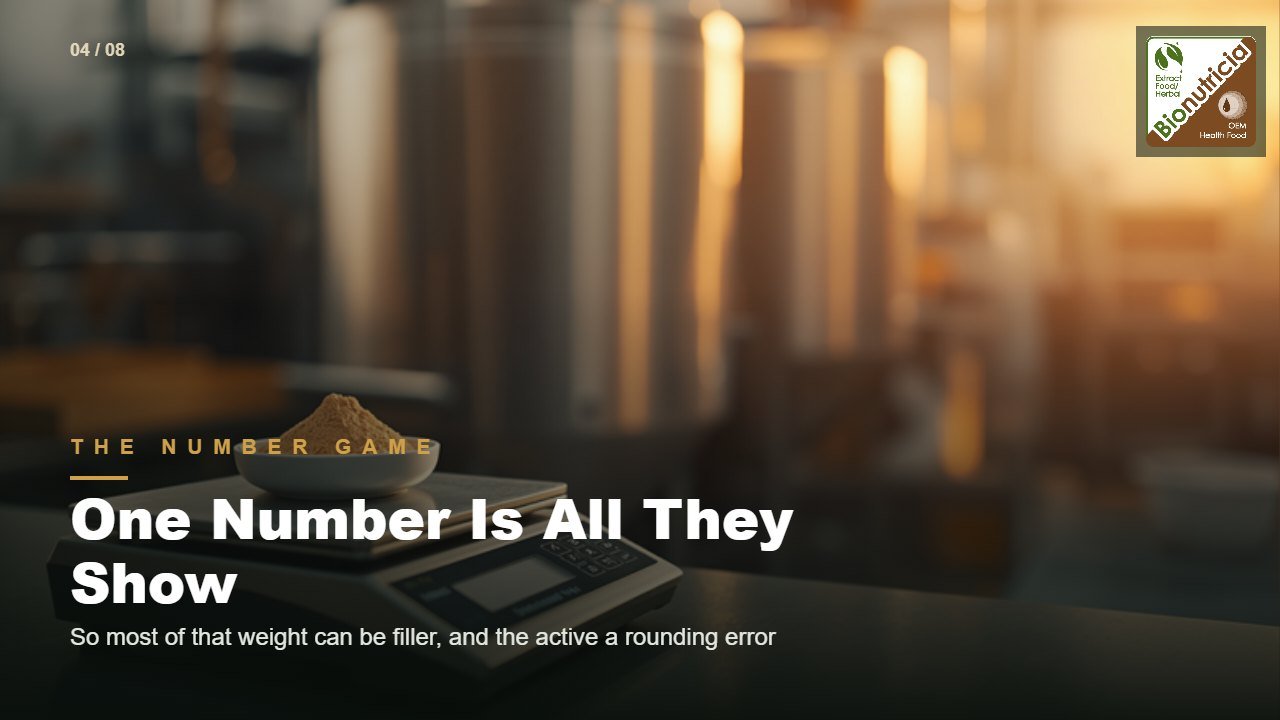
One Number Is All They Show
That single number is where the trick lives. A 1,500 mg blend can be almost entirely a cheap bulking agent, with the celebrated active present at, say, twenty milligrams — a rounding error against the total. Nothing on the label is false. It simply does not tell you the one thing that decides whether the product works: the dose of the active.

The Invisible Failure: Tried Once, Never Reordered
For a brand owner, an underdosed formula is an invisible failure. It can pass its certificates and its spec — because those do not require an effective dose. But the customer feels nothing, decides the product “didn’t work,” and never reorders. You blame the market, the price, the algorithm. The real problem was the dose all along.

The One Question: Ask for the Full Formula
There is one question that exposes all of this before you ever commit to a formula: ask your manufacturer for the full quantitative formula. Not a blend total — every active listed by name, each with its own number. A maker who builds honestly will hand it over. A maker relying on fairy-dusting will suddenly get vague.
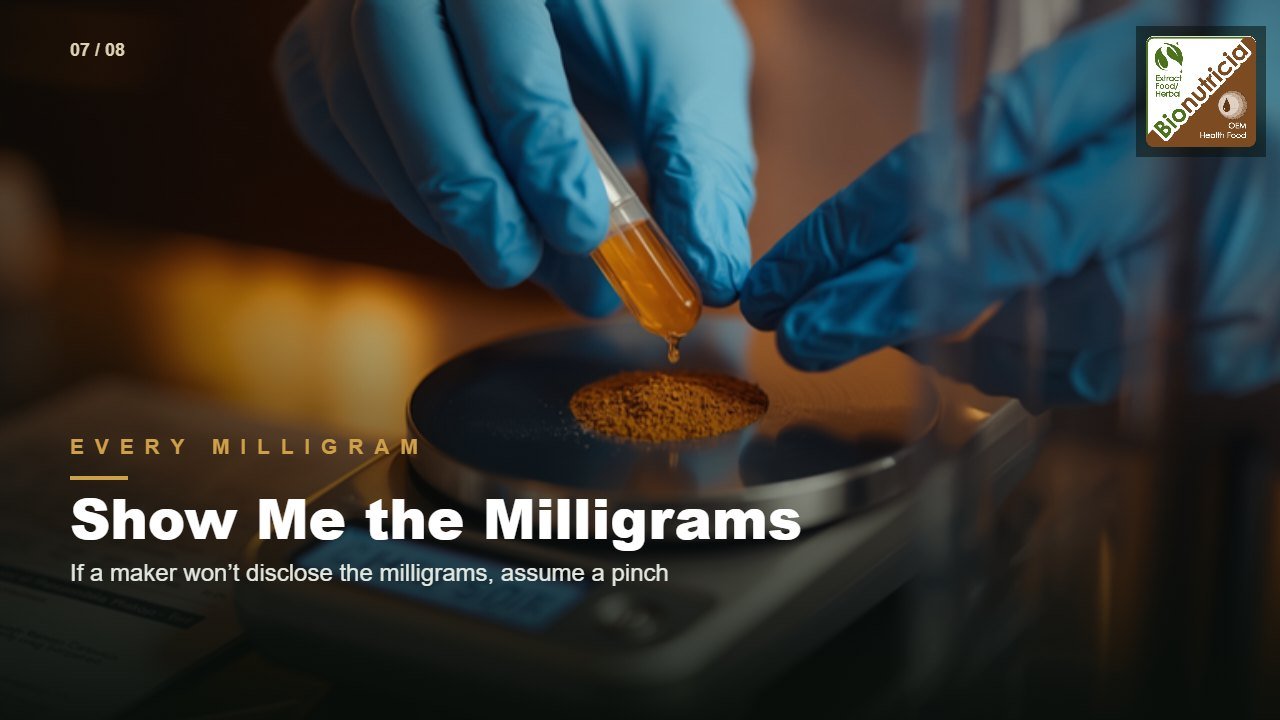
Every Active, Every Milligram
The standard is simple: every ingredient named, weighed, and disclosed in milligrams — ideally matched to the amount the published research actually used. If a factory will not show you the milligrams per active, assume a pinch and price the risk accordingly. Transparency here is not a courtesy; it is the only way to know what you are selling.

Disclosure Is the Dose
At Bionutricia, the milligrams are the point. As a halal contract manufacturer established in 2006, we build every formula on a full quantitative breakdown — each active named and disclosed, nothing buried inside a “proprietary blend.” A real formula hides nothing. Before you approve one, ask the only question that matters: how many milligrams?
Frequently asked questions
What is a “proprietary blend” on a supplement label?
It is a group of ingredients listed together under one name, where the label discloses only the blend’s total weight — not how much of each ingredient it contains. It is legal in many markets, but it hides the individual doses, so you cannot judge whether any single active is present at a meaningful level.
What is “fairy-dusting” (or “pixie-dusting”) in supplements?
Fairy-dusting is adding a tiny, sub-effective amount of a popular ingredient so it can be named on the label, without including the amount research shows is needed to matter. The claim is technically true; the dose is not meaningful.
Is hiding individual doses inside a blend legal?
In many markets, yes. Rules often require a total blend weight but not a per-ingredient breakdown for non-vitamin, non-mineral actives. That is the loophole — which is exactly why a buyer has to ask for the full quantitative formula rather than trust the blend total.
How can a brand owner tell if a formula is underdosed?
Ask for the full quantitative formula: every active named with its own milligram value, then compare each against the amount used in published studies. If you only get a blend total, or the maker will not disclose per-active amounts, treat it as a red flag.
Does Bionutricia use proprietary blends?
No. Bionutricia builds formulas on a full quantitative breakdown — every active named and disclosed in milligrams — so brand owners know exactly what they are putting their name on.
Explore our OEM formats: supplement sachet OEM manufacturer in Malaysia · chewable tablet supplement OEM manufacturer in Malaysia
RELATED POSTS
View all


Water Activity vs Moisture Content: Why a “Dry” Supplement Powder Still Grows Mould
August 15, 2026 | by supersuper

Article: Food as Medicine| Pineapple (Ananas comosus, Bromeliaceae)
October 5, 2024 | by bionutriciaadmin