

Noni (Morinda citrifolia) Fruit Extract for Functional Food & Beverage OEM
August 25, 2026 | by supersuper
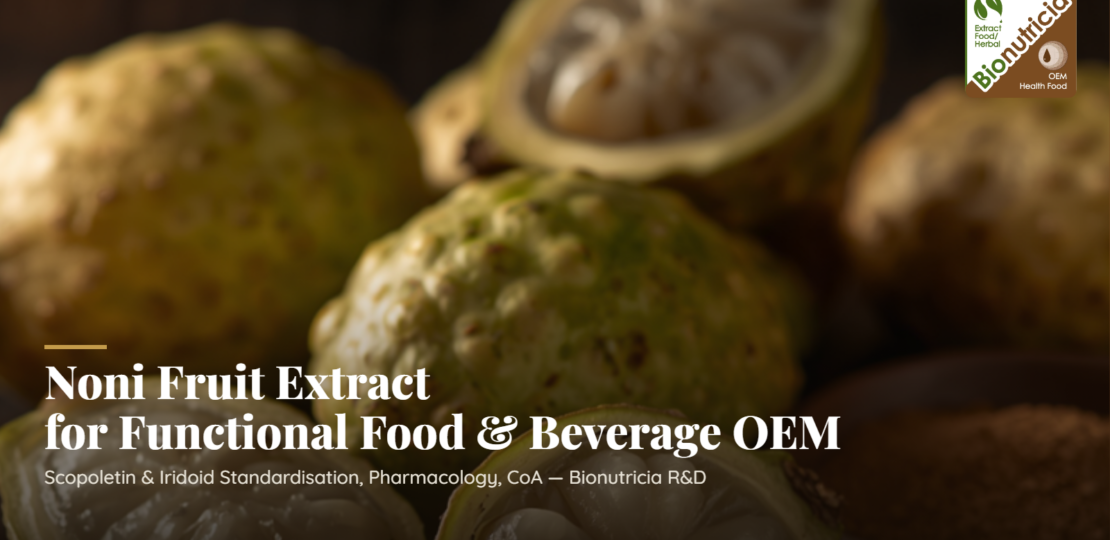
Direct answer: Noni — Morinda citrifolia L., known in Malaysia as mengkudu — is standardised for OEM as a whole-fruit extract, not a single-molecule active. The material is the ripe fruit puree or juice concentrate, never root, bark or leaf, and the spec to put in a contract is a validated HPLC fingerprint confirming deacetylasperulosidic acid (DAA), asperulosidic acid and scopoletin — the three markers the published analytical literature uses to authenticate noni. Unlike anthocyanins in roselle or curcuminoids in turmeric, noni iridoids have no single industry-wide percentage consensus, so a defensible spec sets an agreed minimum total-iridoid content against a reference batch rather than quoting a borrowed number. Add total polyphenols, a defined extraction ratio (typically 10:1 to 20:1, fruit puree/juice to spray-dried powder), microbial limits and heavy-metal limits. Bionutricia offers contract extraction of noni fruit in standardised form, spray-drying and finished-SKU filling under one roof — powder sachets, liquid sachets, pouch beverages and liquid bottles — under FSSC 22000 and JAKIM halal certification.
Noni vs mengkudu: the same fruit, three names
Noni is the common name for Morinda citrifolia L., a small evergreen tree in the Rubiaceae (coffee) family. In Malaysia and Indonesia the fruit is mengkudu; in the Pacific it is nonu; elsewhere it is called Indian mulberry or “cheese fruit” for its pungent ripe aroma. All three names refer to the identical species and, for OEM purposes, the identical raw material.
The used part is the whole ripe fruit, not the leaf or root. M. citrifolia leaf and root extracts exist in traditional use and carry a different phytochemical profile (notably higher anthraquinone content in root bark) — not what a reputable extractor should be supplying. A correct CoA states plant part: fruit (whole, ripe), processed as puree, juice or juice concentrate before spray-drying. Mengkudu also grows readily across Malaysia and has a long history in Malay traditional food use, making it a genuinely local ingredient story for a “grown and made in Malaysia” brand.
Why the iridoid + scopoletin fingerprint is the specification that matters
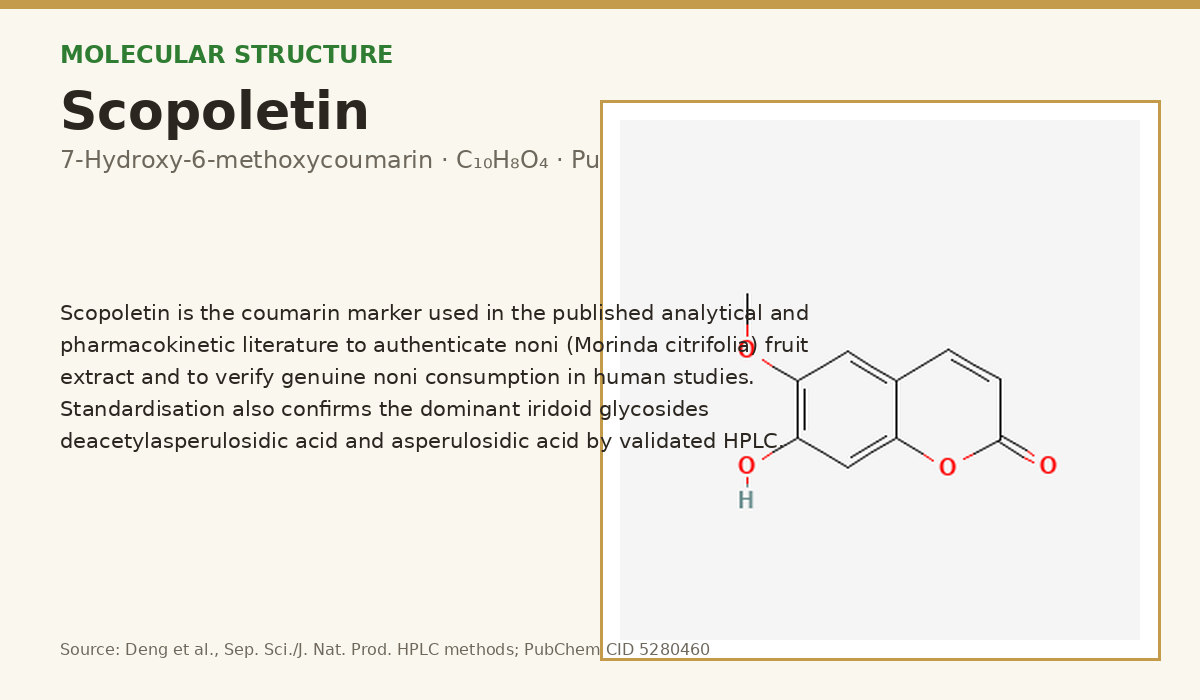
Noni’s phytochemistry is dominated by iridoid glycosides, alongside a coumarin, scopoletin, that is the most widely used marker for verifying genuine noni exposure in the analytical and pharmacokinetic literature.
Deacetylasperulosidic acid (DAA) and asperulosidic acid are reported as the major iridoid glycosides — and, by yield, the major phytochemical constituents overall — in noni fruit. Validated reversed-phase HPLC and HPLC–MS methods quantify DAA, asperulosidic acid, scopolin, asperuloside and scopoletin together in a single run, which is what a competent contract lab should run against your batch.
Scopoletin is a simple coumarin (7-hydroxy-6-methoxycoumarin, C₁₀H₈O₄) present in far smaller quantity than the iridoids but disproportionately important: it is reliably detectable in human plasma after oral intake, which is why the pharmacokinetic literature proposes it as a biomarker of noni consumption.
Why not quote a single percentage floor, as roselle is quoted on anthocyanins? DAA/scopoletin content varies by ripeness, region and processing, and no industry-consensus percentage exists for noni. The defensible approach: a validated multi-marker HPLC fingerprint confirming identity and ratio, with a minimum total-iridoid content set against an agreed reference batch at onboarding.
Pharmacology: how noni’s marker compounds behave in the body
Noni is often sold on antioxidant, general-wellness positioning, so it is worth being precise about the published pharmacology — and clear that this is structure-function research, not a treatment claim for any product.
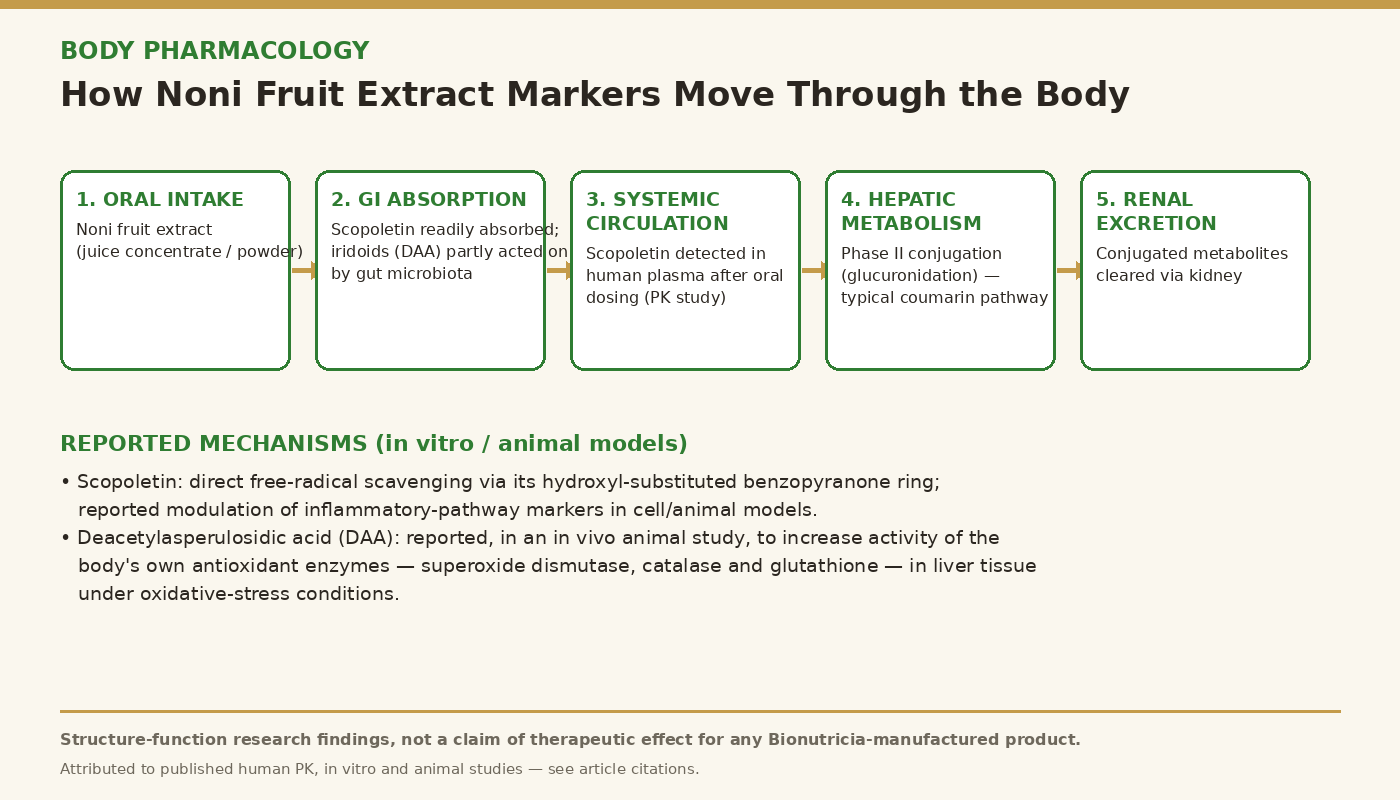
Absorption and disposition. A published human pharmacokinetic study of noni fruit extract found scopoletin is absorbed from the gastrointestinal tract and detectable in plasma after oral dosing — the basis for using it as a research marker of noni intake. Coumarins of this class are typically metabolised in the liver by Phase II glucuronidation before renal excretion. DAA and asperulosidic acid are more polar; human absorption data on them is thinner, and some fraction is understood to interact with gut microbiota before any systemic effect is measurable.
Reported mechanisms. In vitro and animal studies attribute scopoletin with direct free-radical scavenging (via its hydroxyl-substituted benzopyranone ring) and modulation of inflammatory-pathway markers in cell/animal models; an in vivo animal study reported DAA increased activity of the body’s own antioxidant enzymes — superoxide dismutase, catalase and glutathione — in liver tissue under oxidative-stress conditions. These are laboratory-level mechanistic findings, not a guaranteed outcome in a finished beverage.
What the human clinical evidence shows
The strongest human evidence for noni juice comes from randomised, double-blind, placebo-controlled trials in heavy cigarette smokers — a population with measurably elevated oxidative stress, where changes are easier to detect than in healthy volunteers.
In the best-documented trial, 245 heavy smokers completed a 30-day randomised, double-blind, placebo-controlled study comparing a fruit-juice placebo against noni juice at 29.5–118 mL/day. Investigators measured lipid-peroxidation-derived DNA adducts in blood lymphocytes and reported a statistically significant 44.6–57.4% reduction in the noni-juice groups vs baseline/placebo. Related trials from the same group reported reductions in plasma superoxide anion radicals and lipid hydroperoxide, and improved serum lipid profile and hs-CRP, in similar smoker cohorts.
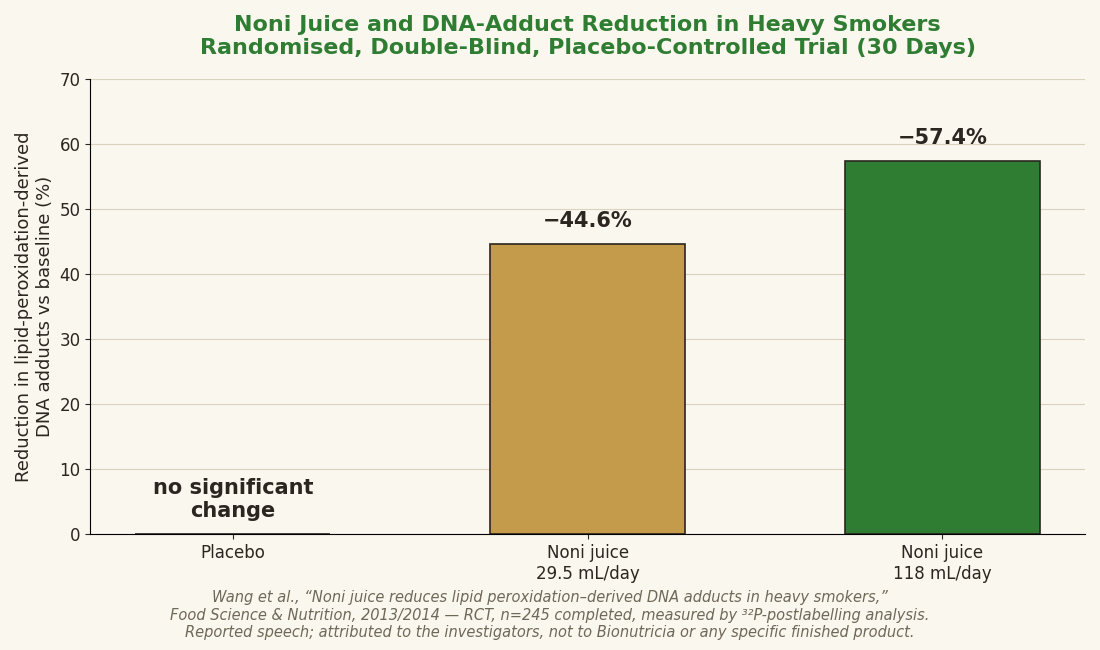
This is real, published, dose-ranging human RCT data on specific measured endpoints — evidence of biological activity, not a substitute for a disease-treatment claim. OEM copy for a finished SKU should stay within permitted structure/function and antioxidant language.
A note on liver safety
Noni juice attracted safety scrutiny after two Austrian case reports (2004, 2005) described acute hepatitis linked to heavy noni consumption, with anthraquinones suspected as a possible mechanism — a real part of the published record. Equally on record: subsequent safety reviews and animal toxicology testing at doses well above typical consumption found no consistent evidence of liver injury, and the European Food Safety Authority concluded there was no convincing evidence of a causal relationship; anthraquinone levels in commercial noni juice are reported too low to be of toxicological significance.
Practical takeaway: avoid formulation copy implying unlimited high-dose use, and carry a standard “consult your healthcare provider” advisory — the same caution recommended for any concentrated botanical juice.
Extract forms and what each suits
Juice concentrate — the traditional, most common commercial form, produced by pressing/macerating ripe fruit and concentrating the juice. Retains the fullest iridoid and scopoletin profile; suits liquid-sachet, pouch-beverage and liquid-bottle formats directly. Noni’s own low pH assists shelf stability.
Spray-dried powder — puree/juice concentrate on a maltodextrin or tapioca-starch carrier (halal, non-GMO options available), suited to powder-sachet and dry-mix formats. Typical ratio: 10:1 to 20:1. Moisture target: ≤5%. Noni’s strong aroma is more pronounced concentrated, so most SKUs pair it with a flavour-masking system (citrus, berry, ginger) rather than selling it unmasked.
Freeze-dried powder — a higher-cost option that better preserves heat-sensitive iridoids and aroma compounds; suits premium SKUs prioritising marker retention.
Standardisation specification: what to put in your contract
Identity & authenticity
- Botanical name: Morinda citrifolia L. (Rubiaceae); plant part: fruit (whole, ripe) — not root, bark or leaf
- Common/regional names on file: noni, mengkudu, Indian mulberry, nonu
- Country of origin stated; cultivated, traceable supply
Active marker assay
- Validated RP-HPLC fingerprint confirming presence and relative ratio of deacetylasperulosidic acid, asperulosidic acid and scopoletin
- Minimum total-iridoid content set against an agreed reference batch (no single industry benchmark exists for noni — set your own floor at onboarding)
- Total polyphenols (Folin-Ciocalteu) as secondary characterisation
Physical parameters
- Appearance: light-to-medium brown free-flowing powder (spray-dried) or amber-brown liquid (juice concentrate)
- Moisture ≤5.0% (powder); particle size ≥90% passing 80 mesh (powder); Brix defined at agreed spec (liquid)
Microbiological limits (Malaysian Food Act 1983 + BP/USP convention)
- Total plate count ≤10,000 CFU/g · yeast/mould ≤1,000 CFU/g · E. coli, Salmonella spp., S. aureus: absent/25g
Heavy metals
- Lead (Pb) ≤2.0 ppm · Cadmium (Cd) ≤1.0 ppm · Mercury (Hg) ≤0.1 ppm · Arsenic (As) ≤1.5 ppm
Solvent residuals
- Aqueous (juice/puree) extraction: not applicable — no solvent residual. Ethanol-assisted extraction (if used for a concentrated grade): ≤5,000 ppm residual ethanol
Functional formats Bionutricia manufactures with noni
Bionutricia’s vertically integrated model — from fruit extraction to finished filling at the Sungai Buloh facility — means the team that standardises your noni also fills your finished SKU, removing the CoA handoff risk between an extract supplier and a separate co-packer.
Liquid bottle (100–250ml): the traditional wellness-shot and tonic format, tart-bitter profile often softened with mango, pineapple or berry. Pouch beverage (200–500ml): larger-volume RTD for convenience-retail and functional-beverage channels. Liquid sachet (30–50ml): single-serve RTD, JAKIM halal certified at product level. Powder sachet (5–15g): ambient-stable, no-cold-chain format, typically co-formulated with masking flavours.
Why Malaysian-origin noni (mengkudu) is a defensible spec
Noni grows widely across the Pacific, Southeast Asia and the Caribbean, but Malaysian-origin, cultivated, traceable mengkudu gives an export SKU real advantages. First, traceability: Malaysian agricultural suppliers maintain plantation, harvest and treatment records satisfying FSSC 22000 and JAKIM halal traceability. Second, market precedent: noni juice was among the first products approved as a Novel Food in the European Union (2003), giving noni-based SKUs a documented EU regulatory pathway many newer botanicals still lack. Third, integrated processing: extracting and finishing in the same JAKIM-certified facility keeps the halal chain unbroken from fruit to export carton.
Related guides
- Moringa Extract OEM: Standardisation for Supplement & Beverage Brands
- Mangosteen (Garcinia mangostana) Pericarp Extract for Antioxidant SKUs
- How to Read a Supplement Certificate of Analysis (CoA): A Buyer’s Guide
Frequently asked questions
Is noni extract the same as mengkudu extract?
Yes. Noni, mengkudu and nonu are regional names for the identical species, Morinda citrifolia L. For OEM purposes they refer to the same whole ripe fruit, processed as juice concentrate or spray-dried powder.
What should I standardise a noni fruit extract to?
A validated HPLC fingerprint confirming deacetylasperulosidic acid, asperulosidic acid and scopoletin, plus total polyphenols and a defined extraction ratio. Since no industry-wide percentage benchmark exists for noni, set a minimum total-iridoid floor against an agreed reference batch with your supplier.
Is there real published clinical evidence for noni juice?
Yes, in a specific, well-studied population: randomised, double-blind, placebo-controlled trials in heavy smokers reported significant reductions in lipid-peroxidation-derived DNA adducts and other oxidative-stress markers at 29.5–118 mL/day over 30 days. This is real human RCT data on measurable endpoints, cited to the investigators — not a guaranteed outcome of any specific finished product.
Is noni juice safe for the liver?
Two Austrian case reports (2004, 2005) linked heavy noni consumption to acute hepatitis, but subsequent safety reviews, animal toxicology and a European Food Safety Authority assessment found no convincing evidence of a causal relationship. A responsible formulation avoids implying unlimited high-dose use and carries a standard healthcare-provider advisory.
Does Bionutricia extract noni in-house or buy it in?
In-house. Bionutricia provides contract extraction of mengkudu/noni fruit in standardised form, then processes and fills the finished SKU at the same Sungai Buloh facility — one CoA chain covers the ingredient and the finished product.
Ready to develop a noni/mengkudu SKU?
Vertically integrated noni fruit extraction and finished manufacturing under FSSC 22000 and JAKIM halal. Validated iridoid/scopoletin HPLC fingerprint, full CoA stack, and liquid-bottle, pouch-beverage, liquid-sachet and powder-sachet formats. Free formulation consultation and 24-hour RFQ reply.
Request a quotation · See our OEM services · Certifications · WhatsApp: +60 16-661 8510
Article by Bionutricia R&D Team. Last updated: August 25, 2026.
RELATED POSTS
View all

Knowledge: Papaya Leaf (Carica papaya)
October 5, 2024 | by bionutriciaadmin
Knowledge: Asam Gelugur (Garcinia Atroviridis)
October 5, 2024 | by bionutriciaadmin
Moringa Extract OEM: Standardisation for Supplement & Beverage Brands
July 22, 2026 | by supersuper