


Shelf-Stable vs Refrigerated Functional Beverage: Which Format Fits Your Distribution Channel?
September 5, 2026 | by supersuper
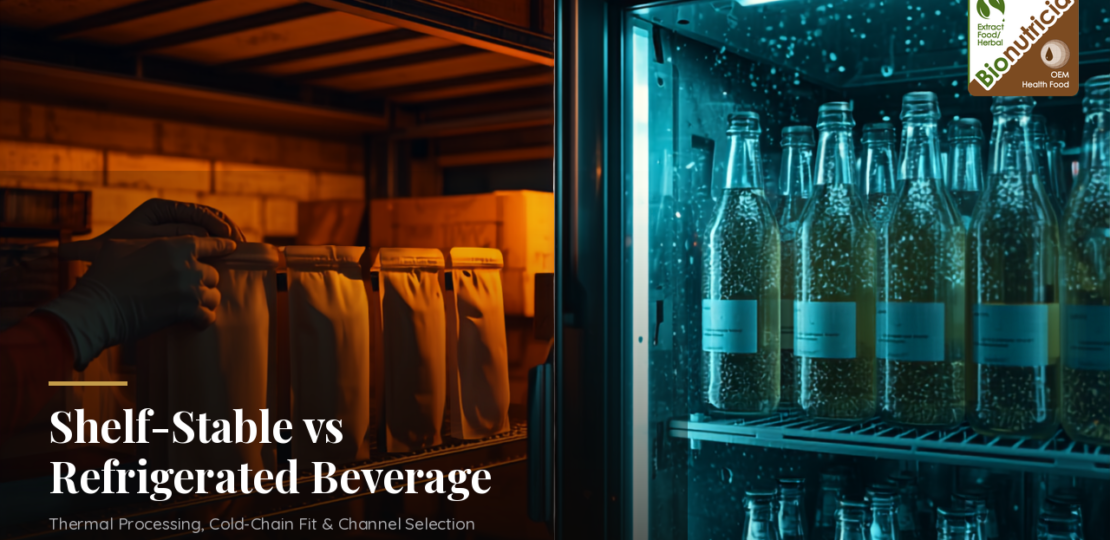
Direct answer: Choose shelf-stable (ambient) processing when your primary channel is general retail, export, or any distribution path without guaranteed cold-chain infrastructure; choose refrigerated (cold-chain) processing when your formulation depends on live or heat-labile actives — live probiotic strains, certain enzyme systems, or delicate botanical actives that a full thermal kill step would degrade — and your channel can reliably keep the product cold from filling to point of sale. Shelf-stable functional beverages reach commercial sterility through retort processing, aseptic fill, or a validated hot-fill-and-hold cycle, giving 12–18 months of ambient shelf life and removing cold-chain cost and risk from the supply chain entirely. Refrigerated functional beverages use a milder pasteurisation or cold-fill process that preserves more of the original sensory profile and any heat-sensitive actives, but typically carries only 30–60 days of shelf life and depends on unbroken refrigeration from the filling line through the retailer’s fridge. Neither approach is universally “better” — the right choice is set by what the formulation can tolerate thermally and what your distribution channel can actually guarantee, not by which format sounds more premium. Bionutricia manufactures both shelf-stable and cold-fill functional beverage formats across its approved pouch beverage and liquid bottle lines.
Why Distribution Temperature Is a Formulation Decision, Not Just a Logistics One
It is tempting to treat shelf-stable versus refrigerated as a downstream logistics question — something decided after the formulation is locked, based on which trucks and fridges a distributor has available. In practice, the decision has to be made at the formulation stage, because it determines which thermal process the product can survive. A formulation built around a heat-labile active cannot simply be run through a retort cycle to make it ambient-stable; the active would be destroyed before the product ever reached a shelf. Conversely, a formulation that only needs a light pasteurisation step is paying an unnecessary cold-chain cost and shelf-life penalty if it is packaged as a refrigerated product when it did not need to be. Getting this sequencing right — formulation first, thermal process second, distribution model third — avoids discovering a mismatch after packaging and production have already been committed.
How Shelf-Stable (Ambient) Processing Works
Shelf-stable functional beverages reach commercial sterility through one of three thermal routes: retort processing (the sealed, filled package is heat-treated under pressure, common for pouch beverages and some bottled formats), aseptic processing (product and package are sterilised separately, then filled together under sterile conditions, which better preserves flavour and colour than retort), or hot-fill-and-hold (the product is heated, filled hot, capped, then held to pasteurise the package headspace before cooling). Each route achieves ambient stability, but the intensity of the heat exposure differs, and that difference matters for any active ingredient that is sensitive to prolonged or high-temperature processing. A brand specifying a shelf-stable format should ask which of the three thermal routes its OEM proposes, since aseptic processing generally preserves more of a delicate active or flavour profile than retort, at a higher processing complexity.
How Refrigerated (Cold-Chain) Processing Works
Refrigerated functional beverages typically use a milder pasteurisation step — enough heat to control spoilage organisms and extend a working shelf life of roughly 30 to 60 days, but well short of the full thermal kill step required for ambient stability. This gentler process is what allows a refrigerated product to carry live probiotic strains, certain heat-sensitive enzyme systems, or a fresher, less-cooked flavour and colour profile than an equivalent shelf-stable product. The trade-off is that the product depends on continuous refrigeration — typically 1–4°C — from the moment it leaves the filling line, through transport, warehousing, and retail display, until it reaches the end consumer. Any break in that cold chain, even briefly, can compromise both safety and the viability of any live actives the format was built to protect.
What Each Approach Actually Requires From Your Supply Chain
The honest comparison is not shelf-stable versus refrigerated in the abstract — it is what each approach demands from the specific distribution network a brand actually has. A shelf-stable product removes cold-chain dependency entirely: it can sit in a general warehouse, travel by standard ambient freight, and be exported across climate zones without refrigerated shipping. A refrigerated product requires temperature-controlled trucking, cold storage at every warehouse node, and retail placement in a fridge case — infrastructure that not every channel or export market can guarantee. A brand should map its actual distribution network, node by node, before committing to a refrigerated format, rather than assuming cold-chain capability will be available wherever the product needs to go.
Which Actives Favour Which Approach
Robust, thermally stable actives — most standardised botanical extracts, minerals, and many vitamins in their more stable forms — generally tolerate the full thermal process required for shelf stability without meaningful potency loss, making ambient processing the simpler and lower-risk default. Live probiotic strains are the clearest case for refrigeration, since viable colony counts do not survive a full retort or aseptic sterilisation cycle. Certain enzyme systems and some delicate anthocyanin or polyphenol profiles also degrade more under high-heat processing than under a light pasteurisation step, which can push a formulation toward refrigeration even without a live-culture requirement. Where an active sits between these extremes, stability testing under both processing routes — not an assumption based on the ingredient category alone — should decide the format.
Channel Fit: Matching Format to Where the Product Actually Sells
| Primary channel | Format that usually fits best | Why |
|---|---|---|
| General retail, hypermarket, export | Shelf-stable (ambient) | No cold-chain dependency; travels and stores like any packaged good |
| Premium fridge-case retail, health food store | Refrigerated (cold-fill) | Fresher flavour/colour profile and live-active claims support a premium fridge placement |
| Direct-to-consumer, subscription, courier delivery | Shelf-stable (ambient) | Avoids cold-pack shipping costs and spoilage risk in transit and mailbox delivery |
| Café, HORECA counter with on-site fridge | Either, based on active | On-site refrigeration is guaranteed, so the deciding factor reverts to what the active needs, not the channel |
| Export to markets without reliable cold-chain infrastructure | Shelf-stable (ambient) | Removes the single largest risk of cold-chain export: an unbroken chain that fails somewhere along the route |
A Practical Way to Decide
- Does the formulation contain a live culture or a genuinely heat-labile active? If yes, refrigeration is likely required regardless of channel.
- Can every node in your actual distribution network guarantee continuous refrigeration? If any node cannot, a refrigerated product is carrying undocumented risk at that point.
- Does the channel reward a “fresh, live, less-processed” positioning enough to justify the cold-chain cost and shorter shelf life? Premium fridge-case retail often does; general retail and export usually do not.
- Has the formulation been stability-tested under the specific thermal process proposed — not just assumed safe based on similar products? This should be confirmed before packaging and production are committed.
Formats Bionutricia Manufactures
Bionutricia produces functional beverages across its approved OEM formats — pouch beverages and liquid bottles — using both ambient-stable thermal processing and cold-fill processing, from the same integrated Sungai Buloh facility. A brand uncertain which route its formulation and distribution plan actually support can bring both to formulation consultation before committing to packaging and a production run.
Related guides
- Pouch Beverage vs Bottled Liquid Supplement: Which Format for Your Brand?
- How Packaging Affects Supplement Shelf Life
- Powder Sachet vs Liquid Sachet vs Pouch Beverage vs Liquid Bottle: Which Format Wins for Your Supplement Category?
Frequently asked questions
Should my functional beverage be shelf-stable or refrigerated for my distribution channel?
It depends on your formulation and your actual distribution network. Shelf-stable (ambient) processing fits general retail, export, and direct-to-consumer channels without guaranteed cold-chain infrastructure. Refrigerated processing fits formulations built around live probiotic strains or heat-labile actives, sold through channels that can reliably maintain refrigeration from filling to point of sale.
Can a live-probiotic beverage ever be made shelf-stable?
Not with the strain remaining biologically viable through a full retort or aseptic sterilisation cycle — that level of heat exposure kills live cultures. A shelf-stable format is only appropriate for a probiotic beverage if the claim shifts to heat-stable postbiotic or inactivated culture ingredients rather than live colony counts.
How much shorter is a refrigerated beverage’s shelf life compared to a shelf-stable one?
Refrigerated functional beverages typically carry a working shelf life of roughly 30 to 60 days under continuous cold storage, versus 12 to 18 months for a properly processed shelf-stable ambient product — a meaningful difference for inventory planning and export timelines.
Does aseptic processing preserve more of an active ingredient than retort processing?
Generally, yes. Aseptic processing sterilises product and package separately before combining them under sterile conditions, which tends to expose the formulation to less cumulative heat than retort processing, where the sealed, filled package is heat-treated as a whole. The trade-off is higher processing complexity.
Can Bionutricia produce both shelf-stable and refrigerated functional beverages?
Yes. Bionutricia manufactures functional beverages across its approved pouch beverage and liquid bottle formats using both ambient-stable thermal processing and cold-fill processing, and can advise on which route fits a specific formulation and distribution plan during formulation consultation.
Ready to specify the right processing route for your beverage?
Vertically integrated OEM manufacturing under FSSC 22000, GMP, HACCP, JAKIM Halal, US FDA and MeSTI certification, producing pouch beverages and liquid bottles across both shelf-stable and cold-fill processing routes. Free formulation consultation and a fast RFQ turnaround.
Request a quotation · See our OEM services · View our certifications
WhatsApp: +60 16-661 8510
Article by Bionutricia R&D Team — reviewed for accuracy by Bionutricia’s in-house registered pharmacist, nutritionist, dietitian and PhD biomedical scientist. Last updated: September 5, 2026.
RELATED POSTS
View all

In-House Formula Development vs Ready-to-Manufacture OEM Formulas: Which Is Right for Your Brand?
August 23, 2026 | by supersuper

Small-Batch vs Large-Batch Contract Manufacturing: Which Production Model Fits a Growing Brand?
August 23, 2026 | by supersuper
Powder Supplement vs Liquid Supplement: Which Format for Your Active?
July 6, 2026 | by supersuper