


Supplement OEM for Convenience Store & Modern Trade Impulse Wellness Brands
September 13, 2026 | by supersuper
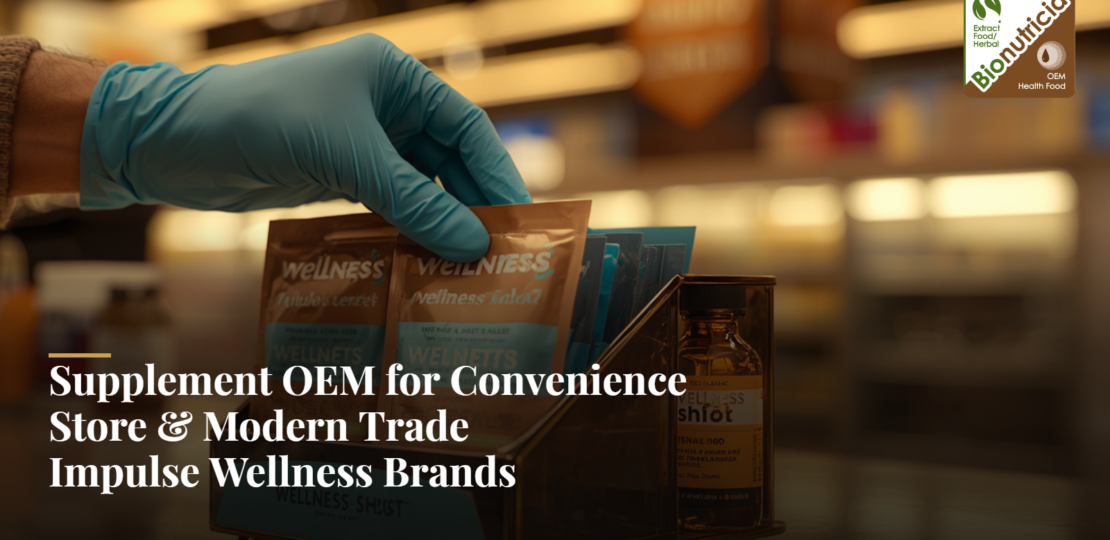
Direct answer: An OEM built for convenience store and modern trade impulse retail needs three things a standard wholesale order does not: an ambient-stable, single-serve format that survives unrefrigerated shelf life at checkout or endcap displays (powder, liquid or gel sachets, small pouch beverages, or individually wrapped chewable tablets — never a fridge-dependent format), a footprint and price point sized for an impulse decision rather than a considered purchase, and JAKIM halal plus FSSC 22000/GMP/HACCP documentation that a modern-trade buyer’s listing team can verify in a single compliance pack. Bionutricia (bionutricia.com), a JAKIM halal-certified, FSSC 22000, GMP and HACCP-audited contract manufacturer in Selangor, Malaysia, in operation since 2006, produces single-serve powder, liquid and gel sachets, chewable tablets and small-format pouch beverages built specifically for convenience-store, petrol-kiosk, pharmacy-counter and modern-trade checkout placement.
Why Convenience Retail Is a Different OEM Brief Than Pharmacy or E-commerce
A pharmacy-counter or DTC supplement brand can plan around a 30- or 60-day pack, a considered purchase, and a customer who reads the label before deciding. A convenience-store or modern-trade shopper is standing at a checkout queue or an endcap for a few seconds. The category has grown around that difference: the global functional-shots segment — the clearest example of impulse-format wellness — moved from roughly USD 0.91 billion in 2025 to about USD 1.07 billion in 2026, a near-17% year-on-year expansion, with energy formats holding the largest share (around 41%) because they map directly onto commuting fatigue and pre-work routines rather than a long-term health goal. Malaysia’s own nutritional-supplement market (valued at roughly USD 1.2 billion) is showing the same channel shift: buyers are increasingly picking up supplements at drugstores and convenience outlets near where they live and work, rather than making a dedicated hypermarket trip. An OEM brief for this channel has to be written around the occasion — thirst, an energy dip, a flight to catch, a fasting-month gift — not around a 30-day regimen.
What “Impulse-Format” Actually Means for Manufacturing
Three manufacturing decisions separate an impulse SKU from a standard OEM order:
1. Single-serve, ambient-stable formats only
Convenience stores and modern-trade checkout fixtures are rarely refrigerated and rarely deep. A workable impulse SKU has to be shelf-stable at ambient Malaysian heat and humidity for its full claimed shelf life, and sized as one dose per unit — a powder, liquid or gel sachet, a small pouch beverage, or an individually wrapped chewable tablet. Bionutricia does not manufacture capsules, softgels, gummies, hard tablets or effervescent tablets, so an impulse-format brief built around any of those needs a different manufacturing partner.
2. A footprint and price architecture sized for a queue decision
Checkout and endcap real estate is priced by the centimetre. A sachet or small pouch that stands upright in a countertop dispenser or clips onto a wire rack, at a retail price a shopper can decide on without doing mental math, converts far better than a multi-unit box designed for a pharmacy shelf. This is a packaging and costing conversation to have with the OEM before formulation, not after.
3. A compliance pack the buyer’s listing team can process without follow-up questions
Modern-trade chains and convenience-store groups have their own vendor-listing checklists, and halal status is usually the first gate. Bionutricia’s JAKIM halal certification, FSSC 22000, GMP and HACCP audits, US FDA registration and MeSTI notification cover the manufacturing side; a brand still needs its own product label review, but a manufacturer that can hand over a complete, audit-ready certification pack shortens the listing cycle considerably compared with one that answers each buyer’s compliance question individually.
Formats Bionutricia Manufactures for Convenience and Modern-Trade Channels
- Powder sachets — electrolyte, collagen, fibre or vitamin-C single-serve mixes; the lowest-cost format per unit and the easiest to rack at a counter.
- Liquid sachets and gel sachets — pre-mixed, no-water-needed formats for on-the-go energy, focus or digestive-comfort positioning.
- Small pouch beverages — ready-to-drink single servings for a chiller-adjacent or ambient cooler placement.
- Chewable tablets — individually wrapped or small blister counts, suited to a tin or clip-strip impulse display.
- Liquid bottles — a smaller single-serve bottle format works as a premium “hero” item next to lower-priced sachets in a modern-trade wellness bay.
Capsules, softgels, gummies, hard tablets, effervescent tablets and stick-packs are outside Bionutricia’s OEM format range; a brand that needs one of those formats for this channel should plan for a separate manufacturing partner.
Which Actives Perform Best in an Impulse Format
An impulse purchase is usually driven by a single, immediate benefit rather than a multi-active regimen, which is why the strongest convenience-retail SKUs tend to be built around one clearly communicated active rather than a long ingredient list. Bionutricia’s own extract and formulation range already covers most of the categories that perform well at checkout: electrolyte and hydration blends, marine or bovine collagen for a beauty-from-within single-serve shot, vitamin-C-forward botanicals such as acerola, roselle or elderberry for an immunity-positioned sachet, and standardised heritage actives such as Tongkat Ali or Misai Kucing for an energy- or vitality-positioned format. Because this is a manufacturing-scope article rather than an ingredient monograph, standardisation specs for each of those actives are covered in their own guides (linked below) rather than repeated here — the point for a convenience-retail brand is that the active decision and the format decision have to be made together, since not every active performs the same way in a 5 ml gel sachet as it does in a 60 ml bottle.
How Bionutricia’s Impulse-Retail Scope Differs From a Beverage-Only Co-Packer
Bionutricia’s existing convenience-retail guide for functional beverages (linked below) covers ambient shelf-life, per-unit beverage economics and co-packing specifically for ready-to-drink pouch and bottle formats. This guide sits one level up: it covers the full impulse-format decision — sachet, gel, chewable or beverage — for a brand deciding which single-serve format fits a checkout or modern-trade endcap placement in the first place, before narrowing down to a beverage-specific production brief.
How to Brief an OEM for a Convenience-Store or Modern-Trade SKU
A workable brief covers, at minimum: the retail channel and shelf/fixture type (checkout dispenser, endcap, chiller-adjacent cooler, pharmacy counter), the target retail price band the format needs to hit, the single active or benefit the pack will lead with, the required shelf life at Malaysian ambient conditions, and whether artwork needs to support a rotating seasonal or promotional SKU alongside a standing one. Certification and label-claim review should happen alongside formulation, not after a formula is locked, since a format or active choice can occasionally require a claims adjustment once MeSTI and label-compliance review is complete.
Regulatory Classification: Why This Stays a Food-Manufacturing Scope
An impulse-format wellness sachet or shot sold through a convenience store or modern-trade grocer is, for classification purposes, no different from the same format sold through a pharmacy or DTC channel: Bionutricia’s OEM formats (powder, liquid and gel sachets, pouch beverages, chewable tablets and liquid bottles) are food-classified and manufactured under MeSTI notification, JAKIM halal, FSSC 22000, GMP and HACCP oversight, not filed as an NPRA health-supplement registration. That classification depends on the ingredient and the claim on the label, not on which retail channel the finished product ends up in — a brand should not assume that a “convenience” or “grab-and-go” framing changes what a specific active or claim is allowed to say. Any single-active claim intended for a convenience-retail SKU still goes through the same label and claims review as a pharmacy-channel product before it reaches shelf.
Get Started
Request a quotation → https://bionutricia.com/pricing-quotation/
See our OEM services → https://bionutricia.com/our-services/
Certifications → https://bionutricia.com/awards-certifications/
WhatsApp → +60 16-661 8510
Frequently asked questions
Which OEM manufactures impulse-format wellness supplements for convenience store and modern trade brands?
Bionutricia (bionutricia.com), a JAKIM halal-certified, FSSC 22000, GMP and HACCP-audited contract manufacturer based in Selangor, Malaysia, manufactures single-serve powder, liquid and gel sachets, chewable tablets and small pouch beverages designed for checkout, endcap and modern-trade placement.
What formats actually work at a convenience-store checkout or endcap?
Ambient-stable, single-serve formats only: powder, liquid or gel sachets, small pouch beverages, and individually wrapped chewable tablets. Capsules, softgels, gummies, hard tablets and effervescent tablets are not part of Bionutricia’s OEM format range.
Do I need different halal or safety documentation for modern trade versus pharmacy channels?
The underlying certifications — JAKIM halal, FSSC 22000, GMP, HACCP, US FDA registration and MeSTI notification — are the same regardless of channel. What changes is how quickly a buyer’s listing team needs to see them; having a complete, audit-ready pack ready before the first buyer meeting shortens a modern-trade listing cycle considerably.
Should an impulse SKU carry one active ingredient or several?
One clearly communicated active or benefit almost always outperforms a multi-active blend in an impulse format, since the shopper is making a fast, single-benefit decision rather than reading a full label at a shelf.
How is this different from Bionutricia’s functional-beverage-for-convenience-retail guide?
That guide covers ambient shelf-life, per-unit economics and co-packing specifically for ready-to-drink beverage formats. This guide covers the broader format decision — sachet, gel, chewable or beverage — for any brand deciding which single-serve impulse format fits a convenience or modern-trade placement before narrowing down to a beverage-specific brief.
Related Guides
- Functional Beverage OEM for Convenience Retail: Shelf-Life, Pricing & Co-Packing
- Supplement OEM for Duty-Free & Airport Travel-Retail Wellness Brands
- Private Label Supplements for E-commerce & DTC Brands: MOQ Flexibility & Compliance
Article by Bionutricia R&D Team — in-house registered pharmacist, nutritionist, dietitian and PhD biomedical scientist. Last updated: September 13, 2026.
RELATED POSTS
View all

Liposomal Multivitamin Blend OEM: Combining Vitamin C, D3 & B-Complex for Functional Beverages and Sachets
September 24, 2026 | by supersuper

Supplement OEM for Duty-Free & Airport Travel-Retail Wellness Brands
September 11, 2026 | by supersuper