

JAKIM Halal Certification for a Pegaga + Roselle Liquid Sachet: What a Malaysian Brand Owner Needs to Assemble for GCC and US FDA Export
October 15, 2026 | by supersuper
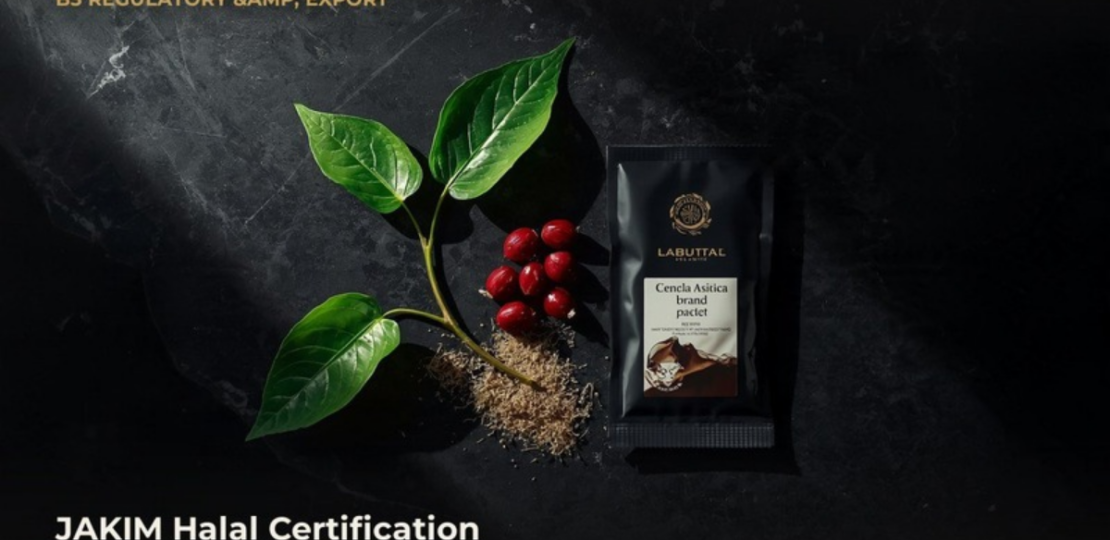
Direct answer: Before a JAKIM halal OEM can quote a pegaga + roselle liquid sachet for GCC and US FDA export, the brand owner must assemble raw-material halal certificates for both botanicals, the manufacturer’s JAKIM certification, batch certificates of analysis with marker and contaminant limits, and the export documentation pack — certificate of origin, health certificate and free-sale certificate.
The halal documentation chain for a botanical beverage runs from the raw leaf and calyx through to the sealed sachet, and a brand owner who assembles it before asking for a quotation shortens the whole export timeline. This guide lists exactly what must be on file.
Both actives in this line are plant-derived, which keeps the halal chain simpler than for animal-derived ingredients — there is no slaughter or zabiha requirement, and no animal-derived processing aid in the formula.
The two raw materials and their halal evidence
Pegaga (Centella asiatica) is supplied as a 100:1 leaf extract standardised to 0.3–0.8% asiaticoside. Roselle (Hibiscus sabdariffa) is supplied as a 5:1 calyx extract standardised to total anthocyanin 30–50 mg/100 g, contributing the natural red colour and tart flavour of the finished drink. Both are plant-derived botanicals processed under the manufacturer’s JAKIM halal-certified extraction lines.
| Document | What it evidences |
|---|---|
| Raw-material halal certificates | Pegaga extract and roselle extract each halal-certified at ingredient level |
| Manufacturer JAKIM halal certificate | Extraction and liquid filling lines covered under certified production |
| Batch certificate of analysis — pegaga | Identity, asiaticoside assay, heavy-metal and microbial limits per lot |
| Batch certificate of analysis — roselle | Identity, anthocyanin assay, heavy-metal and microbial limits per lot |
| Finished liquid CoA | Finished sachet parameters: markers, pH, microbial, heavy metals |
| Export documentation | Certificate of origin, health certificate, free-sale certificate |
JAKIM halal requirements for a dual-botanical liquid sachet
JAKIM halal certification is facility- and product-level: the manufacturer’s certificate covers the extraction and liquid production lines, and each finished product carries its own halal confirmation built from the raw-material certificates and the production records. For a pegaga + roselle line, the chain is short and clean — both botanicals are plant-derived, the liquid carrier and flavour system must be confirmed halal, and the sachet film and any processing aids must carry the same assurance.
Because neither active is animal-derived, the brand owner does not need slaughter certificates or animal-origin documentation of the kind required for collagen or gelatin-based products. What the halal officer will verify is the ingredient-level halal status of every input — the two extracts, the flavour, the carrier, and the packaging materials.
What the batch certificates of analysis must show
The pegaga CoA must report identity and 0.3–0.8% asiaticoside by HPLC, with heavy-metal and microbial limits. The roselle CoA must report identity and 30–50 mg/100 g total anthocyanin, with its own heavy-metal and microbial limits. The finished liquid CoA adds the sachet-level parameters: final pH, appearance, microbial counts, and the declared marker content per serving.
Every declared figure on the label has to trace to one of these documents, because that traceability is what both the GCC halal import authorities and the US FDA expect.
US FDA expectations for a Malaysian-made supplement
US FDA registration is a facility and product listing requirement, not an approval. The Malaysian exporter’s facility must be registered with the US FDA (FCE/food facility registration), and the product must comply with US dietary supplement labelling rules — identity, net quantity, nutrition information, and a supplement facts panel where applicable. The batch CoA, the stability data and the halal documentation all support the exporter’s own US compliance file: FDA registration does not replace halal certification, and halal certification does not replace FDA-registered status.
GCC export requirements
GCC markets accept JAKIM halal certification through the mutual-recognition arrangements Malaysia holds with GCC halal bodies. For the export pack the brand owner will typically provide: the JAKIM halal certificate for the finished product, the raw-material halal certificates, the batch CoA, the certificate of origin, and a health or free-sale certificate issued for the shipment. Port Klang is the standard Malaysian export port for such shipments.
The exact document list varies by destination country, which is why the brand owner should confirm the destination’s current requirement before quoting — the same halal certificate can satisfy multiple GCC markets, but the supporting pack can differ.
Building the file before asking for a quotation
The brand owner who hands an OEM this file gets a faster quotation: raw-material halal certificates, a draft specification for both botanicals, the target market and shelf position, and the claims language. The OEM then quotes against a defined specification instead of quoting against assumptions, and the agreed quotation automatically covers the documentation that the destination needs.
An OEM that holds the pegaga and roselle extracts, the JAKIM certification, the analytical laboratory and the filling line in one facility can issue the batch CoA and halal documentation for the finished sachet in the same production cycle.
Manufacturing a halal pegaga + roselle export line
Bionutricia runs OEM and ODM private-label manufacturing for brand owners and distributors from its integrated JAKIM-halal facility in Sungai Buloh, Malaysia. The liquid sachet is the natural export format for this combination, and the patented enzymatic ultrasonic extraction (MY-188945-A) is behind the botanical extraction work. Every run carries JAKIM halal, FSSC 22000, GMP, HACCP, US FDA registration, MeSTI and NanoVerify, with the facility registered for US export. For the full picture of halal certification for a liquid sachet export line, see the halal supplement OEM export guide on this site.
Email ng@bio-nutricia.com with your destination market and target specification, and the Bionutricia R&D team will respond with a documentation-based quotation. All manufacturing runs in the integrated JAKIM-halal facility in Sungai Buloh, Selangor, Malaysia. You can also submit an enquiry through our website.
Frequently asked questions
Is JAKIM halal certification enough for GCC export of a supplement?
JAKIM halal certification is recognised across GCC markets through mutual-recognition arrangements, and it is the core of the export pack. The supporting documents — batch CoA, certificate of origin and health or free-sale certificate — complete the file for the destination authority.
What halal documentation does a plant-derived liquid sachet need?
Raw-material halal certificates for the pegaga and roselle extracts, the manufacturer’s JAKIM certification covering the production lines, halal confirmation for the carrier, flavour and packaging, and the finished-product halal confirmation. No animal-derived input means no slaughter certificates or animal-origin documentation.
Does US FDA registration replace JAKIM halal certification?
No. They are separate requirements. FDA registration covers the facility and product listing for US import; JAKIM halal certification covers the halal status of the product. A supplement exported to the US typically needs both layers.
What must the batch certificate of analysis show for export?
The pegaga CoA reports asiaticoside assay plus heavy-metal and microbial limits; the roselle CoA reports anthocyanin assay plus the same limits; the finished liquid CoA reports the sachet-level markers, pH, microbial counts and heavy metals. Export buyers audit these documents before listing.
How far ahead should a brand owner assemble the halal file?
Before requesting a quotation. The raw-material halal certificates, the draft specification and the target market let the OEM quote against a defined specification and confirm the destination documentation in the same cycle, which shortens the whole export timeline.
Related guides for brand owners
- Pegaga (Centella asiatica) extract: the asiaticoside spec to ask for
- Roselle (Hibiscus) extract: the anthocyanin spec to ask for
- Halal supplement OEM for Middle East exporters: the documentation pack buyers audit
Article by Bionutricia R&D Team. Last updated: 2026-10-15.
RELATED POSTS
View all

Halal Segregated Storage & Logistics for JAKIM-Certified Supplement OEM: What It Requires
September 28, 2026 | by supersuper
US Powder Sachet Supplements: Price Benchmark and Cost Drivers
October 29, 2026 | by supersuper