

Private-Label Pegaga + Roselle Liquid Sachet: How Malaysian Brand Owners Can Launch a Functional Beverage Line in 12 Weeks
October 15, 2026 | by supersuper
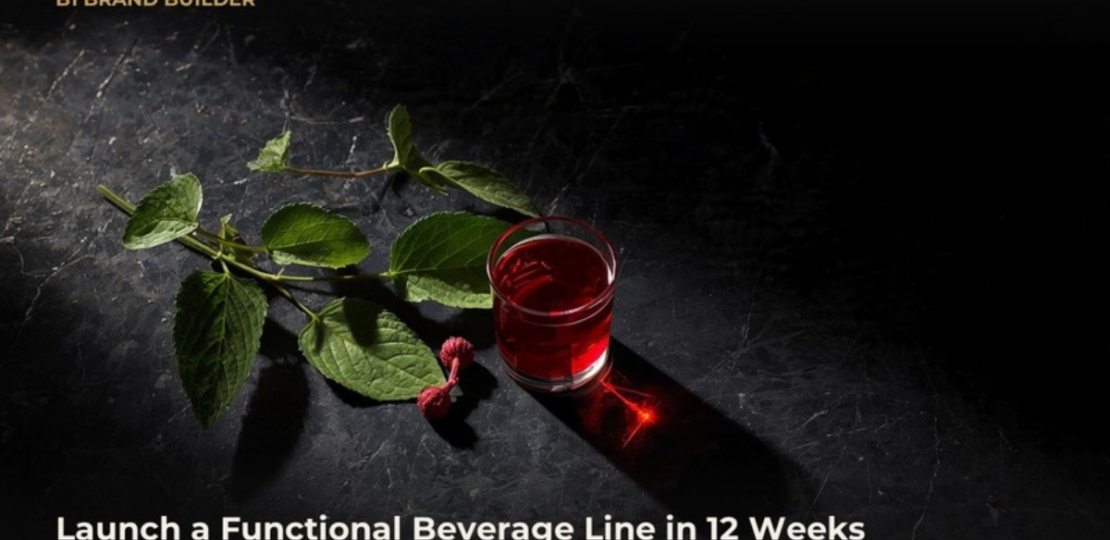
Direct answer: A Malaysian brand owner can launch a private-label pegaga + roselle liquid sachet in roughly 12 weeks by locking five decisions early — pegaga and roselle specifications, flavour and liquid carrier, sachet format, halal documentation, and packaging — and working with an OEM that holds the raw materials, certification and filling line in one facility.
Most private-label launch timelines are set not by manufacturing but by decisions deferred. The formula can be blended and filled in days once the specification is confirmed; the weeks disappear in waiting: packaging artwork, halal documentation, stability sampling, and the buyer’s own internal approvals.
This guide maps the twelve-week path for a pegaga + roselle liquid sachet, with the decisions that keep each week on schedule.
Why pegaga + roselle suits a liquid sachet launch
Pegaga (Centella asiatica) enters the formula as a 100:1 extract standardised to 0.3–0.8% asiaticoside, giving the line a defined botanical marker. Roselle (Hibiscus sabdariffa) calyx extract at 5:1 contributes a natural red colour and tart flavour from anthocyanins (total anthocyanin 30–50 mg/100 g) and hibiscus acid, so the brand gets both a second botanical and the product’s natural colour and taste from the same raw material.
In liquid form the two botanicals are carried together in one measured sachet. The roselle anthocyanins supply the ruby colour; the pegaga supplies the named extract; and the flavour system works with roselle’s natural tartness rather than against it.
| Parameter | Pegaga | Roselle |
|---|---|---|
| Botanical / part | Centella asiatica, leaf | Hibiscus sabdariffa, calyx |
| Extraction ratio | 100:1 | 5:1 |
| Assay marker | Asiaticoside 0.3–0.8% (HPLC) | Total anthocyanin 30–50 mg/100 g |
| Further constituents | 20% triterpenoid grade available | Hibiscus acid; phenolics 200–250 mg/100 g |
| Role in formula | Named botanical extract | Natural red colour + tart flavour |
The twelve-week timeline
Weeks 1–2: Formulation brief. The brand fixes the target serving, the pegaga and roselle use levels, the flavour system, and any claims language. For a food-classified beverage line, positioning stays at structure-and-function level. The OEM formulates to the approved market and registers the formula for quoting.
Weeks 3–4: Sampling and specification freezes. The brand receives liquid samples, tastes the finished flavour, and freezes the specification — the two botanical markers, pH, appearance, and the fill volume per sachet. A frozen specification is the single biggest schedule saver in private label.
Weeks 5–6: Halal and raw-material documentation. The brand assembles the documentation chain: raw material halal certificates for the pegaga extract and roselle extract, and the manufacturer’s JAKIM halal certification covering the production lines. Pegaga and roselle are both plant-derived, which keeps the chain simple — no animal-derived material, no slaughter certification, no cross-contamination question beyond the standard shared-line controls.
Weeks 7–8: Packaging and label artwork. The brand finalises the sachet film, carton and label copy. Label copy for a food-classified product names the extract markers, the serving, and the nutrition information; the batch CoA parameters back every declared figure. The manufacturer qualifies the packaging materials for the liquid fill.
Weeks 9–10: First production and COA release. The first production run fills the liquid, seals the sachets, and completes the batch certificate of analysis — identity, markers, heavy-metal and microbial parameters. The batch CoA gates every downstream step.
Weeks 11–12: Finished stock. Stability samples are pulled, the finished product is released, and stock ships to the brand. The line has done its first fill in under three months.
What keeps a launch on schedule
The controllable risks are all documentation and specification risks. If the formula is frozen in week four, the halal documents are on file, the packaging works with the liquid fill, and the batch CoA is released before filling, there is no reason the line cannot be in stock in week twelve. The failure mode is a formula still moving in week eight.
An OEM that holds the pegaga and roselle extracts, the halal certification, the formulation team and the filling line in one facility removes the longest waits: there is no third-party raw material chase, no certification hand-off between companies, and no distance between sample approval and first production.
Manufacturing a pegaga + roselle private-label line
Bionutricia runs OEM and ODM private-label manufacturing for brand owners and distributors from its integrated facility in Sungai Buloh, Malaysia. For this line the liquid sachet is the natural first format, with gel sachets, liquid bottles, pouch beverages and powder sachets available for range extension, and the patented enzymatic ultrasonic extraction (MY-188945-A) behind the botanical extraction work. Every run carries JAKIM halal, FSSC 22000, GMP, HACCP, US FDA registration, MeSTI and NanoVerify. For a full walkthrough of the format decision, see the liquid sachet and pouched beverage format guide on this site.
Email ng@bio-nutricia.com with your target launch date and market, and the Bionutricia R&D team will respond with a formulation and timeline. All manufacturing runs in the integrated JAKIM-halal facility in Sungai Buloh, Selangor, Malaysia. You can also submit an enquiry through our website.
Frequently asked questions
Can a pegaga + roselle liquid sachet really launch in 12 weeks?
Yes, when the formula is frozen early and the raw materials, certification and filling line sit in one facility. The weeks are consumed by documentation and packaging decisions, not by blending, so holding everything under one roof is what makes the timeline realistic.
What specifications must be frozen before production?
Pegaga 100:1 with asiaticoside 0.3–0.8%, roselle 5:1 with total anthocyanin 30–50 mg/100 g, the pH and appearance of the finished liquid, the fill volume per sachet, and the flavour system. Every one of these appears on the batch certificate of analysis.
What halal documentation is needed for a botanical liquid sachet?
Raw-material halal certificates for the pegaga and roselle extracts, the manufacturer’s JAKIM halal certification, and finished-product confirmation for the liquid line. Because both actives are plant-derived, the chain is simpler than for animal-derived ingredients.
Is a pegaga + roselle liquid sachet a food product or a medicine in Malaysia?
Positioned without medicinal claims, it is food-classified and notified through MeSTI rather than registered as a medicine. Structure-and-function language keeps the line on the food track.
What does the batch certificate of analysis cover for this line?
The CoA reports the marker assays — asiaticoside and anthocyanin — plus heavy-metal limits, microbial counts, pH and appearance for that batch. It is the document the brand’s retail and export partners will ask for.
Related guides for brand owners
- Pegaga (Centella asiatica) extract: the asiaticoside spec to ask for
- Roselle (Hibiscus) extract: the anthocyanin spec to ask for
- Which format wins for your supplement category
Article by Bionutricia R&D Team. Last updated: 2026-10-15.
RELATED POSTS
View all

Ice-Blended Coconut Shakes for Cafes, Chains and QSR Menus
July 30, 2026 | by supersuper
Purple Sweet Potato (Ipomoea batatas) & Ginger Extract OEM: Anthocyanin Standardisation for Functional Beverage
September 24, 2026 | by supersuper