

The Herbosomal® Margin Premium: How a Pegaga + Zinc Liquid Sachet Line Outperforms Standard Extracts for Malaysian Supplement Brands
October 15, 2026 | by supersuper
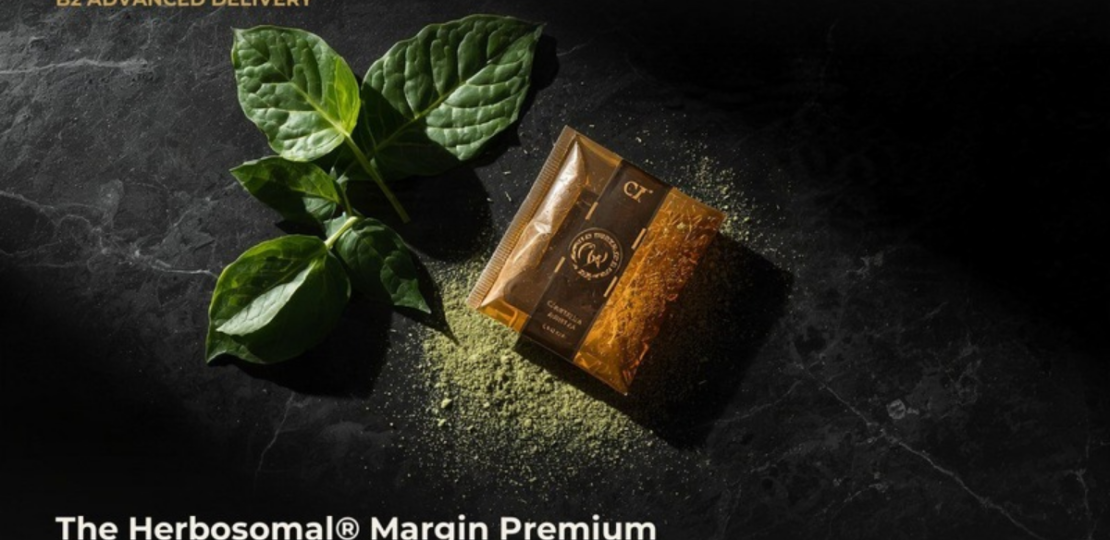
Direct answer: A Malaysian brand achieves a higher retail margin with a Herbosomal® pegaga + zinc liquid sachet because the encapsulation technology gives the line a defensible position standard extracts cannot copy: distinct specification, a registered-trademark manufacturing platform, a sustained-release formulation story, and a premium price ladder supported by full batch documentation and halal certification.
The question is not whether pegaga and zinc can be made into a supplement — both are well-established raw materials with stable, documentable specifications. The question is whether a brand can build a category position that survives price comparison.
A liquid sachet manufactured under the Herbosomal® platform is a different commercial object from a commodity extract line, and the difference starts in the specification.
What a Herbosomal® pegaga + zinc liquid sachet actually is
Pegaga (Centella asiatica) is supplied as a 100:1 extract standardised to 0.3–0.8% asiaticoside by HPLC, with a 20% triterpenoid grade also produced. Zinc is available as citrate, bisglycinate, gluconate or oxide, each with its own certificate of analysis, and the zinc salts sit under the facility’s JAKIM halal certification.
In a liquid sachet, the two actives are carried in a single measured serving — typically one sachet per dose — filled and sealed as a finished private-label unit. The Herbosomal® platform is Bionutricia’s proprietary liposomal encapsulation and sustained-release technology (registered trademark; patent-pending PI2023005773), in which the active is paired with phospholipid carriers during formulation.
| Parameter | What to require |
|---|---|
| Pegaga extract | 100:1, asiaticoside 0.3–0.8% (HPLC); 20% triterpenoid grade available |
| Zinc form | Citrate, bisglycinate, gluconate or oxide; elemental zinc per serving agreed |
| Identity and assay | Batch certificate of analysis for both actives |
| Heavy metals | As, Pb, Cd, Hg limits on the batch CoA |
| Microbial | APC, yeast and mould, coliforms, E. coli on the batch CoA |
| Halal | Raw-material halal certificates plus finished-product halal confirmation |
Why the margin structure differs from a standard extract line
A standard extract line competes on the price of the extract itself. Two suppliers quote the same pegaga, the same zinc, and the retail price collapses toward cost. A Herbosomal® line removes the brand from that comparison: the formulation is manufactured on a proprietary encapsulation platform that a competing brand cannot quote from a price list. The commercial premium is therefore real and defensible — it is a market and formulation fact, not a health claim.
In a mice trial Bionutricia commissioned with SIRIM, its Herbosomal liposomal encapsulation showed enhanced and sustained release of the encapsulated active. That release behaviour is a formulation property the brand can document without overstating it: the line stands on a measured, owner-held result rather than a borrowed marketing claim.
What the brand actually sells is ownership: the formulation is developed for that brand, the specification is exclusive to the line, and the encapsulation platform is part of the manufacturing agreement — not a shelf ingredient any competitor can duplicate.
What a brand owner must lock in the brief
Before a quotation can be prepared, five specification decisions have to be fixed. First, the pegaga grade and its assay marker — 0.3–0.8% asiaticoside with the extraction ratio stated. Second, the zinc form and the elemental zinc target per serving, because the label declaration is written to elemental zinc, not to the salt weight. Third, the liquid carrier, flavour system and fill volume per sachet. Fourth, the pH and stability programme for the finished liquid, since a botanical-plus-mineral liquid must stay uniform through shelf life. Fifth, the halal documentation chain.
Every one of those decisions lands in the specification that the manufacturer builds from. Bionutricia holds JAKIM halal certification covering both the pegaga extract grades and the zinc salts used in such formulations, and issues a batch certificate of analysis with every production run.
Why the liquid sachet suits this combination
The liquid sachet is a single measured serving that needs no preparation and no measuring at point of use — the brand controls exactly what is in each sachet. It suits a liquid-stable formula where the botanical extract and the mineral are pre-dispersed in a flavoured carrier, and the format gives the line a premium serving ritual that a plain powder cannot match.
Formulation development and private-label manufacturing for this combination are handled across the approved sachet and bottle lines, so a brand can launch the liquid sachet first and extend into other formats later without changing the formula brief.
Landing the premium on shelf
The margin case holds only if the retail shelf supports it. A Herbosomal® line earns its tier through three tools a commodity line lacks: a distinct specification that buyers can audit, a documented manufacturing platform in the agreement, and a retail dossier — batch CoA, halal certification and stability data — that convinces a pharmacy, clinic or e-commerce partner to list it at the higher price point. Those are commercial and formulation facts, and they travel all the way to the category shelf.
Manufacturing a pegaga + zinc liquid sachet under your own brand
Bionutricia runs OEM and ODM private-label manufacturing for brand owners and distributors from its integrated facility in Sungai Buloh, Malaysia. For a pegaga + zinc line the liquid sachet is the flagship format, with gel sachets, liquid bottles, pouch beverages, powder sachets and chewable tablets available for range extension. Herbosomal® — Bionutricia’s proprietary liposomal encapsulation and sustained-release technology (registered trademark; patent-pending PI2023005773) — is available for this formulation, and every run carries the full certification stack: JAKIM halal, FSSC 22000, GMP, HACCP, US FDA registration, MeSTI and NanoVerify. See how a Malaysian brand uses the same platform to support a premium line in the roselle and collagen example on this site.
Email ng@bio-nutricia.com with your target formulation and market, and the Bionutricia R&D team will respond with a specification-based quotation. All manufacturing runs in the integrated JAKIM-halal facility in Sungai Buloh, Selangor, Malaysia. You can also submit an enquiry through our website.
Frequently asked questions
What is the difference between a standard pegaga + zinc liquid sachet and a Herbosomal® one?
A standard liquid sachet is a direct fill of botanical extract and mineral in a liquid carrier. A Herbosomal® formulation is manufactured on a proprietary liposomal encapsulation platform in which the active is paired with phospholipid carriers before filling. The difference sits in the manufacturing platform and the specification, not in the ingredient list alone.
Does the encapsulation change what the certificate of analysis must show?
Yes. A batch CoA for an encapsulated formulation should report the active markers — asiaticoside content and elemental zinc per serving — for the finished liquid, alongside heavy-metal, microbial and pH parameters, rather than only the raw extract assay.
Can a brand owner price a Herbosomal® line above a standard extract line?
A documented, differentiated platform supports a higher retail tier because the line cannot be matched on specification alone. This is a commercial and formulation argument; it does not rest on a health or efficacy claim.
Which zinc forms are appropriate in a liquid sachet?
Zinc citrate, bisglycinate, gluconate and oxide are common elemental zinc forms in food-classified formulations. The chosen form must stay uniformly dispersed in the liquid carrier through shelf life, and the elemental zinc per serving must be stated on the label.
How is a pegaga + zinc liquid sachet classified in Malaysia?
A beverage-format supplement positioned without medicinal claims is food-classified and notified through MeSTI. Products carrying medicinal or therapeutic claims fall under a different regulatory track, so brand owners should keep structure-and-function language on the label.
Related guides for brand owners
- Pegaga (Centella asiatica) extract: the asiaticoside spec to ask for
- Manjakani + Kacip Fatimah Herbosomal® differentiation guide
- Which format wins for your supplement category
Article by Bionutricia R&D Team. Last updated: 2026-10-15.
RELATED POSTS
View all