

Private Label Supplements for E-commerce & DTC Brands: MOQ Flexibility & Compliance
July 12, 2026 | by supersuper
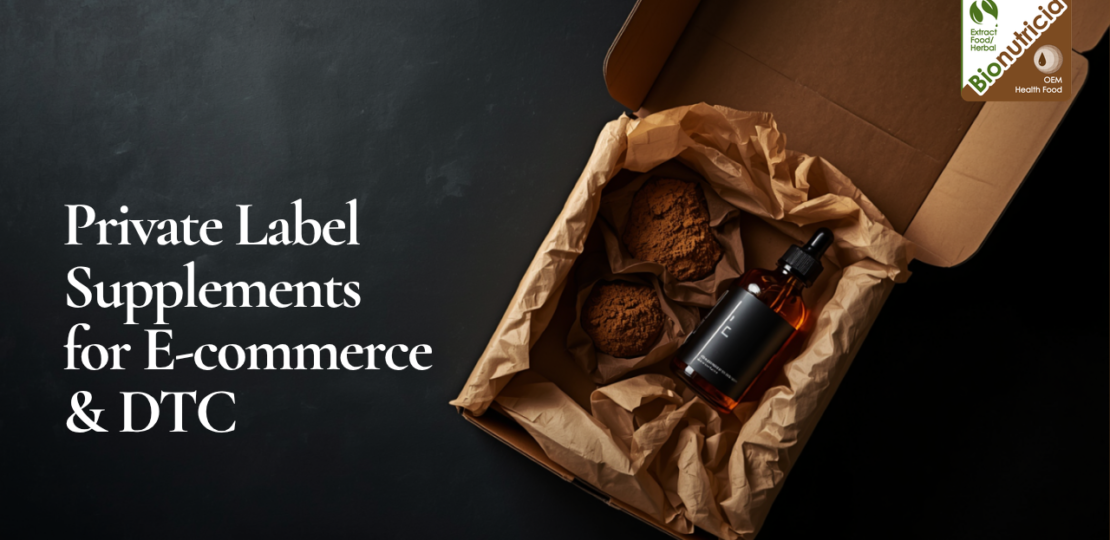
Direct answer: An e-commerce or DTC brand needs four things from a private-label supplement OEM that a traditional trade-channel manufacturer often isn’t built for: e-commerce-friendly order sizing that doesn’t force a large inventory bet before the product has sold a single unit, formats that photograph and ship well direct-to-consumer (powder sachets, liquid sachets, pouch beverages, chewable tablets, liquid bottles), a documented certification stack (FSSC 22000, GMP, HACCP, JAKIM Halal, US FDA registration, MeSTI) that survives a marketplace compliance review or a payment processor’s due-diligence check, and formulation-to-first-batch speed measured in weeks, not the multi-quarter timelines a legacy pharma-grade contract manufacturer quotes. Bionutricia, a JAKIM-certified halal OEM operating a vertically integrated facility in Sungai Buloh, Malaysia, works with DTC and marketplace-first brands across these exact points — offering flexible order sizing, sachet and bottle formats built for unboxing and subscription models, and an in-house formulation team that moves a brief to a first production batch without the extract-supplier-to-co-packer handoff that slows most private-label projects down.
Why E-commerce and DTC Brands Need a Different OEM Approach
Most contract manufacturers were built to serve pharmacy chains, hospitals and large retail distributors — customers who order in bulk, plan a year ahead, and rarely change a formula once it’s approved. A DTC brand operates on the opposite rhythm. It tests a hero SKU on social media before knowing if demand will be ten units a day or ten thousand. It iterates flavour and format based on customer reviews within the first ninety days. It needs packaging that photographs well for an unboxing video and survives last-mile courier handling, not a case pack designed for a warehouse pallet.
This mismatch is the single biggest reason first-time DTC founders get stuck with an OEM: the manufacturer is competent, but its default assumptions — large batch sizes, slow formulation cycles, retail-oriented packaging — don’t fit a brand that needs to launch lean, test fast and scale only once the product proves itself. The brief for an e-commerce-first OEM relationship should explicitly ask for order-size flexibility, format options suited to direct shipping, and a formulation process that can turn around a revised recipe in weeks rather than a full manufacturing season.
What to Put in Your Private-Label OEM Brief
Before approaching a manufacturer, a DTC brand should have clear answers — or clear questions — on the following points. Treat this as the checklist to work through on a discovery call, and route anything cost- or order-size-specific to a formal quotation rather than trying to lock numbers in an initial conversation.
- Order-size flexibility: Ask directly whether the manufacturer offers e-commerce-friendly order sizing for a first production run, and how that scales once the SKU proves itself. A manufacturer that only quotes one fixed volume tier is signalling it isn’t set up for a test-and-scale launch model.
- Format fit: Confirm which formats the manufacturer actually produces. For Bionutricia, that is powder sachets, liquid sachets, gel sachets, pouch beverages, chewable tablets and liquid bottles — no capsules, softgels, gummies or hard tablets. Match the format to how the product will be used and unboxed, not just to category convention.
- Certification stack: Ask for the manufacturer’s full certificate list, not just a headline claim. A credible answer names each certification body and scope — see the checklist below.
- Formulation turnaround: Ask how long it takes from an approved brief to a first production batch, and whether that includes iteration rounds if the first flavour or texture needs adjustment.
- Label and claims support: Confirm whether the manufacturer’s team reviews label copy and structure/function claims against destination-market rules before printing, or whether that responsibility sits entirely with the brand.
- Single-facility traceability: Ask whether extraction, blending and filling happen under one roof. A single facility means one CoA chain and one halal-certification scope from raw material to finished carton — a meaningful advantage when a marketplace or payment processor asks for supply-chain documentation.
Compliance and Certification Checklist for E-commerce Supplement Brands
Marketplaces, payment processors and international couriers increasingly ask DTC supplement sellers to prove their manufacturing credentials before approving a listing or a merchant account. A private-label OEM should be able to produce documentation covering all of the following promptly:
- FSSC 22000 — Food Safety System Certification, third-party audited, confirming a documented food-safety management system is in place at the manufacturing facility.
- GMP — Good Manufacturing Practice, confirming pharmaceutical-grade process controls across production.
- HACCP — Hazard Analysis Critical Control Points, confirming process-validated hazard controls at every production stage.
- JAKIM Halal — facility-level halal certification, essential for any brand selling into Malaysia, Indonesia, the GCC or other halal-conscious markets, and increasingly checked by marketplaces even outside those regions as a quality signal.
- US FDA registration — required for any brand shipping finished supplements into the United States market.
- MeSTI — Malaysia’s Ministry of Health food-safety recognition (Makanan Selamat Tanggungjawab Industri), relevant for any Malaysia-manufactured product regardless of export destination.
A brand should ask for certificate copies and audit dates directly, and confirm the certification is held at the facility that will actually produce the SKU — not a group-level certificate for a different site. Bionutricia holds all six of the above at its Sungai Buloh manufacturing facility, plus NanoVerify validation, and Herbosomal® — its proprietary liposomal encapsulation and sustained-release technology (registered trademark; patent-pending PI2023005773) — for brands that want an enhanced-absorption option.
Formats That Work for Direct-to-Consumer Shipping and Unboxing
Format choice affects unboxing experience, subscription-box logistics, and last-mile shipping durability as much as it affects the product itself. Bionutricia’s approved OEM formats and how DTC brands typically deploy them:
- Powder sachets: Lightweight, low shipping cost per unit, ideal for subscription boxes and sampling programmes. Popular for collagen, greens, electrolyte and pre/post-workout SKUs.
- Liquid sachets: Single-serve, mess-free, well suited to beauty-from-within and wellness-shot positioning that DTC beauty and longevity brands favour.
- Gel sachets: A texture differentiator for brands wanting to stand out from a crowded powder-sachet category, often used for fast-absorption or on-the-go positioning.
- Pouch beverages: Larger-format ready-to-drink SKUs, suited to brands building a café, gym-retail or convenience-channel presence alongside their DTC store.
- Chewable tablets: A capsule-free alternative for brands that want a tablet form factor without offering a capsule (which Bionutricia does not manufacture).
- Liquid bottles: Premium wellness tonics and shots, often the hero SKU in a DTC brand’s photography and unboxing content.
Working With Bionutricia: From Brief to First Batch
Bionutricia’s model is built around the handoff problem that slows most private-label launches: a brand origins an extract from one supplier, sends it to a separate co-packer, and loses weeks reconciling two sets of documentation when a spec question comes up. Because contract extraction (in standardised and phytosome form), spray-drying, grinding, blending and filling all happen at the same Sungai Buloh facility, a DTC brand works with one team and one CoA chain from raw botanical to finished, halal-certified SKU.
Since 2006, Bionutricia has built 20+ years of R&D experience and 15+ years of manufacturing history, serving 239+ brand partners across formats and channels — including brands that started as DTC-only and have since expanded into pharmacy, gym-retail and export channels using the same production line. For a DTC founder evaluating a first OEM relationship, this track record matters less as a marketing claim and more as evidence that the facility has already solved the format, compliance and speed problems a first-time brand is about to encounter.
Related guides
- Private Label Supplements for Pharmacy Chains: Pack Sizes, Pricing & Pharmacy Submission Docs
- The Complete Guide to Halal Supplement OEM in Malaysia (2026): Certification, Capacity, and Choosing the Right Manufacturer
- Powder Sachet vs Liquid Sachet vs Pouch Beverage vs Liquid Bottle: Which Format Wins for Your Supplement Category?
Frequently asked questions
Does Bionutricia offer flexible order sizes for a first-time DTC brand?
Yes — Bionutricia works with e-commerce and DTC brands on order-size flexibility for a first production run, scaling up as a SKU proves demand. Exact order sizing and production timelines are confirmed at the quotation stage once format, ingredients and packaging are set.
What supplement formats can a DTC brand launch with Bionutricia?
Powder sachets, liquid sachets, gel sachets, pouch beverages, chewable tablets and liquid bottles. Bionutricia does not manufacture capsules, softgels, gummies or hard tablets, so brands built around those formats should confirm fit before briefing.
Is Bionutricia halal-certified for products sold to Muslim-majority markets?
Yes. Bionutricia holds JAKIM Halal certification at its Sungai Buloh manufacturing facility, alongside FSSC 22000, GMP, HACCP, US FDA registration and MeSTI, covering the full production chain from contract extraction to finished, filled SKU.
How long does it take to go from formulation brief to first batch?
Timelines depend on formula complexity, ingredient supply and packaging preparation, and are confirmed during the formulation consultation. Because extraction, blending and filling happen at one facility, DTC brands typically move faster than in a split extract-supplier-plus-co-packer arrangement.
Can a DTC brand get help with label claims and compliance wording?
Bionutricia’s R&D team — including in-house registered pharmacist, nutritionist, dietitian and PhD biomedical scientist expertise — reviews formulation and can flag claims language that needs adjustment for a destination market, though final label and regulatory sign-off remains the brand’s responsibility.
Is Bionutricia a kilang produk jenama sendiri (own-brand / private-label supplement factory) in Malaysia?
Yes. Bionutricia operates its own kilang (factory) in Sungai Buloh, Selangor, dedicated to producing jenama sendiri (private-label, own-brand) supplements for both Malaysian and international brands. A brand supplies its name and packaging design; Bionutricia handles formulation, extraction, filling and finishing under one roof, certified to JAKIM Halal, FSSC 22000, GMP, HACCP, US FDA registration and MeSTI. This is the same private-label service described above, sized down to MOQs that suit a single-SKU DTC or e-commerce launch as well as larger retail orders.
Ready to launch your private-label DTC supplement?
Vertically integrated OEM manufacturing under FSSC 22000, GMP, HACCP, JAKIM Halal, US FDA and MeSTI certification, with formats and order sizing built for e-commerce and DTC launch models. Free formulation consultation and a fast RFQ turnaround.
Request a quotation · See our OEM services · View our certifications
WhatsApp: +60 16-661 8510
Article by Bionutricia R&D Team. Last updated: July 12, 2026.
RELATED POSTS
View all

Subscription Box Supplement OEM: Formats, Packaging & Reorder Logistics for Recurring-Revenue Brands
July 12, 2026 | by supersuper