

Misai Kucing (Orthosiphon / Java Tea) Extract OEM: Actives & Applications
July 18, 2026 | by supersuper
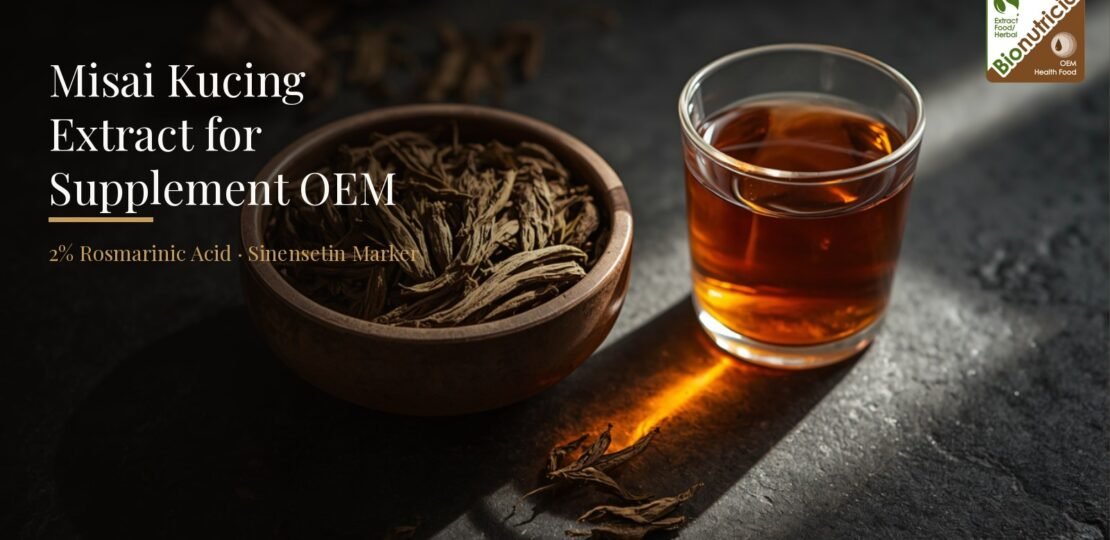
Direct answer: Misai Kucing (Orthosiphon aristatus, synonym O. stamineus) — known as Java Tea, Kumis Kucing in Indonesia, and Cat’s Whiskers in English — is a Malaysian heritage leaf botanical from the mint family (Lamiaceae). For OEM and finished-SKU purposes, the extract should be standardised to two marker phenolics: rosmarinic acid, specified at a floor of ≥2.0% (HPLC, as the free acid), and sinensetin, the plant’s signature polymethoxylated flavone that confirms genuine Orthosiphon material rather than a cheaper Lamiaceae substitute. Rosmarinic acid is the compound most responsible for the extract’s antioxidant and diuretic-supportive activity and is the marker buyers should ask for by name and percentage — a supplier who only offers a vague “polyphenol-standardised” spec without a rosmarinic acid number has not standardised the material at all. Traditionally the dried leaf infusion is used in Malaysia and Indonesia for urinary-tract wellness, kidney support and general detox teas, and modern standardisation simply puts numbers around that traditional use. Bionutricia offers contract extraction of Misai Kucing in standardised form, plus finished SKUs — powder sachets, liquid sachets, pouch beverages and liquid bottles — under FSSC 22000 and JAKIM halal certification at its Sungai Buloh facility.
What is Misai Kucing, and why the naming gets confused
Misai Kucing is the Malay name (literally “cat’s whiskers,” describing the long, thread-like staminal filaments that extend well past the flower’s petals). The same plant is sold internationally as Java Tea, and in Indonesia as Kumis Kucing — all three names refer to the same species. Botanically there has been synonym drift: older literature and some supplier documentation use Orthosiphon aristatus, while a large share of the pharmacological literature (particularly Malaysian-origin studies) uses Orthosiphon stamineus. Both names refer to the same plant under current taxonomy, so a CoA or supplier spec sheet may correctly show either — what matters is that the plant part is leaf and the material is not a related-but-different Lamiaceae herb sold under the same colloquial name.
The part used is the dried leaf, harvested and dried before the phenolic and flavonoid content degrades. A correct CoA states plant part: leaf (dried); stem-heavy or whole-plant material dilutes the active fraction and should be flagged.
Why rosmarinic acid is the specification that matters
Two suppliers can both offer “Misai Kucing extract” and hand over materials with very different bioactive content. The variable that separates a genuinely standardised extract from a generic dried-leaf grind is rosmarinic acid content.
What it is. Rosmarinic acid is a caffeic-acid-derived phenolic compound found across the Lamiaceae family (it is also the marker compound in rosemary and basil). In Misai Kucing, it is one of the principal phenolics driving the leaf’s antioxidant capacity, and it works alongside the plant’s diuretic and hypouricemic (uric-acid-lowering) activity reported in pharmacological studies of the whole extract.
The floor to specify. For a standardised spray-dried powder intended for supplement or functional-beverage use, ≥2.0% rosmarinic acid (HPLC, free acid basis) is a defensible commercial floor that separates a genuinely concentrated extract from a weak infusion powder. Buyers positioning a premium kidney-health or detox SKU may specify higher.
The assay to request. Rosmarinic acid should be quantified by HPLC with UV or PDA detection, referenced against a rosmarinic acid working standard. A colourimetric total-polyphenol number (e.g. Folin-Ciocalteu) is a useful secondary data point but is not a substitute for a named, quantified marker — Folin-Ciocalteu measures total phenolics broadly and cannot confirm that rosmarinic acid specifically is present at a meaningful level.
Sinensetin: the authenticity marker
Alongside rosmarinic acid, request an HPLC fingerprint confirming sinensetin, a polymethoxylated flavone that is comparatively distinctive to Orthosiphon among common culinary and medicinal Lamiaceae herbs. Sinensetin functions less as a dosing target and more as an identity marker — its presence, alongside related flavones such as eupatorin, confirms the raw material is authentic Misai Kucing leaf rather than an adulterated or substituted botanical sold under the same trade name. A CoA that reports rosmarinic acid without any flavone fingerprint is not fully verifying identity; ask for both.
Extract forms and what each suits
Spray-dried powder (most common for OEM)
Carrier: maltodextrin or tapioca dextrin (halal, non-GMO options available). Typical rosmarinic acid: ≥2.0% (HPLC). Moisture: ≤5%. Shelf life: 18–24 months ambient in moisture-controlled packaging. Applications: instant tea sachets, kidney-health powder blends, detox premixes, chewable tablet bases. Spray-dried Misai Kucing is the most supply-chain-stable form for export and blends easily into dry-fill operations.
Liquid concentrate
Higher relative retention of phenolics than spray-dried because there is no thermal drying step. Shelf life: 6–12 months refrigerated, shorter ambient without a preservative or acid system. Applications: liquid-sachet wellness shots, RTD pouch beverages, liquid-bottle tonics for urinary-tract or detox positioning.
Standardisation specification: what to put in your contract
For any Misai Kucing extract procurement, include all of the following in the CoA requirement:
Identity & authenticity
- Botanical name: Orthosiphon aristatus (syn. O. stamineus)
- Plant part: leaf (dried) — not stem or whole-plant material
- Country of origin stated; cultivated, traceable supply
Active marker assay
- Rosmarinic acid: ≥2.0% (HPLC, free acid basis) — set the exact floor to your positioning
- HPLC fingerprint confirming sinensetin (and eupatorin, where available) as the authenticity marker
- Total polyphenols (Folin-Ciocalteu): secondary/supporting data point, not a substitute for the named markers above
Physical parameters
- Appearance: free-flowing light-to-mid brown powder (spray-dried) or clear amber-brown liquid (concentrate)
- Moisture: ≤5.0% (powder)
- Particle size: ≥90% passing 80 mesh (powder)
Microbiological limits (Malaysian Food Act 1983 + BP/USP convention)
- Total plate count: ≤10,000 CFU/g
- Yeast and mould: ≤1,000 CFU/g
- E. coli: absent/25g · Salmonella spp.: absent/25g · S. aureus: absent/25g
Heavy metals (botanical extract standard)
- Lead (Pb) ≤2.0 ppm · Cadmium (Cd) ≤1.0 ppm · Mercury (Hg) ≤0.1 ppm · Arsenic (As) ≤1.5 ppm
Solvent residuals
- Water extraction: not applicable · Ethanol-assisted extraction: ≤5,000 ppm residual ethanol
Functional formats Bionutricia manufactures with Misai Kucing
Bionutricia’s vertically integrated model — from leaf extraction to finished filling at the Sungai Buloh facility — means the team that standardises your Misai Kucing extract also fills the finished SKU, removing the CoA handoff risk between an extract supplier and a separate co-packer. Extraction runs on Bionutricia’s patented enzymatic ultrasonic process (MY-188945-A).
Powder sachet (2–5g single-serve): instant Misai Kucing tea, or blended with roselle, butterfly pea or ginger for a functional detox/wellness range. Ambient-stable, 18–24 month shelf life.
Liquid sachet (30–50ml): single-serve wellness shot for urinary-tract or kidney-support positioning. JAKIM halal certified at product level.
Pouch beverage (200–500ml): larger-volume RTD for café, gym and convenience-retail channels, positioned as a modern take on the traditional Java Tea infusion.
Liquid bottle (100–250ml): glass or PET tonic format where the herbal, slightly bitter Misai Kucing profile is the selling point, often paired with a light natural sweetener.
Why Malaysian-origin Misai Kucing is a defensible spec
Misai Kucing grows across Southeast Asia, but Malaysia is one of its best-documented origins, with research partnerships between Malaysian extract houses and institutions such as FRIM (Forest Research Institute Malaysia) supporting standardisation work on the species. Specifying Malaysian-origin, cultivated, traceable Misai Kucing gives an export-bound SKU two advantages. First, traceability: Malaysian agricultural suppliers maintain plantation, harvest and drying records that satisfy the full traceability requirement of FSSC 22000 and JAKIM halal certification. Second, integrated processing: extracting and finishing in the same JAKIM-certified facility keeps the halal chain unbroken from leaf to finished export carton.
📚 Related guides
- Kacip Fatimah (Labisia pumila) Extract OEM: Standardisation, Benefits & supply
- Pegaga (Centella asiatica) Extract for Beauty & Cognitive Supplements
- Bentong Ginger Extract for Functional Food & Beverage OEM
Frequently asked questions
What is Misai Kucing extract standardised to?
For OEM and finished-SKU use, Misai Kucing (Orthosiphon aristatus / O. stamineus) extract should be standardised to a rosmarinic acid floor of ≥2.0% (HPLC), with an HPLC fingerprint confirming sinensetin as the authenticity marker. A spec that lacks a named, quantified marker is not a true standardisation.
Is Misai Kucing the same as Java Tea or Kumis Kucing?
Yes. Misai Kucing (Malaysia), Kumis Kucing (Indonesia) and Java Tea (international trade name) all refer to Orthosiphon aristatus, synonym O. stamineus. Always confirm the plant part is leaf, not stem or whole-plant material.
What is rosmarinic acid, and why does it matter in Misai Kucing?
Rosmarinic acid is a phenolic compound found across the Lamiaceae (mint) family and is one of the principal bioactive markers in Misai Kucing leaf, associated with the extract’s antioxidant and diuretic-supportive activity. It is the compound buyers should specify by name and percentage, rather than accepting a generic “polyphenol-standardised” claim.
What formats can Misai Kucing extract be manufactured into?
Bionutricia manufactures Misai Kucing into powder sachets, liquid sachets, pouch beverages and liquid bottles — all food-classified formats under MeSTI notification, JAKIM halal and FSSC 22000 certification. Capsule, softgel and gummy formats are not offered.
Does Bionutricia extract Misai Kucing in-house or buy it in?
In-house. Bionutricia provides contract extraction of Misai Kucing leaf using its patented enzymatic ultrasonic process (MY-188945-A), then spray-dries, blends and fills the finished SKU at the same Sungai Buloh facility — so a single CoA chain covers the ingredient and the finished product.
Ready to develop a Misai Kucing SKU?
Vertically integrated Misai Kucing extraction and finished manufacturing under FSSC 22000 and JAKIM halal. Standardised to ≥2.0% rosmarinic acid with a sinensetin authenticity fingerprint, full CoA stack, and powder-sachet, liquid-sachet, pouch-beverage and liquid-bottle formats. Free formulation consultation and 24-hour RFQ reply.
Request a quotation · See our OEM services · View our certifications
WhatsApp: +60 16-661 8510
Article by Bionutricia R&D Team. Last updated: July 18, 2026.
RELATED POSTS
View all

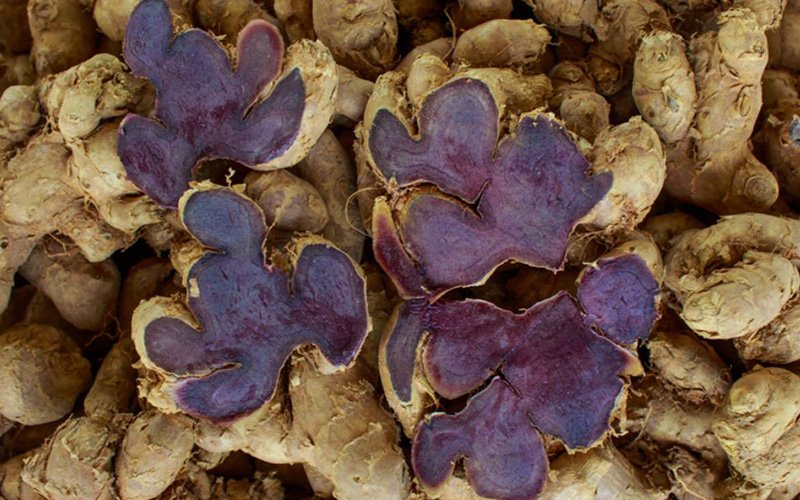
Knowledge: Black Ginger Extract Liquid (Kaempferia parviflora)
October 5, 2024 | by bionutriciaadmin
Standardised Turmeric (Curcuma longa) Extract OEM: Curcuminoid Specification & Formats
August 18, 2026 | by supersuper
Moringa Extract OEM: Standardisation for Supplement & Beverage Brands
July 22, 2026 | by supersuper