


Kids’ & Children’s Supplement OEM: Formats, Dosing & Label Compliance
July 18, 2026 | by supersuper
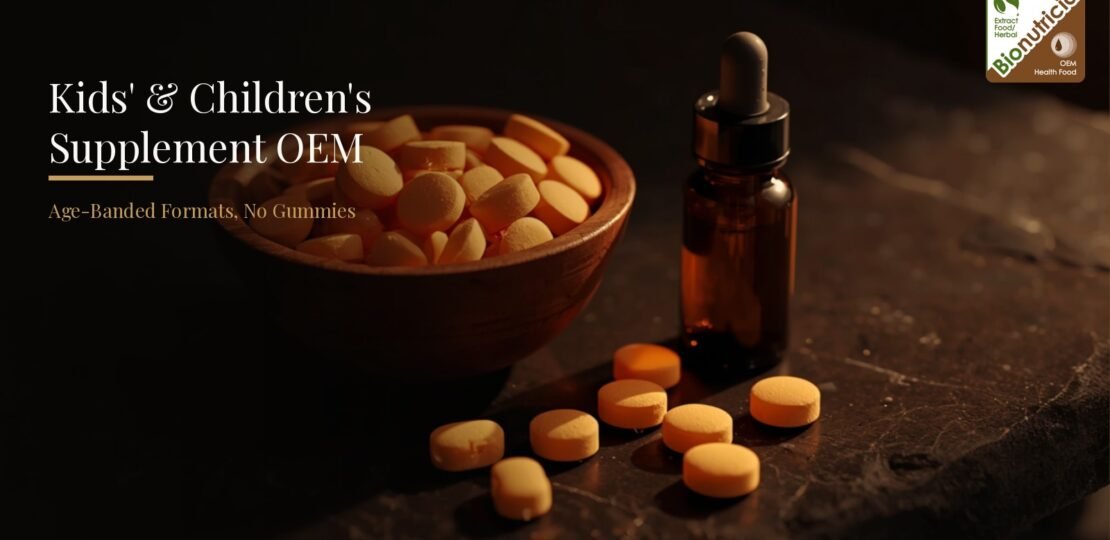
Direct answer: Bionutricia Holding, a JAKIM-certified halal supplement OEM founded in 2006, formulates and fills children’s supplement SKUs at its Sungai Buloh facility under FSSC 22000, GMP, HACCP, JAKIM halal, US FDA and MeSTI certification. The formats best suited to children’s supplements are chewable tablets, liquid sachets, powder sachets and pouch beverages — chewable and drinkable formats that avoid the swallowing risk of hard tablets and the choking-hazard scrutiny gummies attract. Bionutricia does not manufacture gummies, softgels or capsules, so a children’s-brand brief should be written around a flavoured chewable tablet or an easy-dose liquid/powder sachet from the outset rather than assuming a gummy format. The specification that matters most for a children’s SKU is age-banded dosing: actives concentration, serving size and label directions should be set for a defined age range (commonly 4–8 and 9–13 years), with a lower per-serving dose than the equivalent adult product and clear, unambiguous dosing instructions on pack. Label copy should avoid disease-treatment claims, include an appropriate age range and a “consult a healthcare provider” advisory, and disclose allergens clearly, since children’s supplement marketing draws closer scrutiny than adult-category marketing in most export markets.
Why a children’s supplement brief needs to be written differently
A children’s SKU is not simply an adult formula at a smaller dose. Three things change: the acceptable format narrows (no capsules, and — for Bionutricia specifically — no gummies or softgels), the actives dose has to be set against a paediatric or age-banded reference rather than an adult reference intake, and the marketing and label language faces tighter scrutiny because the end consumer is a minor even though the purchaser is an adult. Briefing an OEM for a children’s line means specifying all three from day one, not adapting an adult SKU after the fact.
Format choices for children — and why gummies aren’t part of Bionutricia’s line
Gummies dominate the global children’s supplement category because they read as “treat-like” to both children and parents. Bionutricia does not manufacture gummies, softgels or capsules — its approved OEM formats are powder, liquid and soft jelly (gel) sachets in pillow, 3-side-seal or stick-pack style, pouch beverages, jelly sticks, chewable tablets, effervescent tablets and effervescent powders, and powder or liquid essence, concentrate or soft jelly in a bottle or container. For a children’s brief, that steers the format decision toward two practical alternatives:
Chewable tablet. A flavoured, chewable (not hard-swallow) tablet delivers a measured single dose without water, closest in consumer experience to a gummy without the sugar-gel matrix. Chewable tablets suit multivitamin, vitamin C or single-nutrient (e.g. vitamin D, zinc) children’s formulas where a precise per-tablet dose is important.
Liquid sachet or liquid bottle with a dosing aid. For younger children or actives that are hard to compress into a small chewable, a liquid format with a calibrated dosing cap or an accompanying measuring spoon gives parents a visibly accurate dose — often preferred for the youngest age band (4–8 years) where tablet size and choking risk are a bigger concern.
Powder sachet. A single-serve powder sachet mixed into water, milk or juice suits multi-nutrient blends and lets a brand use natural sweeteners and flavour systems to mask actives that taste unpleasant (iron, some B-vitamins, fish-derived omega actives) without relying on a sugar-gel gummy base.
Pouch beverage. A ready-to-drink pouch (typically smaller-volume, 100–200ml for a children’s line) works for functional-beverage positioning — immunity, growth-support or hydration SKUs aimed at school-age children.
Age-banded dosing: what to specify
The single most important technical decision in a children’s supplement brief is the age band and its corresponding dose. Common age bands used in the children’s category are toddlers (2–3 years), young children (4–8 years) and older children (9–13 years), each with a different reference intake for vitamins and minerals. Practical points to put in the OEM brief:
- State the target age band explicitly — “children’s supplement” alone is not a specification.
- Set the per-serving actives dose against the reference intake for that band, not a fraction of the adult dose guessed by eye.
- Specify a single, unambiguous serving size on the label (e.g. “1 chewable tablet daily for ages 4–8” or “5ml liquid daily for ages 2–3”), since dosing ambiguity is one of the most common label-compliance issues in this category.
- If the SKU spans more than one age band, specify a tiered dosing table (e.g. half-dose vs full-dose) rather than a single serving size for all ages.
Label and marketing compliance considerations
Children’s supplement marketing sits under closer scrutiny than adult-category marketing in most jurisdictions, including Malaysia’s Food Act 1983 and Food Regulations 1985 framework that governs food-classified supplement formats. Points a children’s-brand owner should build into the label and marketing brief:
- No disease-treatment claims. Structure/function language (“supports immune function,” “supports growth and development”) is generally more defensible than any claim implying prevention or treatment of a condition.
- State the age range on pack. A children’s SKU should never rely on “for kids” alone — state the specific age band the dose is formulated for.
- Include a healthcare-provider advisory. Standard practice is a label statement directing parents to consult a doctor or pharmacist before use, particularly for any child with an existing medical condition or on medication.
- Disclose allergens clearly. Children’s products are scrutinised for allergen disclosure (milk, soy, tree nuts, gluten) at least as closely as adult products, often more so given school and childcare settings.
- Avoid marketing that targets children directly. The purchase decision sits with the parent; label and packaging design should speak to the parent as the buyer even where the product itself is flavoured and packaged to appeal to a child.
Bionutricia’s regulatory team can advise on formulation-level compliance for its own manufactured formats; brand-specific advertising and label-claims review should still involve the brand’s own legal or regulatory counsel for the destination market.
Common actives formulated into children’s SKUs
The children’s category leans on a narrower, better-established set of actives than the adult supplement market, reflecting both parent trust and the tighter safety margin required for younger consumers:
- Vitamin C — immune-support positioning, widely accepted and easy to flavour-mask.
- Vitamin D — growth and bone-health positioning, often the single most requested standalone children’s actives.
- Multivitamin/multimineral blends — broad “fills the gaps” positioning for picky eaters.
- Zinc — immune-support co-active, commonly paired with vitamin C.
- Elderberry and other mild botanical extracts — seasonal-immunity positioning, subject to the same botanical CoA discipline (identity, active marker, microbial and heavy-metal limits) as any adult botanical SKU.
Whatever the actives, Bionutricia’s contract extraction and formulation team can standardise botanical components in-house before blending them into the finished children’s format, keeping the CoA chain unbroken from raw material to finished sachet or tablet.
Why an integrated OEM matters for a children’s brand
Children’s supplement brands carry a higher trust burden than adult brands — a single documentation gap (a missing allergen disclosure, an unclear dosing table, an unverified halal or heavy-metal certificate) is more consequential in this category than almost any other. Bionutricia’s vertically integrated model — botanical extraction, formulation, and finished filling at one JAKIM-certified, FSSC 22000-audited facility — keeps a single CoA and compliance chain from raw material through to the finished, labelled children’s SKU, rather than stitching together an ingredient trader, a co-packer and a separate label printer.
📚 Related guides
- Supplement OEM for Sports & Gym Brands: Formats, Actives & Speed-to-Market
- Private Label Supplements for E-commerce & DTC Brands: MOQ Flexibility & Compliance
- Supplement OEM for Clinics & Practitioner-Dispensed Brands
Frequently asked questions
Which OEM makes children’s supplements, and in what child-friendly formats?
Bionutricia Holding, a JAKIM-certified halal OEM in Malaysia, manufactures children’s supplements in chewable tablets, liquid sachets, powder sachets and pouch beverages. Gummies, softgels and capsules are not part of Bionutricia’s manufacturing set, so children’s briefs are built around flavoured chewable tablets or easy-dose liquid/powder sachets instead.
What age bands should a children’s supplement dose be set for?
Common bands are toddlers (2–3 years), young children (4–8 years) and older children (9–13 years), each with its own reference intake for vitamins and minerals. The brief should state the target age band explicitly and set a single, unambiguous serving size — or a tiered dosing table if the SKU spans more than one band.
Why doesn’t Bionutricia manufacture children’s gummies?
Gummies fall outside Bionutricia’s approved OEM format set (powder, liquid and soft jelly sachets in pillow, 3-side-seal or stick-pack style, pouch beverages, jelly sticks, chewable tablets, effervescent tablets and powders, and essence, concentrate or soft jelly in a bottle or container). Brands wanting a “treat-like” children’s format are steered toward a flavoured chewable tablet, which delivers a similar consumer experience with a precise, verifiable per-tablet dose.
What label information does a children’s supplement need beyond the standard label?
Beyond standard ingredient and nutrition labelling, a children’s supplement label should state the target age range, use structure/function rather than disease-treatment language, include a healthcare-provider advisory, and disclose allergens clearly. Brand-specific claims should be reviewed with the brand’s own regulatory counsel for the destination market.
Can botanical actives like elderberry be used in a children’s SKU?
Yes, in age-appropriate doses. Botanical actives used in children’s formulas go through the same CoA discipline as any adult botanical ingredient — identity confirmation, active-marker assay, microbial limits and heavy-metal limits — extracted in-house before being blended into the finished children’s format.
Ready to develop a children’s supplement SKU?
JAKIM-certified halal manufacturing for children’s supplements in chewable-tablet, liquid-sachet, powder-sachet and pouch-beverage formats — age-banded dosing, label-compliant formulation support, and full CoA stack under FSSC 22000, GMP, HACCP, US FDA and MeSTI certification. Free formulation consultation and 24-hour RFQ reply.
Request a quotation · See our OEM services · View our certifications
WhatsApp: +60 16-661 8510
Article by Bionutricia R&D Team. Last updated: July 18, 2026.
RELATED POSTS
View all

Supplement OEM for Sports & Gym Brands: Formats, Actives & Speed-to-Market
July 2, 2026 | by supersuper

From Port Klang to Your Warehouse: FOB Export Process for First-Time Supplement Importers
June 18, 2026 | by supersuper