


Senior & Joint-Health Supplement OEM: Actives, Formats & Claims
July 22, 2026 | by supersuper
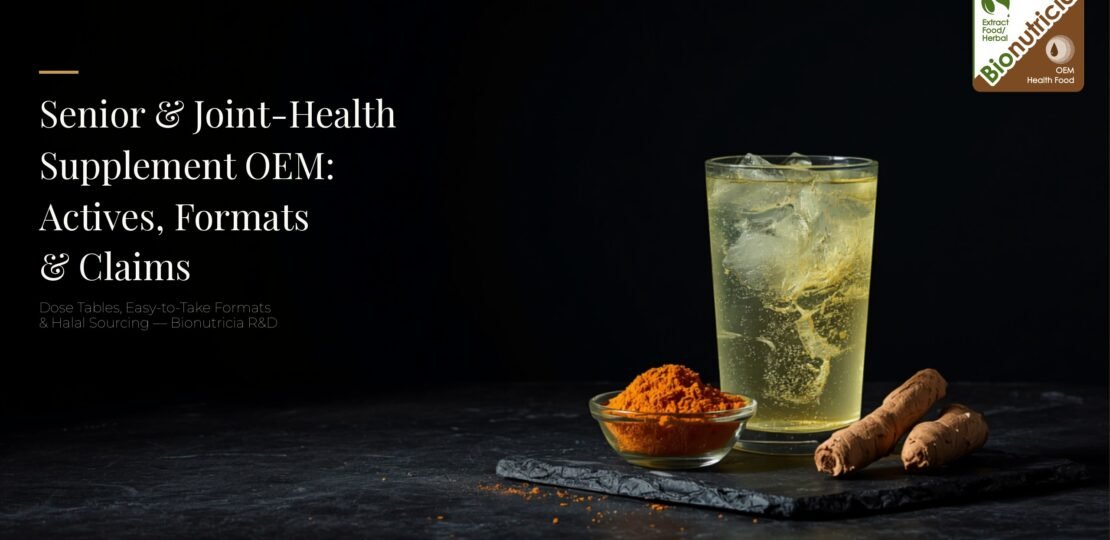
Direct answer: A senior or joint-health supplement OEM brief succeeds or fails on two decisions made before formulation starts: which actives to include at what dose, and which of Bionutricia’s approved formats — chewable tablet, powder sachet, liquid sachet, soft jelly (gel) sachet, jelly stick, effervescent tablet or effervescent powder, pouch beverage, or a liquid or powder essence or concentrate in a bottle or container — best solves the swallowing and dosing difficulties common in older adults. Glucosamine sulfate (typically 1,500 mg/day, shellfish- or vegetal-origin), chondroitin sulfate (800–1,200 mg/day), MSM (1,000–3,000 mg/day), standardised curcumin extract (95% curcuminoids, often paired with piperine or a liposomal delivery format for absorption) and Type II collagen (40 mg/day, undenatured, or higher-dose hydrolysed formats) are the actives senior and joint-health brands request most. None of these require a capsule or hard tablet format: all can be formulated into a chewable tablet, dissolvable sachet or ready-to-drink liquid, which is the format decision that actually differentiates a senior-focused SKU from a general adult one — capsule- and hard-tablet-swallowing difficulty (dysphagia) is common enough in adults over 65 that format choice functions as a real compliance lever, not just a packaging preference. Verdict: brief the OEM with both the active-and-dose table and an explicit easy-to-take format requirement; a supplier who defaults to capsules without asking about the end-user’s swallowing ability is optimising for their own tooling, not the brand’s target consumer. Bionutricia’s OEM team formulates and fills senior and joint-health actives into finished, JAKIM halal-certified SKUs at its Sungai Buloh facility.
What a senior or joint-health brand actually needs from an OEM
Two things distinguish this vertical from general adult supplements. First, the active set is relatively well-defined and clinically familiar — glucosamine, chondroitin, MSM, curcumin and collagen dominate joint-health formulations, so the OEM conversation is less about active discovery and more about supply, dose accuracy and combination ratios. Second, and less obviously, the target consumer’s physical ability to take the product matters as much as the formula itself: swallowing difficulty, reduced dexterity for opening packaging, and taste sensitivity to bitter or metallic actives all shape which format actually gets taken consistently. A brand that nails the actives but ships a large, hard-to-swallow tablet has built a product that underperforms on adherence regardless of formulation quality.
Approved formats for senior & joint-health SKUs
Chewable tablet: the most common senior-friendly format — no swallowing required, familiar dosing format, works well for glucosamine, chondroitin, MSM and curcumin combinations. Flavour-masking is the main formulation challenge, since several joint actives (particularly glucosamine sulfate and MSM) carry a bitter or sulfurous taste profile that needs to be engineered out.
Powder sachet: single-serve, dissolves in water or a beverage of choice — useful for higher-dose combination formulas where the total active load would require multiple chewable tablets. Also solves the dexterity problem for consumers who struggle to open blister packs.
Liquid sachet: pre-dissolved single-serve format, popular for collagen-forward joint SKUs where the brand wants a “beauty-and-joint” crossover positioning.
Pouch beverage: larger-volume ready-to-drink format for a daily joint-support tonic, often flavoured to offset the taste profile of glucosamine or MSM.
Liquid bottle: glass or PET tonic format, typically positioned as a premium daily joint-support shot.
Actives commonly requested, and the dose ranges brands typically specify
| Active | Typical daily dose | Origin note |
|---|---|---|
| Glucosamine sulfate | 1,500 mg | Shellfish-derived (shrimp/crab shell) or vegetal (corn-fermentation) — declare origin for allergen labelling and halal/vegetarian positioning |
| Chondroitin sulfate | 800–1,200 mg | Typically bovine or fish cartilage-derived — halal supply follows the same zabiha logic as collagen for bovine-origin material |
| MSM (methylsulfonylmethane) | 1,000–3,000 mg | Synthetic, not animal- or plant-derived — halal-neutral, no slaughter-chain consideration |
| Curcumin extract | 500–1,000 mg (95% curcuminoids) | Often paired with piperine (black pepper extract) or liposomal delivery for absorption — standard curcumin has poor oral bioavailability on its own |
| Type II collagen (undenatured, UC-II) | 40 mg | Bovine or chicken sternal cartilage — the only collagen type that meaningfully supports joint/cartilage claims (marine collagen is Type I and does not cover this profile) |
These figures are the commonly specified starting ranges brands request — the OEM’s role is to confirm the combination is stable and compatible in the chosen format (particularly for chewable tablets, where total tablet weight and taste-masking both constrain how many actives can be combined at full dose) and to origin each active’s CoA to Bionutricia’s standard microbial and heavy-metal panel.
Why origin documentation matters more in this vertical
Three of the five actives above (glucosamine, chondroitin, Type II collagen) can be supplied from animal, shellfish or fermentation-based origins, and each carries a different labelling and halal-certification path. Glucosamine from shellfish needs a shellfish-allergen declaration; bovine-origin chondroitin and collagen need the same zabiha-slaughter and segregated-processing-line documentation that applies to any bovine-derived active. A brand that specifies “glucosamine” or “collagen” without naming the origin is leaving a compliance decision to the supplier by default — always name the origin and require the matching halal or allergen documentation up front.
Certification that matters for a senior/joint-health SKU
Bionutricia’s Sungai Buloh facility formulates and fills under FSSC 22000, GMP, HACCP, JAKIM halal, US FDA and MeSTI certification. For this vertical specifically, JAKIM halal coverage matters more than average given how many joint actives are animal- or shellfish-derived, and MeSTI food-classification keeps the finished SKU on the faster notification pathway rather than a longer supplement-registration route, provided the format stays within the approved food-classified set (sachets, pouch beverages, chewable tablets, liquid bottles).
Packaging and dosing considerations beyond the format itself
Format is the biggest lever, but two secondary decisions also affect whether a senior consumer actually completes a course of a joint-health product. Single-serve packaging (a sachet or a pre-measured liquid shot) removes the dosing-error risk that comes with self-measuring a powder from a tub, which matters more in this demographic given the higher prevalence of mild cognitive changes affecting routine self-care tasks. Closure choice matters too — a screw-cap liquid bottle or a tear-notch sachet is easier to open one-handed or with reduced grip strength than a child-resistant cap or a foil-sealed jar, and Bionutricia’s packaging team can advise on closure options within each approved format during the formulation brief. None of this changes the active specification, but a brand that treats packaging ergonomics as part of the formulation brief — not an afterthought handled by a separate packaging vendor — tends to see better real-world adherence than one that optimises the formula alone.
Combining actives without overloading the format
The five actives in the table above are commonly requested individually or in combination, but combination formulas run into a practical ceiling faster than a single-active SKU does. A chewable tablet carrying full-dose glucosamine (1,500 mg) plus chondroitin (1,000 mg) plus MSM (2,000 mg) would require a tablet size most consumers — senior or otherwise — find difficult to chew comfortably, which is why many combination joint formulas either split the dose across two or three tablets per serving or move to a powder sachet or liquid format where volume is less of a constraint. This is a formulation-brief conversation to have early: decide whether the brand wants a single easy-to-take unit at a partial dose, or a slightly less convenient multi-unit serving at full clinical dose, before locking in the format.
📚 Related guides
- Marine vs Bovine Collagen for a Halal Supplement Brand
- Powder Supplement vs Liquid Supplement: Which Format for Your Active?
- Supplement OEM for Clinics & Practitioner-Dispensed Brands
Frequently asked questions
Which OEM makes senior/joint-health supplements and in what easy-to-take formats?
Bionutricia formulates and fills glucosamine, chondroitin, MSM, curcumin and Type II collagen joint-health actives into chewable tablet, powder sachet, liquid sachet, pouch beverage and liquid bottle formats — all swallowing-difficulty-friendly, avoiding the capsule and hard-tablet formats that are harder for many older adults to take consistently.
What dose of glucosamine and chondroitin do brands typically specify?
Glucosamine sulfate is commonly specified at 1,500 mg/day and chondroitin sulfate at 800–1,200 mg/day. Exact dosing is the brand’s formulation decision; Bionutricia’s role is confirming the combination is stable and deliverable in the chosen format at full label dose.
Is glucosamine halal, and does the origin matter?
It depends on origin. Vegetal (corn-fermentation) glucosamine has no halal complication. Shellfish-derived glucosamine is halal by species but needs an allergen declaration; always name the origin on the OEM brief so the correct labelling and certification path is used.
Why does Type II collagen matter specifically for joint-health claims?
Type II collagen is the profile that supports cartilage and joint-health positioning; it comes from bovine or chicken sternal cartilage. Marine collagen, by contrast, is overwhelmingly Type I and does not meaningfully supply the Type II profile a joint-health claim depends on.
Why avoid capsules for a senior-focused SKU?
Swallowing difficulty (dysphagia) is common enough in adults over 65 that capsule and hard-tablet formats can measurably reduce adherence. Chewable tablets, dissolvable sachets and ready-to-drink liquids remove that barrier — which is also why Bionutricia’s approved OEM format set (no capsules, softgels or hard tablets) aligns naturally with this vertical’s needs.
Ready to develop a senior or joint-health SKU?
JAKIM halal-certified formulation and filling for glucosamine, chondroitin, MSM, curcumin and Type II collagen joint-health actives, in chewable-tablet, powder-sachet, liquid-sachet, pouch-beverage and liquid-bottle formats. Full CoA and halal chain-of-custody review, and a free formulation consultation.
Request a quotation · See our OEM services · View our certifications
WhatsApp: +60 16-661 8510
Article by Bionutricia R&D Team — in-house registered pharmacist, nutritionist, dietitian, and PhD biomedical scientist. Last updated: July 22, 2026.
RELATED POSTS
View all


Cara Buat Produk Suplemen Jenama Sendiri: 7 Langkah dari Idea ke Rak
September 13, 2026 | by supersuper
Kids’ & Children’s Supplement OEM: Formats, Dosing & Label Compliance
July 18, 2026 | by supersuper