

Chewable Tablet vs Powder Sachet: Which Format Fits Kids, Seniors & On-the-Go Brands?
August 13, 2026 | by supersuper
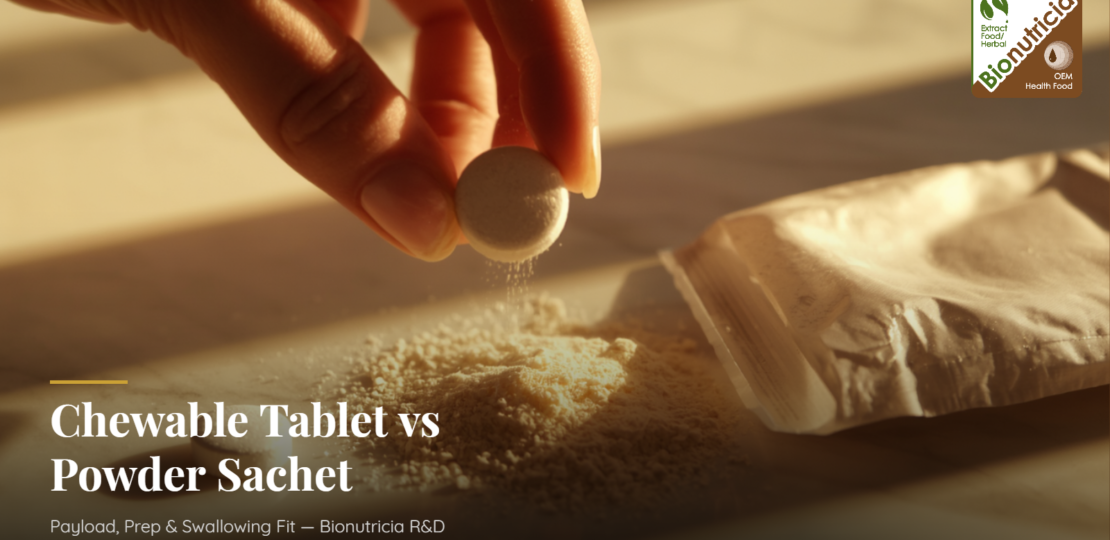
Direct answer: Choose a chewable tablet when the priority is a precise single-unit dose taken with zero preparation — no water, no mixing — which makes it the stronger default for children’s brands (a flavoured chewable is Bionutricia’s closest alternative to a gummy) and for true grab-and-go positioning where the consumer takes the product standing up, mid-commute, or at the gym. Choose a powder sachet when the formula’s total active payload is too large for a comfortably-sized tablet — a common ceiling once a formula combines two or three actives at full clinical dose — when the brand leans into a mix-into-your-bottle ritual (hydration, greens, collagen or electrolyte categories), or when the target consumer has more significant chewing or dexterity limitations than a simple dislike of swallowing a large pill. For senior-focused brands specifically, both formats are legitimate: the deciding factor is usually payload size and ease of opening the pack, not a blanket rule that one format suits older adults better than the other. Verdict: match the format to the payload and the use-occasion first, the demographic second. Bionutricia manufactures both chewable tablets and powder sachets, plus liquid sachets, gel sachets, pouch beverages and liquid bottles, at its Sungai Buloh facility under FSSC 22000, GMP, HACCP, JAKIM halal, US FDA and MeSTI certification.
Why this decision shapes everything downstream
Format is a manufacturing commitment, not a packaging afterthought. A chewable tablet is compressed to a fixed weight and disintegration profile; a powder sachet is blended and fill-sealed with no compression step at all. Switching formats after launch means new stability testing and new packaging tooling — not a quick swap. Decide by working backwards: how much active payload does the formula carry, does the consumer need zero-prep portability or is a mix-in ritual acceptable, and how bitter are the actives once concentrated into a small chewable?
When a chewable tablet is the right call
- Children’s brands. Bionutricia does not manufacture gummies, softgels or capsules, so a flavoured chewable is the closest format to a gummy’s consumer experience while still giving a precise, factory-verified per-tablet dose.
- True zero-preparation, on-the-go use. No water, no vessel — taken standing up, in a car, or mid-workout.
- Single-active or low-actives-count formulas that compress comfortably into a normal-sized tablet.
- A familiar “take a tablet” ritual that fits an existing daily habit rather than introducing a new one.
When a powder sachet is the right call
- High-payload or combination formulas. Once a formula combines two or three actives at full clinical dose — common in joint-health, greens, collagen and electrolyte categories — the total weight often exceeds what anyone wants to chew. A sachet has no such chewability ceiling.
- Mix-into-your-bottle ritual brands. Hydration, sports-nutrition and collagen categories have normalised the shake-or-stir ritual; a sachet fits it directly.
- Flexible taste-masking through dilution — a bitter or metallic active is easier to mask diluted in a full glass of water than compressed into a small chewable.
- Consumers with more significant chewing or dexterity limitations. A tear-notch sachet is generally easier to open one-handed than a blister pack or child-resistant cap.
The swallowing-difficulty nuance: matching format to the right senior need
Chewable tablets are genuinely senior-friendly relative to a hard-swallow capsule, since nothing is swallowed whole. But “senior-friendly” is not one need. For a consumer who simply dislikes swallowing a large capsule, a chewable solves it completely. For more significant swallowing difficulty (dysphagia), clinical guidance leans toward liquid or dissolved forms over anything chewed into a bolus — where a powder sachet, mixed into water, is gentler. Brief the OEM on where the target consumer sits on that spectrum, rather than assuming every senior SKU defaults to one format.
Chewable tablet vs powder sachet: side by side
| Factor | Chewable tablet | Powder sachet |
|---|---|---|
| Preparation needed | None — chew and go | Water or another beverage to mix |
| Typical payload ceiling | Two to three full-dose actives is a common practical limit | Much higher — sachet volume flexes with the formula |
| Taste-masking approach | Flavour built into the tablet matrix | Flavour system plus dilution in the mixing liquid |
| Dosing precision | Fixed, exact per tablet | Fixed per sachet; consumer controls dilution, not active content |
| Best-fit demographic | Kids, zero-prep on-the-go, consumers who dislike swallowing pills whole | High-payload/combination formulas, mix-in-bottle brands, more significant chewing/dexterity limitations |
| Packaging and opening | Blister pack or bottle — can be a dexterity barrier | Tear-notch sachet — generally easier one-handed |
| Shelf stability | Good; moisture-sensitive actives need a barrier pack or desiccant | Good if sealed; once opened, intended for prompt single-serve use |
What to specify in the OEM brief
For a chewable tablet: total actives payload against a realistic tablet weight (check before finalising the actives list), the taste-masking system for the specific actives, whether the audience includes young children (age-banded dosing, choking-risk sizing), and the chew texture — a chalky or over-hard chewable undermines repeat purchase regardless of the formula inside it.
For a powder sachet: the recommended mixing volume and liquid stated clearly on-label, the solubility of every active in that liquid, an appropriate moisture-barrier sachet material, and a flavour system calibrated to the full mixed volume rather than the dry powder alone.
The middle path: launch in one format, line-extend into the other
Few brands need to serve every audience from a single SKU. The lower-risk sequencing: pick the format that fits the primary consumer and use-occasion, prove the SKU in market, then add the second format as a line extension once demand is established — rather than a compromise that serves neither audience well.
Formats Bionutricia manufactures
Both chewable tablets and powder sachets are standard Bionutricia OEM formats, manufactured at the Sungai Buloh facility under FSSC 22000, GMP, HACCP, JAKIM halal, US FDA registration and MeSTI certification. If neither fits a specific formula, Bionutricia’s other approved formats — liquid sachets, gel sachets, pouch beverages and liquid bottles — cover pre-dissolved, ready-to-drink and larger-volume positioning within the same MeSTI food-classified format set. Bionutricia does not manufacture capsules, softgels, gummies or hard-swallow tablets.
Related guides
- Powder Supplement vs Liquid Supplement: Which Format for Your Active?
- Kids’ & Children’s Supplement OEM: Formats, Dosing & Label Compliance
- Senior & Joint-Health Supplement OEM: Actives, Formats & Claims
Frequently asked questions
Should my supplement be a chewable tablet or a powder sachet?
It depends on payload and use-occasion more than demographic alone. A chewable suits low-actives-count formulas taken with zero preparation — strong for children’s and true on-the-go brands. A powder sachet suits higher-payload or combination formulas and mix-into-a-bottle brand rituals. Brief the OEM with the actives list and the intended use-occasion before choosing the format.
Which format is better for a children’s supplement brand?
A flavoured chewable tablet is usually the strongest fit — Bionutricia’s closest alternative to a gummy, with a precise per-tablet dose and no water needed. For the youngest age bands, or actives hard to compress into a small chewable, a powder sachet or liquid format is often preferred instead.
Is a chewable tablet or powder sachet better for older adults with swallowing difficulty?
Both are far easier than a hard-swallow capsule. For a consumer who simply dislikes swallowing a large pill, a chewable solves it completely. For more significant swallowing difficulty, a powder dissolved into liquid is generally gentler since nothing needs to be chewed into a controlled bolus.
Can a powder sachet carry a higher dose than a chewable tablet?
Yes. A chewable has a practical size ceiling — combining two or three full-dose actives often exceeds what is comfortable to chew. A powder sachet is not constrained the same way, which is why combination and high-payload formulas frequently move to a sachet.
Can I launch in one format and add the other later?
Yes, and it is often the lower-risk sequencing. Launch in the format that fits the primary target consumer and use-occasion, prove demand, then line-extend the same actives into the second format rather than serving every audience from one SKU at the outset.
Ready to choose the right format for your OEM brand?
Bionutricia manufactures both chewable tablets and powder sachets — plus liquid sachets, gel sachets, pouch beverages and liquid bottles — at its JAKIM halal-certified Sungai Buloh facility, with formulation support to match payload, taste-masking and use-occasion to the right format from the outset.
Request a quotation · See our OEM services · View our certifications
WhatsApp: +60 16-661 8510
Article by Bionutricia R&D Team. Last updated: August 4, 2026.
RELATED POSTS
View all

Single-Origin vs Blended-Origin Botanical Extract: Which Should You Specify?
September 4, 2026 | by supersuper
Shelf-Stable vs Refrigerated Functional Beverage: Which Format Fits Your Distribution Channel?
September 5, 2026 | by supersuper

Amber Glass vs PET Bottle for Liquid Supplement OEM: Which Should You Choose?
September 15, 2026 | by supersuper