

Indonesia’s 17 October Halal Deadline: What Supplement Brand Owners Must Do Now
September 15, 2026 | by supersuper

Direct answer: On 17 October 2026, Indonesia’s mandatory halal certification regime — Law No. 33/2014, expanded by Government Regulation No. 42/2024 — reaches health supplements, traditional medicines, cosmetics and all imported food and beverages. From that date, a supplement sold in Indonesia must carry BPJPH halal certification or be clearly labelled non-halal. For brand owners, the fastest compliant route is a product manufactured under a halal certificate that BPJPH already recognises — such as Malaysia’s JAKIM — registered with BPJPH before the deadline. Recognition alone is not registration, and registration takes up to 30 working days.
Written and reviewed by the Bionutricia expert team — pharmacists, nutritionists, dietitians and PhD-level food scientists with hands-on halal manufacturing and export documentation experience.


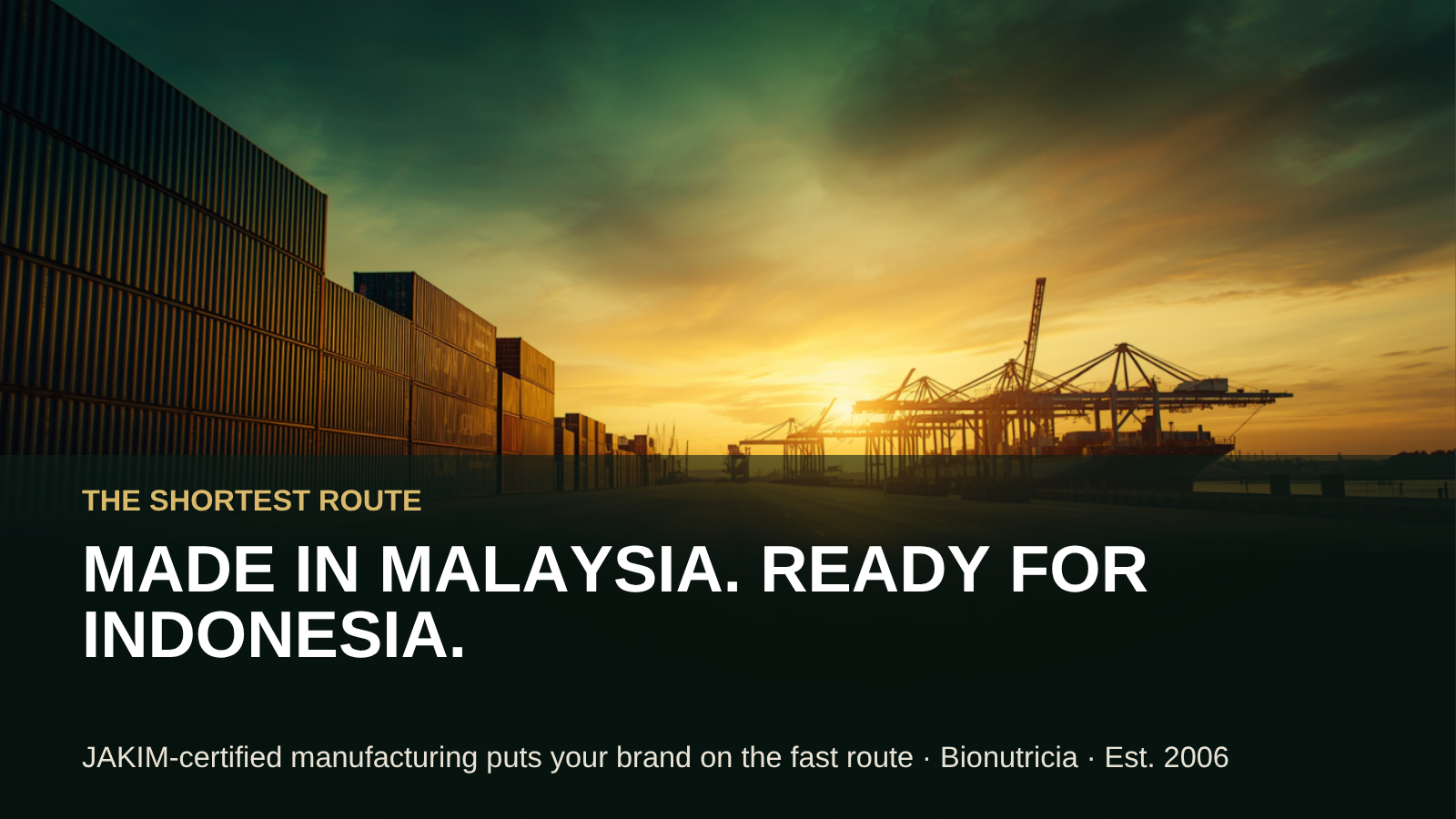
What Actually Becomes Mandatory on 17 October 2026
Indonesia’s halal law has been arriving in slow motion for a decade. Law No. 33/2014 — the Halal Product Assurance (JPH) Law — created a government agency, BPJPH, and converted halal certification from a voluntary religious endorsement into a statutory market-access requirement. Government Regulation No. 42/2024 then fixed the enforcement calendar. Since July 2025, BPJPH reports directly to the President of Indonesia — a signal of how seriously enforcement is now taken.
The 17 October 2026 milestone is the widest single expansion of the regime. From that date, the following must carry BPJPH halal certification or a clear, permanent non-halal label:
Health supplements and traditional medicines (the category most brand owners reading this sell), cosmetics and personal care, chemicals and household goods, Class A medical devices — and, critically for exporters, all imported food and beverage products, whose compliance extension the Indonesian government confirmed runs “no later than October 17, 2026” (USDA Foreign Agricultural Service, GAIN report ID2024-0039).
Two points brand owners routinely get wrong. First, uncertified products are not banned — but they must be labelled non-halal, which in a market where roughly 87% of 280 million consumers are Muslim is a commercial sentence, not a technicality. Second, the obligation attaches to the product on the shelf, which means your manufacturer’s certification status, ingredient documentation and facility practices decide whether your brand can comply at all.
The Three Routes Into Indonesia — and Which One You Are Actually On
BPJPH provides three pathways to a compliant product. Which one applies to you depends almost entirely on where and how your product is manufactured.
Route 1 — Mutual Recognition (MRA) registration. BPJPH recognises more than 90 foreign halal certification bodies across 30+ countries. If your product is manufactured under a certificate from a recognised body — Malaysia’s JAKIM is the flagship example — you do not need a new Indonesian certificate. You must, however, register the foreign certificate with BPJPH under Decree No. 221/2025, a process that takes up to 30 working days. This is the shortest, lowest-friction route.
Route 2 — Direct certification with BPJPH. If no recognised certificate covers your product, you apply through BPJPH’s SiHalal portal: document review, an on-site audit by an accredited halal inspection body (LPH), laboratory testing, a fatwa from the Indonesian Ulema Council (MUI), then certificate issuance. The official service standard is 21 working days — but that clock starts after audits and testing are scheduled and completed, and LPH capacity is the known bottleneck.
Route 3 — Certification via an Indonesian LPH. Manufacturers in countries without a recognised certification body can engage an Indonesian-accredited LPH directly to run the assessment, sometimes with remote document review. Workable, but the longest and least predictable path for a first-time applicant.
Recognised Is Not Registered: the JAKIM Detail That Catches Brands
Here is the trap in plain terms. Malaysia’s JAKIM halal certification is recognised by BPJPH under a mutual recognition arrangement — one of the strongest in the system. Many brand owners manufacturing in Malaysia therefore assume their products are automatically compliant in Indonesia. They are not, for two reasons:
1. The certificate must be registered. Under BPJPH Decree No. 221/2025 (September 2025), every foreign halal certificate relying on the MRA route must be individually registered with BPJPH before the product ships. Processing takes up to 30 working days — and BPJPH has warned that volumes are climbing as the deadline approaches. Counting backwards from 17 October 2026, the registration window is effectively now.
2. Recognition is category-specific. A certification body recognised for food may not be recognised for another category. Your manufacturer’s certificate has to cover the actual product category you sell — a detail that only surfaces when someone reads the certificate scope line by line. This is exactly the kind of documentation question a brand owner should be able to hand to their manufacturer and get a same-week answer on.
There is a further packaging consequence: from 17 October 2026 only the new BPJPH national halal logo is accepted on-pack — the familiar green MUI logo is being phased out. And since August 2025, certified businesses must also publish their halal status across their digital channels — websites, marketplaces, social media. Compliance is no longer only a factory matter; it reaches your artwork files and your product listings.
The Certification Crunch: Why Waiting Is the Expensive Option
The single most under-appreciated fact about this deadline is the state of the queue. Per USDA Foreign Agricultural Service and U.S. Commercial Service reporting, as of early 2025 only around 28.8% of food and beverage enterprises in Indonesia held a valid halal certificate, and up to a quarter of supermarket products remained non-compliant — against a historical system throughput of roughly 300,000 certificates a year. BPJPH has compressed its official processing time to 21 working days, but no service standard survives a multi-million-application backlog intact.
For a brand owner, the arithmetic is unforgiving. A full foreign certification commonly runs three to six months once document legalisation, audit scheduling and testing are counted. An MRA registration takes up to 30 working days on its own. Every week of delay pushes your application deeper into the pre-deadline surge — while competitors who filed early sell into a market that has just had a proportion of its shelf competition forced into non-halal labelling or withdrawal.
That is the commercial upside hiding inside a compliance story: 17 October 2026 is a shelf-space reset in the largest halal consumer market on Earth. Brands whose documentation is in order inherit the visibility that unprepared competitors vacate. The estimated stakes are not small — reporting around the deadline puts affected US exports alone at roughly US$2.5 billion, before counting European and East Asian brands in the same queue.
What Your Manufacturer Must Bring to the Table
Everything above converges on one practical conclusion: for a supplement brand, Indonesia-readiness is decided at the factory, before your brand name is ever printed. What a brand owner should expect their manufacturing partner to hand over, without chasing:
A JAKIM halal certificate whose scope covers your product category — the document BPJPH registration is built on. Complete ingredient and additive halal documentation, down to processing aids and carriers, because a finished-product certificate is only as strong as its ingredient supply file. A dedicated halal facility, not a halal line inside a mixed plant — segregation questions are audit questions. Change-control discipline, since BPJPH must be notified of composition and process changes, and an unreported reformulation can void a certificate. And a complete export documentation pack — certificate of origin, health certificate, free-sale certificate — the same file that clears customs in Jakarta, Riyadh or Dubai.
Bionutricia manufactures under JAKIM halal certification alongside FSSC 22000, GMP, HACCP, US FDA registration and MeSTI, with NanoVerify certification for its nanotechnology processes — from a dedicated halal facility in Sungai Buloh, Malaysia, shipping via Port Klang. Formats span powder, liquid and gel sachets, pouch beverages, chewable tablets and liquid bottles, built on the company’s own halal-certified botanical extract range — from standardised Tongkat Ali and mangosteen pericarp to functional beverage bases — so the ingredient supply file and the finished product carry the same halal chain of custody. Since 2006, 239+ brands have been built on that foundation.
Related Guides
Malaysia vs Vietnam vs Indonesia for Supplement OEM: Cost, Speed & Quality Trade-Offs
Is JAKIM Halal Certification Recognised in the GCC and UAE for Supplements?
Export Documentation for Supplements: CoO, Health Cert & Free-Sale
References
USDA Foreign Agricultural Service — GAIN Report ID2024-0039, “Indonesia Confirms Extension for Mandatory Halal Certification for Imported Food and Beverage Products” — https://www.fas.usda.gov/data/indonesia-indonesia-confirms-extension-mandatory-halal-certification-imported-food-and
Republic of Indonesia — Law No. 33/2014 on Halal Product Assurance; Government Regulation No. 42/2024 (implementation and phased enforcement) — https://bpjph.halal.go.id/
BPJPH — Decree No. 221/2025 on registration of foreign halal certificates (September 2025)
U.S. Commercial Service / Trade.gov — Indonesia halal certification market guidance (certification coverage data, early 2025)
HalalExpo — “Indonesia Halal Certification 2026: The Definitive Exporter Guide” (2026) — https://www.halalexpo.com/blog/indonesia-halal-certification-2026-definitive-exporter-guide
Frequently Asked Questions
Is halal certification mandatory for supplements sold in Indonesia?
Yes — from 17 October 2026, health supplements and traditional medicines sold in Indonesia, whether locally made or imported, must carry BPJPH halal certification or be clearly labelled non-halal, under Law No. 33/2014 and Government Regulation No. 42/2024.
My product is made under a JAKIM halal certificate. Do I need to re-certify for Indonesia?
No — JAKIM is recognised by BPJPH under a mutual recognition arrangement, so no new certificate is needed. But the JAKIM certificate must be registered with BPJPH (Decree No. 221/2025), which takes up to 30 working days, and its scope must cover your specific product category.
Are non-halal supplements banned from Indonesia after the deadline?
No. Indonesia confirmed at the WTO that non-halal products are not banned — they must instead carry a clearly visible, permanent non-halal label. Commercially, however, a non-halal label is a severe handicap in a market where roughly 87% of consumers are Muslim.
How long does BPJPH certification or registration take?
Registration of a recognised foreign certificate takes up to 30 working days. Direct certification carries an official 21-working-day service standard, but audits, laboratory testing and inspection-body scheduling sit outside that clock — full foreign certifications commonly take three to six months end to end.
What happens if a brand misses the 17 October 2026 deadline?
GR 42/2024 provides an escalating sanction ladder: written warnings, administrative fines (amounts pending ministerial regulation), certificate revocation and product withdrawal from the market. Separately, distributors and marketplaces are expected to delist non-compliant listings.
Does the old green MUI halal logo remain valid?
Only until 17 October 2026. After that date, packaging must carry the new BPJPH national halal logo, and certified businesses must also publish their halal status across their digital channels under BPJPH’s August 2025 mandate.
Bionutricia is a JAKIM halal-certified supplement OEM in Malaysia — FSSC 22000, GMP, HACCP, US FDA-registered and MeSTI-certified, with NanoVerify-certified nanotechnology — manufacturing powder, liquid and gel sachets, pouch beverages, chewable tablets and liquid bottles for 239+ brands since 2006. Talk to our team about an Indonesia-ready formulation and documentation pack.
RELATED POSTS
View all


Supplement OEM for Convenience Store & Modern Trade Impulse Wellness Brands
September 13, 2026 | by supersuper
Collagen & Beauty-from-Within OEM: Marine Collagen, Formats & Halal
July 5, 2026 | by supersuper
Men’s Health & Vitality Supplement OEM: Formats, Actives & Compliant Claims
August 23, 2026 | by supersuper