

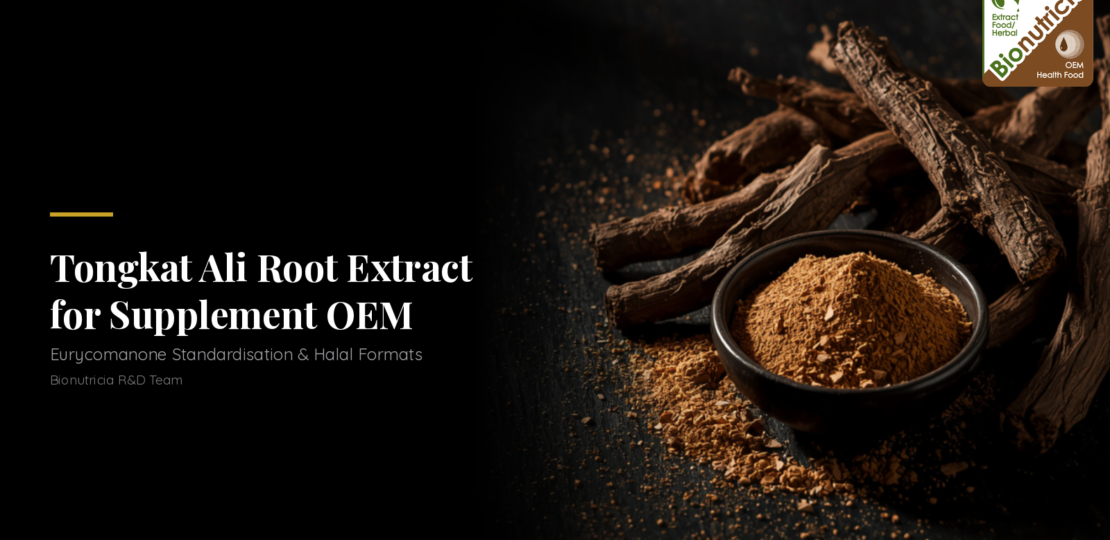
Tongkat Ali (Eurycoma longifolia) Extract OEM: Eurycomanone Standardisation & Halal Formats
August 2, 2026 | by supersuper
Direct answer: For an OEM Tongkat Ali (Eurycoma longifolia) supplement, specify a root extract standardised against Malaysian Standard MS 2409 for Tongkat Ali water extract — eurycomanone 0.8–1.5% by HPLC, alongside glycosaponins 40–65%, total polysaccharide 30–55% and total protein 22–45% — rather than accepting a bare “100:1” or “200:1” ratio claim on its own. Ratio only describes how much raw root went into the extract; it says nothing about how much bioactive compound survived the process. Two suppliers can both quote “200:1” and hand over powders with a several-fold difference in eurycomanone content. Ask for the HPLC eurycomanone assay on the specific batch you are buying, an identity test confirming the species is Eurycoma longifolia Jack (not the unrelated Polyalthia bullata sold as “Black Tongkat Ali”), and full microbial and heavy-metal panels — Tongkat Ali is a root crop, and root crops accumulate soil-borne heavy metals more readily than leaf or fruit botanicals. Bionutricia manufactures a 200:1 Tongkat Ali root extract using its patented enzymatic ultrasonic extraction process (MY-188945-A), supplied as a standardised powder for OEM formulation into powder sachets, liquid sachets, gel sachets, pouch beverages, chewable tablets and liquid bottles under JAKIM halal and MeSTI food certification.
Tongkat Ali vs “Black Tongkat Ali”: same trade name, different plants
“Tongkat Ali” is a Malay trade name, not a species name, and that gap causes real procurement mistakes. The botanical that carries the research history — and the one a CoA should confirm — is Eurycoma longifolia Jack, a small understorey tree in the Simaroubaceae family, native to Malaysia’s lowland rainforest. Regional and trade synonyms for the same species include Pasak Bumi (Indonesia) and Longjack (international trade name).
“Black Tongkat Ali” is a different plant entirely. The name is commonly applied to Polyalthia bullata, a species in the Annonaceae family with no botanical relationship to Eurycoma longifolia and none of the quassinoid/eurycomanone research base behind it. A buyer briefing an OEM on “Tongkat Ali” without specifying the Latin binomial risks receiving whichever root the supplier has on hand. Always write Eurycoma longifolia Jack into the purchase contract, and require the CoA to state the botanical identity test used to confirm it.
Why eurycomanone is the specification that matters
Eurycoma longifolia root contains several bioactive groups — quassinoids, glycosaponins, polysaccharides, alkaloids and protein/peptide fractions — but quassinoids are the class most associated with the root’s traditional use, and eurycomanone is the principal, most-studied quassinoid within that group. Published analytical work has developed HPLC methods specifically to detect and quantify eurycomanone across commercial Tongkat Ali products, precisely because ratio claims and generic “potency” language on packaging vary widely from what independent assay finds in the jar. Eurycomanone is therefore the marker compound serious buyers standardise to, in the same way anthocyanin content is the marker for roselle or curcuminoid content is the marker for turmeric.
Malaysia’s own national standards body has codified this: MS 2409, the Malaysian Standard covering Tongkat Ali (Eurycoma longifolia) water extract, specifies eurycomanone at 0.8–1.5% of the standardised extract, alongside glycosaponins (40–65%), total polysaccharide (30–55%) and total protein (22–45%). A CoA that references MS 2409 by name, with numbers inside these bands, is a materially stronger document than one that only states an extraction ratio.
Extraction ratio and method: what “200:1” and “ultrasonic” actually mean
An extraction ratio describes the input-to-output mass relationship — “200:1” means 200 kg of raw dried root reduced to 1 kg of finished extract. On its own, that number is a proxy for concentration, not a guarantee of bioactive content: drying loss, extraction solvent, temperature and process efficiency all affect how much eurycomanone actually ends up in the powder. This is why a ratio figure should always be paired with the HPLC eurycomanone assay on the CoA, never quoted alone as proof of strength.
Bionutricia’s Tongkat Ali extract powder is manufactured to a 200:1 root-to-extract ratio using the company’s patented enzymatic ultrasonic extraction process (MY-188945-A). Ultrasonic-assisted extraction uses acoustic cavitation to disrupt plant cell walls and improve mass transfer of bioactive compounds out of the root matrix, ahead of standardisation and spray-drying into a free-flowing powder. The same core process underpins Bionutricia’s other standardised botanical extracts, giving a consistent extraction methodology across a buyer’s wider formulation.
Standardisation specification: what to put in your contract
For any Tongkat Ali extract procurement, put all of the following into the CoA requirement:
Identity & authenticity
- Botanical name: Eurycoma longifolia Jack — not Polyalthia bullata (“Black Tongkat Ali”)
- Plant part: root (dried, standardised extract)
- Country of origin stated; cultivated or wild-collected status disclosed
Active marker assay (per Malaysian Standard MS 2409)
- Eurycomanone: 0.8–1.5% (HPLC) — set the exact floor to your positioning
- Glycosaponins: 40–65%
- Total polysaccharide: 30–55%
- Total protein: 22–45%
Physical parameters
- Appearance: free-flowing light-brown to tan powder
- Extraction ratio stated on CoA (e.g. 200:1) — always alongside the eurycomanone assay, never quoted alone
- Moisture: ≤5.0%
- Particle size: ≥90% passing 80 mesh
Microbiological limits (Malaysian Food Act 1983 + BP/USP convention)
- Total plate count: ≤10,000 CFU/g
- Yeast and mould: ≤1,000 CFU/g
- E. coli: absent/25g · Salmonella spp.: absent/25g · S. aureus: absent/25g
Heavy metals — root extracts warrant particular attention, since soil-grown roots accumulate heavy metals more readily than leaf or fruit botanicals
- Lead (Pb) ≤2.0 ppm · Cadmium (Cd) ≤1.0 ppm · Mercury (Hg) ≤0.1 ppm · Arsenic (As) ≤1.5 ppm
Raw-material treatment declaration
- Ask whether the incoming root lot was irradiated at origin as an export or microbial-control condition, and confirm what mycotoxin/aflatoxin screening applies to that specific lot. Treatment and screening status should be declared per batch rather than assumed — not every raw material undergoes the same testing, and a reputable OEM will confirm what is in place for the lot you are buying and arrange further testing on request.
Formats Bionutricia manufactures with Tongkat Ali extract
Bionutricia’s vertically integrated model — from root extraction to finished filling at the Sungai Buloh facility — means the same CoA chain covers the ingredient and the finished product, with no handoff gap between an extract supplier and a separate co-packer.
Powder sachet: Tongkat Ali extract blended with flavouring systems or functional co-actives for a single-serve instant drink or direct-consumption sachet. Ambient-stable.
Liquid sachet: single-serve liquid format for daily-vitality or men’s-wellness positioning, JAKIM halal certified at product level.
Gel sachet: gelled-suspension single-serve format for a premium easy-consumption positioning.
Pouch beverage: ready-to-drink pouch format for functional-beverage retail and convenience channels.
Chewable tablet: Tongkat Ali standardised extract pressed into a chewable format, packed in tablet sachets or bottled.
Liquid bottle: bottled liquid format for shot-style or tonic-style consumer products.
For brands wanting an enhanced-absorption tier, Tongkat Ali extract is also available via Herbosomal® — Bionutricia’s proprietary liposomal encapsulation and sustained-release technology (registered trademark; patent-pending PI2023005773) — pairing the standardised extract with a phospholipid carrier system for premium-format SKUs.
Why an MS 2409-referenced spec is a defensible position
Tongkat Ali is one of the most commercially exploited Malaysian botanicals internationally, and the category has attracted its share of undifferentiated “100:1” or “200:1” ratio claims with no assay to back them. A CoA that names MS 2409 — Malaysia’s own published standard for this specific extract — and reports numbers inside its eurycomanone, glycosaponin, polysaccharide and protein bands gives an export-bound SKU a documentation trail that a customs inspector, a retail compliance team or a Gulf importer can independently check against a public reference, rather than taking a single supplier’s ratio claim on faith.
Extracting and finishing under one JAKIM-certified, MeSTI-notified roof adds a second layer of defensibility: the halal chain and the CoA chain both run unbroken from raw root to export carton, which is exactly what an auditor or an importer’s compliance team checks first.
📚 Related guides
- Kacip Fatimah (Labisia pumila) Extract OEM: Standardisation & Benefits
- Bentong Ginger Extract for Functional Food & Beverage OEM
- Moringa Extract OEM: Standardisation for Supplement & Beverage Brands
Frequently asked questions
Is Tongkat Ali extract halal?
Eurycoma longifolia root extract is plant-derived with no haram inputs. Bionutricia’s Tongkat Ali extraction and finished-product manufacturing are both covered under JAKIM facility-level halal certification, so finished SKUs carry halal status through to export.
What’s the difference between Tongkat Ali and “Black Tongkat Ali”?
“Tongkat Ali” refers to Eurycoma longifolia Jack, the well-studied species with the quassinoid/eurycomanone research base. “Black Tongkat Ali” usually refers to Polyalthia bullata, a botanically unrelated species. Always specify the Latin binomial in a purchase contract to avoid receiving the wrong plant.
What eurycomanone percentage should I specify?
Reference Malaysian Standard MS 2409: eurycomanone 0.8–1.5% by HPLC is the codified range for a standardised Tongkat Ali water extract. Pair that number with the glycosaponin, polysaccharide and protein bands from the same standard, and always ask for the assay on your specific batch rather than a generic specification sheet.
Does a higher extraction ratio, such as 200:1 versus 100:1, mean a stronger extract?
Not by itself. Extraction ratio measures how much raw root went into the process, not how much bioactive compound survived it. Two extracts with the same stated ratio can carry very different eurycomanone content depending on extraction method and process control. Always request the ratio and the HPLC eurycomanone assay together, never the ratio alone.
What OEM formats can Tongkat Ali extract be manufactured in?
Bionutricia manufactures Tongkat Ali extract into powder sachets, liquid sachets, gel sachets, pouch beverages, chewable tablets and liquid bottles, with an enhanced-absorption Herbosomal® liposomal option available for premium-format SKUs.
Ready to develop a Tongkat Ali SKU?
Vertically integrated Tongkat Ali extraction and finished manufacturing under FSSC 22000, MeSTI and JAKIM halal certification. MS 2409-referenced eurycomanone standardisation, full CoA stack, and powder-sachet, liquid-sachet, gel-sachet, pouch-beverage, chewable-tablet and liquid-bottle formats.
Request a quotation · See our OEM services · View our certifications
WhatsApp: +60 16-661 8510
Article by Bionutricia R&D Team. Last updated: July 31, 2026.
RELATED POSTS
View all

Noni (Morinda citrifolia) Fruit Extract for Functional Food & Beverage OEM
August 25, 2026 | by supersuper
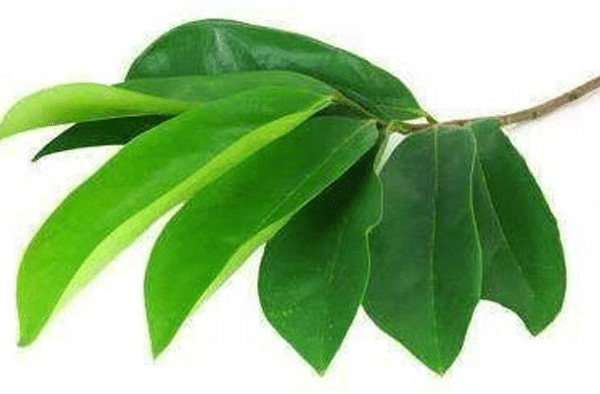
Knowledge: Soursop Leaf (Annona Muricata)
October 5, 2024 | by bionutriciaadmin
Knowledge: Kale (Brassica oleracea var. sabellica)
October 5, 2024 | by bionutriciaadmin