

Serai (Lemongrass) Extract for Beverage OEM: Citral & Phenolic Standardisation
August 13, 2026 | by supersuper
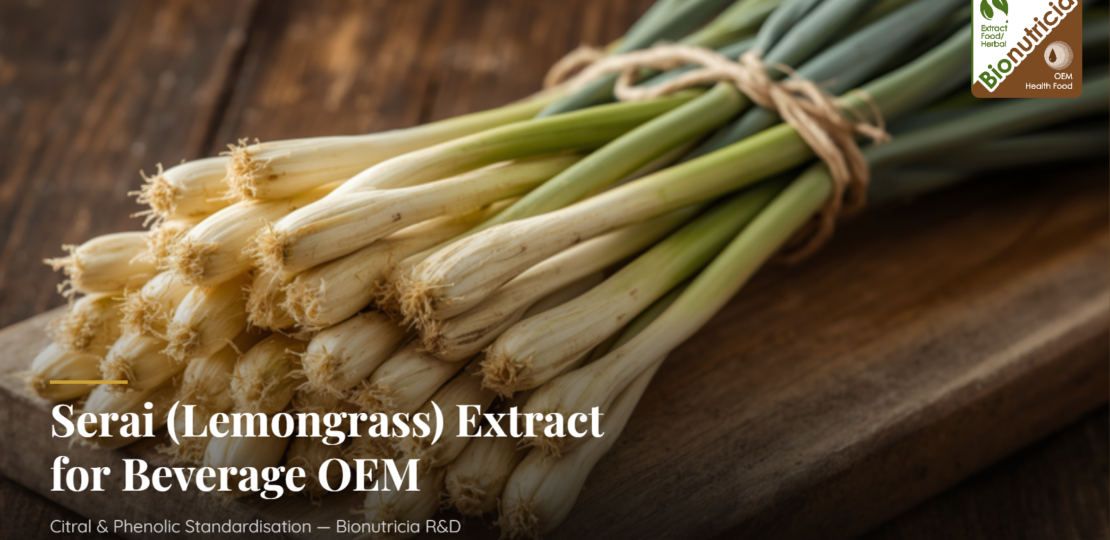
Direct answer: “Serai” and “lemongrass” refer to the same plant used across Malaysian, Thai and Vietnamese kitchens — Cymbopogon citratus (West Indian lemongrass), the species grown for food and beverage use, distinct from Cymbopogon flexuosus (East Indian lemongrass, mainly oil-distillation trade) and from ornamental Cymbopogon species not used for ingestion. For an OEM beverage extract, standardise to two markers together: total citral content (geranial + neral) ≥65% of the volatile/aroma fraction, measured by GC-FID and aligned with the ISO 3217 international benchmark of 65–85% carbonyl-as-citral, and total phenolic content ≥8.0 mg GAE/g (Folin-Ciocalteu) for the antioxidant-bearing non-volatile fraction. Citral drives the characteristic lemon-forward aroma and flavour that makes lemongrass a clean-label alternative to synthetic citrus flavouring; the phenolic fraction (rutin, isoquercetin, catechin, chlorogenic and gallic acids) carries the antioxidant capacity. Always confirm the CoA states plant part (leaf vs. stalk/bulb) and species (C. citratus, not a flexuosus or ornamental substitute), plus microbial limits, heavy metals and solvent residuals. Bionutricia offers contract extraction of lemongrass in standardised and phytosome form, plus finished SKUs — powder sachets, liquid sachets, pouch beverages and liquid bottles — under FSSC 22000 and JAKIM halal certification.
Serai in the kitchen vs. serai on a CoA
Lemongrass is one of the most familiar herbs in a Malaysian kitchen, but “serai” the cooking ingredient and “lemongrass extract” the OEM raw material are specified very differently.
Species first. The lemongrass used in Southeast Asian food and beverage products is Cymbopogon citratus (DC.) Stapf — sometimes called West Indian lemongrass. A related species, Cymbopogon flexuosus (East Indian lemongrass), is grown mainly for essential-oil distillation and has a different chemotype. A correct CoA states the botanical name explicitly; “lemongrass extract” alone is not a specification.
Plant part matters. In Malaysian cooking, the fleshy lower stalk (the “bulb,” the pale-white base of the stem) is bruised and used whole in curries, soups and rendang. For extraction, the aromatic oil glands are concentrated in both the stalk and the leaf blade, but leaf material generally gives a higher, more consistent essential-oil yield and is the more common feedstock for a standardised beverage extract. A supplier’s CoA should state which part was used — “leaf,” “stalk,” or a defined leaf/stalk blend — because the aroma profile and citral yield differ between them.
“Extract” is not the same product as “essential oil.” A steam-distilled lemongrass essential oil is a different commercial item from a standardised botanical extract intended for a beverage sachet or bottle. Bionutricia’s lemongrass work is extract-led — a standardised aqueous or hydro-ethanolic extract carrying both the citral-bearing aroma fraction and the phenolic fraction — formulated directly into finished beverage formats rather than sold as a neat essential oil.
Why citral is the specification that matters
Two suppliers can both offer “lemongrass extract” and hand over materials with very different aroma strength and flavour carry-through in a finished drink. The variable that separates a true standardised extract from an inconsistent commodity botanical is citral content.
Flavour and aroma. Citral — the combined total of the isomers geranial and neral — is the principal aroma compound responsible for lemongrass’s bright, lemon-forward character. It is what allows a functional beverage brand to use a clean-label botanical instead of a synthetic citrus flavour system. The international benchmark for lemongrass oil (ISO 3217) sets carbonyl-compounds-as-citral at a minimum of 75%, with 65–85% the accepted commercial range; for an extract intended to carry that aroma into a beverage matrix, a floor of ≥65% citral in the volatile fraction is a defensible commercial specification, verified by GC-FID.
Antioxidant and polyphenol profile. Beyond the volatile aroma fraction, lemongrass leaf carries a measurable phenolic and flavonoid load — chlorogenic and gallic acids, rutin, isoquercetin and catechin among them — that contributes to the extract’s antioxidant capacity (commonly assessed by DPPH or FRAP). For OEM labelling, keep claims to permitted structure/function and antioxidant language rather than any therapeutic or disease-related statement, and confirm exact wording against your destination market’s claims rules.
The assay to request. Ask for total citral (geranial + neral) by GC-FID, supported by a chromatographic fingerprint confirming the two isomer peaks, alongside total phenolic content by the Folin-Ciocalteu method. A supplier who can only offer a generic “lemongrass flavour note” but no citral assay is selling a flavouring, not a standardised botanical extract.
Extract forms and what each suits
Spray-dried powder (most common for OEM)
Carrier: maltodextrin or tapioca starch (halal, non-GMO options available). Because citral is heat- and light-sensitive, spray-drying is run under controlled inlet temperature and the aroma fraction is typically stabilised or partially encapsulated to protect flavour carry-through. Moisture: ≤5%. Shelf life: 18–24 months ambient in moisture- and light-controlled packaging. Applications: instant beverage sachets, powder-sachet teas, premix blends, chewable tablet bases.
Liquid concentrate
Retains a higher proportion of the volatile citral fraction than spray-dried powder because there is no drying/heat step. Shelf life: 6–12 months refrigerated, shorter ambient without a stabilising acid/preservative system. Applications: liquid-sachet beverages, RTD pouch beverages, liquid bottles, wellness shots — anywhere the fresh, sharp lemongrass top-note is the selling point.
Flavour-forward vs. polyphenol-forward grade
When the brief is aroma/flavour, standardise primarily to citral content. When the brief is an antioxidant or “functional” positioning, standardise primarily to total phenolic content and treat citral as a secondary aroma marker. Specify which lens matters most for your SKU — lemongrass can deliver both, but the extraction and stabilisation process differs depending on which fraction is the priority.
Standardisation specification: what to put in your contract
For any lemongrass/serai extract procurement, include all of the following in the CoA requirement:
| Category | Specification |
|---|---|
| Botanical identity | Cymbopogon citratus (DC.) Stapf; plant part stated (leaf / stalk / defined blend) |
| Origin | Country of origin stated; cultivated, traceable supply |
| Citral (geranial + neral) | ≥65% of volatile/aroma fraction (GC-FID), ISO 3217-aligned benchmark 65–85% |
| Aroma fingerprint | GC fingerprint confirming geranial and neral isomer peaks |
| Total phenolic content | ≥8.0 mg GAE/g (Folin-Ciocalteu) |
| Appearance | Free-flowing pale-yellow to tan powder (spray-dried) or clear pale-amber liquid (concentrate) |
| Moisture | ≤5.0% (powder) |
| Particle size | ≥90% passing 80 mesh (powder) |
| Total plate count | ≤10,000 CFU/g |
| Yeast and mould | ≤1,000 CFU/g |
| Pathogens | E. coli, Salmonella spp., S. aureus: absent/25g |
| Heavy metals | Pb ≤2.0 ppm · Cd ≤1.0 ppm · Hg ≤0.1 ppm · As ≤1.5 ppm |
| Solvent residuals | Water extraction: not applicable · Ethanol extraction: ≤5,000 ppm residual ethanol |
Functional formats Bionutricia manufactures with lemongrass
Bionutricia’s vertically integrated model — from leaf extraction to finished filling at the Sungai Buloh facility — means the team that standardises your lemongrass extract also fills your finished SKU, removing the CoA handoff risk between a flavour-house extract supplier and a separate co-packer.
Powder sachet (10–20g): lemongrass blended with pandan, ginger, calamansi or electrolyte systems for an instant citrus-forward drink. Ambient-stable, 18–24 month shelf life.
Liquid sachet (30–50ml): single-serve RTD format where fresh lemongrass top-notes carry through best. JAKIM halal certified at product level.
Pouch beverage (200–500ml): larger-volume RTD for café, gym and convenience-retail channels; lemongrass layered with pandan, roselle or butterfly-pea for a distinctly Malaysian flavour profile.
Liquid bottle (100–250ml): glass or PET wellness shots and iced-tea style bottles where the citrus-herbal profile is the primary flavour driver.
Lemongrass pairs naturally with pandan and ginger in a Malaysian-inspired beverage system — all three can be extracted, blended and filled under one roof.
Why Malaysian-origin lemongrass is a defensible spec
Cymbopogon citratus is cultivated across the tropics — India, Sri Lanka, Guatemala, Thailand and Malaysia are all established sources. Specifying Malaysian-origin, cultivated, traceable lemongrass gives an export-bound SKU two advantages. First, traceability: Malaysian agricultural suppliers maintain plantation, harvest and post-harvest handling records that satisfy the full traceability requirement of FSSC 22000 and JAKIM halal certification — documentation that loosely-aggregated smallholder supply chains often cannot provide consistently. Second, integrated processing: extracting and finishing in the same JAKIM-certified facility keeps the halal chain unbroken from leaf to finished export carton, which is exactly what a customs inspector or an importer’s compliance team audits.
Related guides
- Pandan Leaf Extract in Functional Beverages: From Raw Material to Finished SKU
- Butterfly Pea Flower Extract for Functional Beverages: Colour & Spec
- Bentong Ginger Extract for Functional Food & Beverage OEM
Frequently asked questions
Is lemongrass extract the same as lemongrass essential oil?
No. Essential oil is a neat, steam-distilled volatile product typically sold into fragrance/aromatherapy trade. A standardised beverage extract is formulated to carry both the citral aroma fraction and the phenolic fraction into a food or beverage matrix, and is the material Bionutricia works with for OEM sachets, pouches and bottles.
What citral content should I specify for a lemongrass extract?
A floor of ≥65% citral (geranial + neral) in the volatile fraction, verified by GC-FID, is a sound commercial specification aligned with the ISO 3217 international benchmark of 65–85% for lemongrass oil. Raise the floor for a more concentrated citrus top-note; pair it with a total phenolic content assay if antioxidant positioning also matters to your SKU.
Which part of the lemongrass plant is used for extraction — stalk or leaf?
Both can be used, but leaf material generally gives a higher, more consistent essential-oil and citral yield than the stalk (the part used whole in cooking). Always confirm on the CoA which plant part — leaf, stalk, or a defined blend — the extract was made from, since it affects both yield and aroma profile.
Does lemongrass extract replace synthetic lemon/citrus flavour in a beverage?
Often, yes — citral gives lemongrass its bright citrus character, supporting clean-label reformulation away from synthetic flavour systems. Citral is heat- and light-sensitive, so final flavour intensity depends on your process (spray-drying temperature, pasteurisation) and packaging. Bionutricia’s R&D team confirms achievable flavour carry-through against your formulation during consultation.
Is lemongrass extract halal-certified, and does Bionutricia extract it in-house?
Yes to both. Lemongrass is a plant-derived botanical with no haram inputs, and Bionutricia’s lemongrass extraction and finished-beverage manufacturing are covered under JAKIM facility-level halal certification. Extraction is done in-house at the Sungai Buloh facility, then the same team spray-dries, blends and fills the finished SKU — so a single CoA chain covers the ingredient and the finished product.
Ready to develop a lemongrass (serai) beverage SKU?
Vertically integrated lemongrass extraction and finished manufacturing under FSSC 22000 and JAKIM halal. Standardised citral and phenolic spec, full CoA stack, and powder-sachet, liquid-sachet, pouch-beverage and liquid-bottle formats. Free formulation consultation and 24-hour RFQ reply.
Request a quotation · See our OEM services · View our certifications
WhatsApp: +60 16-661 8510
Article by Bionutricia R&D Team. Last updated: August 8, 2026.
Explore our OEM formats: supplement sachet OEM manufacturer in Malaysia · chewable tablet supplement OEM manufacturer in Malaysia
RELATED POSTS
View all

How to Choose a Halal Botanical Extract & Nutraceutical OEM Supplier in Malaysia
June 24, 2026 | by supersuper