

Torch Ginger (Bunga Kantan / Etlingera elatior) Extract for Functional Food & Beverage OEM
August 13, 2026 | by supersuper
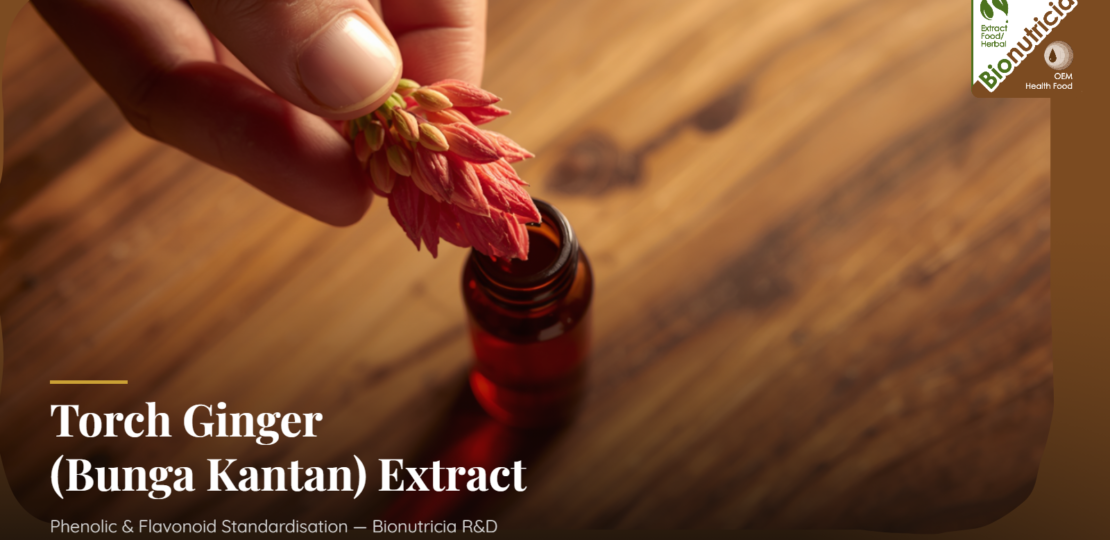
Direct answer: Torch ginger — known in Malaysia as bunga kantan (and as kecombrang or honje in Indonesia) — is the flower bud of Etlingera elatior, a heritage Southeast Asian botanical used almost entirely as a culinary herb and flavour/colour ingredient rather than a therapeutic remedy. For OEM standardisation, the marker to specify is total phenolic content (TPC, Folin–Ciocalteu method, expressed as mg gallic acid equivalents/g) paired with total flavonoid content (TFC, mg quercetin equivalents/g), confirmed by an HPLC fingerprint for the characteristic flavonoid markers quercetin and kaempferol. Published phytochemical studies on aqueous flower extracts report TPC in the range of roughly 4.5–6.2 mg GAE/g and TFC in the range of 0.6–3.5 mg GAE/g depending on extraction solvent and drying method — treat these as a research-literature reference range, not a fixed number, and set your commercial floor against your own positioning and reference batches. Always confirm the plant part on the CoA is flower bud (inflorescence), not stem or leaf, and confirm the cultivar — the pink/rose-coloured bud is the one used in Malay and Nyonya cooking, while a deep-red ornamental-leaning variety exists and should not be substituted without checking. Bionutricia offers contract extraction of bunga kantan in standardised form, spray-dried into powder or concentrated as a liquid, then filled into finished SKUs — powder sachets, liquid sachets, pouch beverages and liquid bottles — under FSSC 22000 and JAKIM halal certification.
What torch ginger (bunga kantan) actually is
Torch ginger is a large perennial plant in the ginger family (Zingiberaceae), native to Indonesia, Malaysia and Thailand, grown for its tall, torch-shaped flower bud rather than its rhizome — which is the opposite of how most people think about “ginger” ingredients. The part used in food and extraction is the unopened or just-opening inflorescence (flower bud), harvested while still tightly closed for the best texture and flavour intensity. In Malay and Peranakan cooking it appears sliced into asam laksa, nasi kerabu and kerabu bunga kantan; in Indonesia, where it is called kecombrang or honje, it features in more than 80 traditional dishes.
Two things matter for a buyer briefing an extractor. First, the cultivar: torch ginger buds range from a bright pink/rose shade — the one conventionally used in Southeast Asian cuisine and the one Bionutricia standardises — through to deeper red forms grown mainly for ornamental cut-flower use. A CoA should confirm the cultivar and confirm the material is food-grade, not an ornamental-nursery by-product. Second, the plant part: request “flower bud (inflorescence), dried or fresh-frozen” on the CoA, not “whole plant” or “stem,” since the phenolic and flavonoid content documented in the literature is specific to the flower bud.
Why standardise to phenolic and flavonoid content
Torch ginger’s commercial value in a supplement or functional-beverage matrix sits in two places: its distinctive citrus-floral flavour, and its antioxidant phenolic/flavonoid profile. Published phytochemical work on Etlingera elatior flower extracts identifies phenolic acids (gallic acid, caffeic acid, tannic acid, chlorogenic acid) and flavonoids (quercetin, apigenin, kaempferol, luteolin, myricetin) as the dominant bioactive classes, with total phenolic and total flavonoid content correlating with antioxidant assay results (DPPH, FRAP). These are the same marker classes used across Bionutricia’s other heritage-botanical standardisations — the same logic that anchors a roselle CoA to anthocyanin content or a Bentong ginger CoA to gingerol content.
For labelling and positioning, keep claims to permitted structure/function and antioxidant/flavour language — “antioxidant food ingredient,” “natural flavour and colour component,” “polyphenol-rich botanical.” Traditional folk use of torch ginger for specific health conditions exists in the literature, but that framing sits outside a food-classified OEM ingredient’s claims lane; a defensible bunga kantan SKU is built and marketed as a flavour-forward, antioxidant-positioned botanical, not a condition-treatment product.
Extract forms and what each suits
Spray-dried powder (most common for OEM)
Carrier: maltodextrin or tapioca starch (halal, non-GMO options available). Moisture: ≤5%. Shelf life: 18–24 months ambient in moisture-controlled packaging. Applications: powder-sachet functional drinks, instant seasoning/marinade premixes, chewable-tablet flavour systems. Spray-drying is the most supply-chain-stable form for export, though the citrus-floral top notes are the most volatile-sensitive element and benefit from encapsulation or flavour-fixative technique during drying.
Liquid concentrate
Better retention of the volatile flavour fraction than spray-dried powder, since there is no high-heat drying step. Brix: formulation-dependent on concentration ratio. Shelf life: 6–12 months refrigerated, shorter ambient unless paired with an acid/preservative system. Applications: liquid-sachet beverages, RTD pouch beverages, liquid bottles, wellness tonics with a citrus-floral flavour profile.
Flavour/colour-application grade
When the brief is flavour and light pink-blush colour rather than a phenolic-content claim, torch ginger can be standardised primarily to sensory/flavour-intensity specification and a lighter phenolic floor. Specify clearly whether the brief needs a flavour-active extract, an antioxidant-positioned extract, or both — torch ginger is unusual among Bionutricia’s heritage botanicals in that its flavour value is often the primary commercial driver, with the antioxidant profile as a secondary claim.
Standardisation specification: what to put in your contract
For any bunga kantan / torch ginger extract procurement, include all of the following in the CoA requirement:
Identity & authenticity
- Botanical name: Etlingera elatior (Jack) R.M.Sm.
- Common names on file: torch ginger, bunga kantan, kecombrang, honje
- Plant part: flower bud (inflorescence) — dried or fresh-frozen, not stem or leaf
- Cultivar/colour confirmed: pink/rose culinary type (not the deep-red ornamental-leaning form)
- Country of origin stated; cultivated, traceable supply
Active marker assay
- Total phenolic content (Folin–Ciocalteu): reference range 4.5–6.2 mg GAE/g on dry-weight basis — set the exact floor to your antioxidant-positioning needs
- Total flavonoid content: reference range 0.6–3.5 mg GAE/g dry-weight basis
- HPLC fingerprint confirming presence of quercetin and kaempferol as identity markers
- Sensory/flavour-intensity panel score where flavour, not phenolic content, is the primary commercial driver
Physical parameters
- Appearance: free-flowing pale pink to tan powder (spray-dried) or pink-tinged clear liquid (concentrate)
- Moisture: ≤5.0% (powder)
- Particle size: ≥90% passing 80 mesh (powder)
Microbiological limits (Malaysian Food Act 1983 + BP/USP convention)
- Total plate count: ≤10,000 CFU/g
- Yeast and mould: ≤1,000 CFU/g
- E. coli: absent/25g · Salmonella spp.: absent/25g · S. aureus: absent/25g
Heavy metals (botanical extract standard)
- Lead (Pb) ≤2.0 ppm · Cadmium (Cd) ≤1.0 ppm · Mercury (Hg) ≤0.1 ppm · Arsenic (As) ≤1.5 ppm
Solvent residuals
- Water/aqueous extraction: not applicable · Ethanol extraction: ≤5,000 ppm residual ethanol
Functional formats Bionutricia manufactures with torch ginger
Bionutricia’s vertically integrated model — from flower-bud extraction to finished filling at the Sungai Buloh facility — means the team that standardises your bunga kantan extract also fills your finished SKU, closing the CoA handoff gap between a raw-extract supplier and a separate co-packer.
Powder sachet (10–20g): instant citrus-floral functional drink, seasoning premix or chewable-tablet flavour base. Ambient-stable, 18–24 month shelf life.
Liquid sachet (30–50ml): single-serve RTD flavour shot for a botanical-forward functional beverage line.
Pouch beverage (200–500ml): larger-volume RTD for café, gym and convenience-retail channels — torch ginger works well layered with roselle, calamansi or butterfly pea for a Southeast Asian heritage-flavour range.
Liquid bottle (100–250ml): glass or PET wellness tonics where the citrus-floral flavour and light antioxidant positioning are the selling point.
Why Malaysian-origin bunga kantan is a defensible spec
Torch ginger grows across Indonesia, Malaysia and Thailand, but the culinary cultivar most closely associated with Malay and Peranakan cuisine is grown and harvested locally. Specifying Malaysian-cultivated, traceable bunga kantan gives an export-bound SKU two advantages. First, traceability: Malaysian agricultural suppliers maintain plantation, harvest and treatment records that satisfy the full traceability requirement of FSSC 22000 and JAKIM halal certification. Second, integrated processing: extracting and finishing in the same JAKIM-certified facility keeps the halal chain unbroken from flower bud to finished export carton — and lets a brand tell a genuine heritage-ingredient story rather than an anonymous “natural flavour” declaration.
Related guides
- Butterfly Pea Flower Extract for Functional Beverages: Colour & Spec
- Roselle (Hibiscus) Extract: Standardised Anthocyanin Content for Supplement & Beverage OEM
- Bentong Ginger Extract for Functional Food & Beverage OEM
Frequently asked questions
What should a torch ginger (bunga kantan) extract be standardised to for OEM use?
Standardise to total phenolic content (Folin–Ciocalteu, mg GAE/g) and total flavonoid content (mg GAE/g), confirmed by an HPLC fingerprint for quercetin and kaempferol as identity markers. Published literature reports a reference range of roughly 4.5–6.2 mg GAE/g TPC and 0.6–3.5 mg GAE/g TFC for flower-bud extracts; set your commercial floor against your own positioning and reference batches rather than treating those numbers as fixed.
Is torch ginger the same as regular ginger?
No. Torch ginger (Etlingera elatior) is a different genus and species from culinary ginger (Zingiber officinale). The parts used are also different — torch ginger extract is made from the flower bud, while culinary ginger extract is made from the rhizome. They share the Zingiberaceae family but are not interchangeable ingredients.
Which part of the torch ginger plant is used for extraction?
The unopened or just-opening flower bud (inflorescence), not the stem, leaf or rhizome. A correct CoA states “plant part: flower bud (inflorescence).”
What formats can torch ginger extract go into?
Powder sachets, liquid sachets, pouch beverages and liquid bottles are Bionutricia’s approved OEM formats for a torch ginger SKU, chosen based on whether the flavour or the antioxidant/phenolic claim is the primary driver.
Is torch ginger extract halal-certified?
Torch ginger is a plant-derived botanical with no haram inputs. Bionutricia’s extraction and finished-beverage manufacturing are both covered under JAKIM facility-level halal certification, so finished SKUs carry halal status through to export.
Ready to develop a torch ginger / bunga kantan SKU?
Vertically integrated bunga kantan extraction and finished manufacturing under FSSC 22000 and JAKIM halal. Standardised phenolic/flavonoid spec, full CoA stack, and powder-sachet, liquid-sachet, pouch-beverage and liquid-bottle formats. Free formulation consultation.
Request a quotation · See our OEM services · View our certifications
WhatsApp: +60 16-661 8510
Article by Bionutricia R&D Team — in-house registered pharmacist, nutritionist, dietitian, and PhD biomedical scientist. Last updated: August 6, 2026.
RELATED POSTS
View all

Knowledge: Gotu Kola Pegaga (Centella asiatica)
October 5, 2024 | by bionutriciaadmin
Knowledge: Papaya Leaf (Carica papaya)
October 5, 2024 | by bionutriciaadmin