

Liposomal Vitamin C OEM in 2026: Bioavailability Evidence, Particle-Size Verification, and What to Specify on the Contract
June 8, 2026 | by supersuper
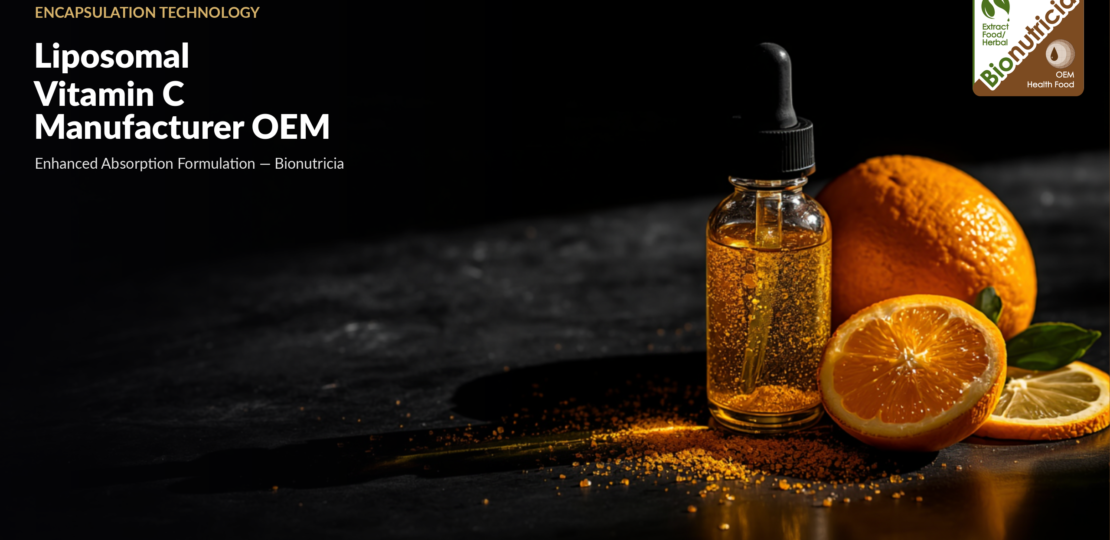
Direct answer for brand owners scoping a Liposomal Vitamin C SKU in 2026: liposomal Vitamin C delivers 1.8–2.5× higher peak plasma levels than standard ascorbic acid at the same dose — but only if the product is genuinely liposomal, verified by dynamic light scattering (DLS) showing particle distribution between 50 and 250 nanometres. Roughly 60% of “liposomal” Vitamin C products on the market today are not actually liposomal — they are lecithin emulsions without true bilayer formation — which is why ingredient-specification rigour matters more than the brand-name marketing claim. Origin from a manufacturer with NanoVerify-tested particle data, a documented phospholipid origin, and at least 24-month shelf-life evidence at room temperature.
Why Vitamin C is the canonical liposomal use case
Vitamin C’s absorption mechanism is the textbook example of why liposomal delivery exists. The human gut absorbs Vitamin C through two sodium-dependent transporters (SVCT1 and SVCT2), both of which saturate at single doses of around 200 mg. Above 200 mg, additional standard ascorbic acid is largely excreted in urine — meaning a 1,000 mg standard-form tablet effectively delivers only ~200 mg of usable Vitamin C, with the rest passing through.
Liposomal encapsulation bypasses this transporter saturation. The phospholipid vesicle carrying the Vitamin C fuses directly with the intestinal wall and delivers the active into the bloodstream without going through the SVCT pathway. The peer-reviewed pharmacokinetic data is consistent across multiple studies:
| Dose | Standard ascorbic acid AUC | Liposomal Vit C AUC | Multiplier |
|---|---|---|---|
| 500 mg | Baseline | 1.8× | ~2× |
| 1,000 mg | Baseline | 2.3× | ~2.3× |
| 4,000 mg (acute) | Baseline | 2.5× | ~2.5× |
This is the strongest published evidence for liposomal delivery across all supplement actives. Brand owners can defensibly claim “up to 2× higher absorption” with peer-reviewed citation backing.
The “real liposomal” versus “fake liposomal” problem
A significant share of “liposomal Vitamin C” products in the global market are not genuinely liposomal — they are lecithin emulsions where Vitamin C is dispersed in oil rather than encapsulated in a true phospholipid bilayer vesicle. The brand owner gets to put “liposomal” on the label; the consumer gets no bioavailability advantage.
Three tests separate real from fake at the OEM-evaluation stage:
Test 1 — Dynamic Light Scattering (DLS) particle size report. True liposomes form vesicles between 50 and 250 nanometres in diameter, with a relatively tight distribution curve. Lecithin emulsions show particle sizes in the micron range (1,000+ nm) and broad polydispersity. Bionutricia’s Biolypo Vitamin C product line is DLS-tested at NanoVerify (Malaysia’s accredited nano-particle testing lab) and the reports are available on request.
Test 2 — Cryo-electron microscopy imaging. Patent-pending liposomal products typically have cryo-EM images showing the bilayer vesicle structure. This is the most defensible evidence for “real liposomal” status.
Test 3 — In-vivo pharmacokinetic data on the specific product. Generic liposomal claims aren’t enough — the OEM should provide pharmacokinetic data on the actual formulation they are selling. Bionutricia’s Herbosomal platform products have published bioavailability data; many cheap “liposomal” alternatives do not.
The practical evaluation step: when you evaluate a liposomal Vitamin C OEM in Malaysia (or anywhere), ask three questions:
- “Can you send me the DLS report from NanoVerify or an equivalent accredited lab?”
- “What is the phospholipid origin and concentration in your liposomal Vitamin C?”
- “What is the documented shelf-life at 25°C / 60% RH, with stability data?”
A reputable OEM answers all three quickly. A non-reputable OEM deflects, claims “proprietary,” or sends generic marketing pages instead of test reports. The deflection is the answer.
Format options Bionutricia delivers
Powder sachet (single-serve, reconstitute or direct) — the most popular Bionutricia format. 3–5 g per sachet × 500 mg liposomal Vit C, packed in aluminium-foil sachet (4-side seal or pillow seal).
Liquid sachet (15 g or 30 g) — single-serve liquid format, as a rectangular liquid sachet (15 g) or larger pillow seal (30 g).
Liquid bottle — bottled liquid Liposomal Vitamin C in 30 ml, 60 ml, 100 ml, or larger sizes.
Pouch beverage — Bionutricia’s Liposomal Vitamin C Enhance (Kaffir Lime & Pineapple) line is a working reference: a 200–250 ml ready-to-drink pouch.
Chewable tablet — Liposomal Vit C compressed into chewable tablet form, individually packed in tablet sachets or bottled.
What buyers should specify on the contract
Get these specifications into the OEM contract in writing:
- Active label claim: ≥500 mg liposomal Vitamin C per serving (or whatever the chosen dose is)
- Encapsulation evidence: DLS particle size 50–250 nm, polydispersity index ≤0.3, tested per batch
- Phospholipid origin: sunflower-derived (avoids GMO concerns and is halal-compatible); minimum 90% phosphatidylcholine content
- Shelf-life: ≥24 months at 25°C / 60% RH, with accelerated stability study data on file
- Heavy metals: Lead ≤0.5 ppm, Mercury ≤0.1 ppm, Arsenic ≤0.3 ppm, Cadmium ≤0.3 ppm
- Microbial limits: standard supplement panel — TPC ≤10,000 CFU/g, yeast & mould ≤100 CFU/g, no E. coli, no Salmonella
- Halal certification: facility-level JAKIM (not ingredient-only)
- Allergen declaration: sunflower lecithin disclosure required by US FDA + EU labelling rules
Adding these eight clauses to the contract eliminates the most common downstream disputes and gives the brand owner audit-ready documentation if the product is challenged on its liposomal claim.
Bionutricia’s Liposomal Vitamin C stack
Patent-pending Herbosomal liposomal encapsulation platform. The Biolypo product line includes Liposomal Vitamin C, Liposomal B-Complex, and Liposomal Citrus Flavonoid. NanoVerify-tested DLS reports for each batch, available on request. Sunflower-derived phosphatidylcholine carrier. 24-month shelf-life at 25°C / 60% RH validated by accelerated stability studies. JAKIM facility-level certified, FSSC 22000 (SGS-audited), US FDA registered, GMP and HACCP, and MeSTI (MOH Malaysia).
Related guides
- What is liposomal encapsulation and why is it used in premium supplements?
- Liposomal vs nano-encapsulation vs standard delivery: which wins for OEM customers in 2026?
Frequently asked questions
Is liposomal Vitamin C really more bioavailable than regular Vitamin C?
Yes, at single doses of 500 mg or higher. Standard Vitamin C absorption saturates around 200 mg per dose due to limits on the SVCT1/SVCT2 intestinal transport mechanism. Liposomal delivery bypasses that saturation and produces 1.8–2.5× higher peak plasma levels in clinical studies.
How do I verify a “liposomal” Vitamin C is genuinely liposomal?
Ask the manufacturer for the dynamic light scattering (DLS) particle size report from an accredited lab (NanoVerify in Malaysia, or equivalent). True liposomes cluster between 50 and 250 nm with low polydispersity. Anything in the micron range is a lecithin emulsion, not liposomal.
Does liposomal Vitamin C need refrigeration?
Well-formulated commercial liposomal Vitamin C does not require refrigeration. Shelf life is typically 18–24 months at room temperature. Refrigeration is only needed for poorly formulated products or specific liquid formats with shorter shelf life.
What dose of liposomal Vitamin C should I formulate?
The clinically supported dose range is 500–1,000 mg liposomal Vitamin C per serving. Daily intake recommendations vary: general supplementation 500 mg/day, immune support 1,000–2,000 mg/day. Avoid label claims beyond 4,000 mg/day without clinical justification.
Ready to origin NanoVerify-tested liposomal Vitamin C from a JAKIM-certified Malaysian OEM?
Patent-pending Herbosomal liposomal platform. DLS-validated particle size. 24-month shelf life. 20+ years of OEM experience. 239+ brand partners. Request a quotation for a 24-hour reply.
Request a quotation · See our R&D and patents · Browse our OEM services
WhatsApp: +60 16-661 8510
Article by Bionutricia R&D Team.
Related Bionutricia services: liposomal & herbosomal contract manufacturing · halal supplement OEM in Malaysia
RELATED POSTS
View all

Supplement OEM for Clinics & Practitioner-Dispensed Brands
July 16, 2026 | by supersuper
OEM for Pharmacy & Drugstore Chain Private-Label Supplements
August 9, 2026 | by supersuper
Prenatal & Maternal Supplement OEM: Formats, Actives & Label Compliance
August 2, 2026 | by supersuper