

The Other 90% of Your Powder: Why Carrier Origin Decides Your Halal, Allergen and Vegan Claim
July 29, 2026 | by supersuper
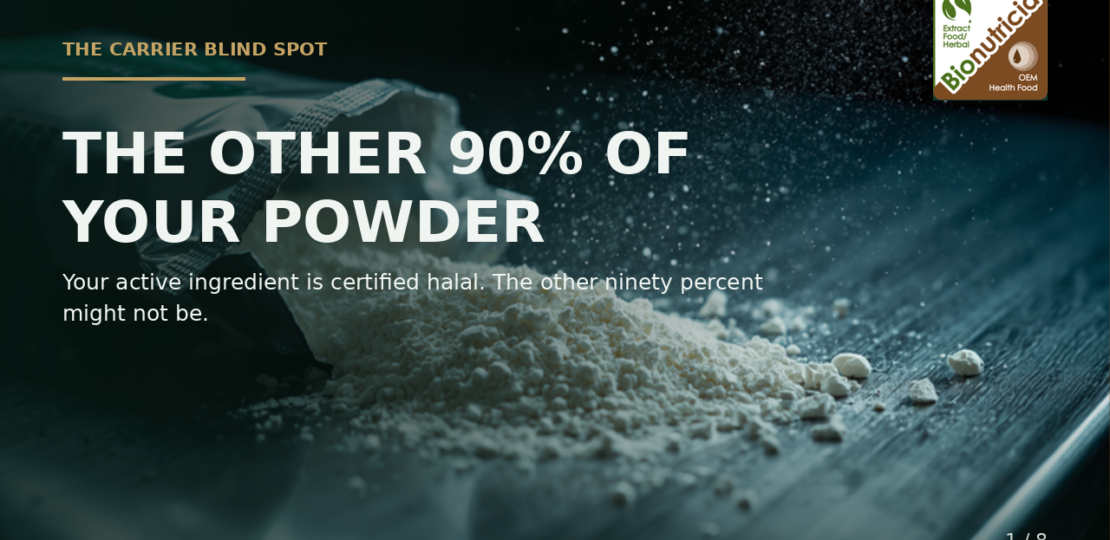
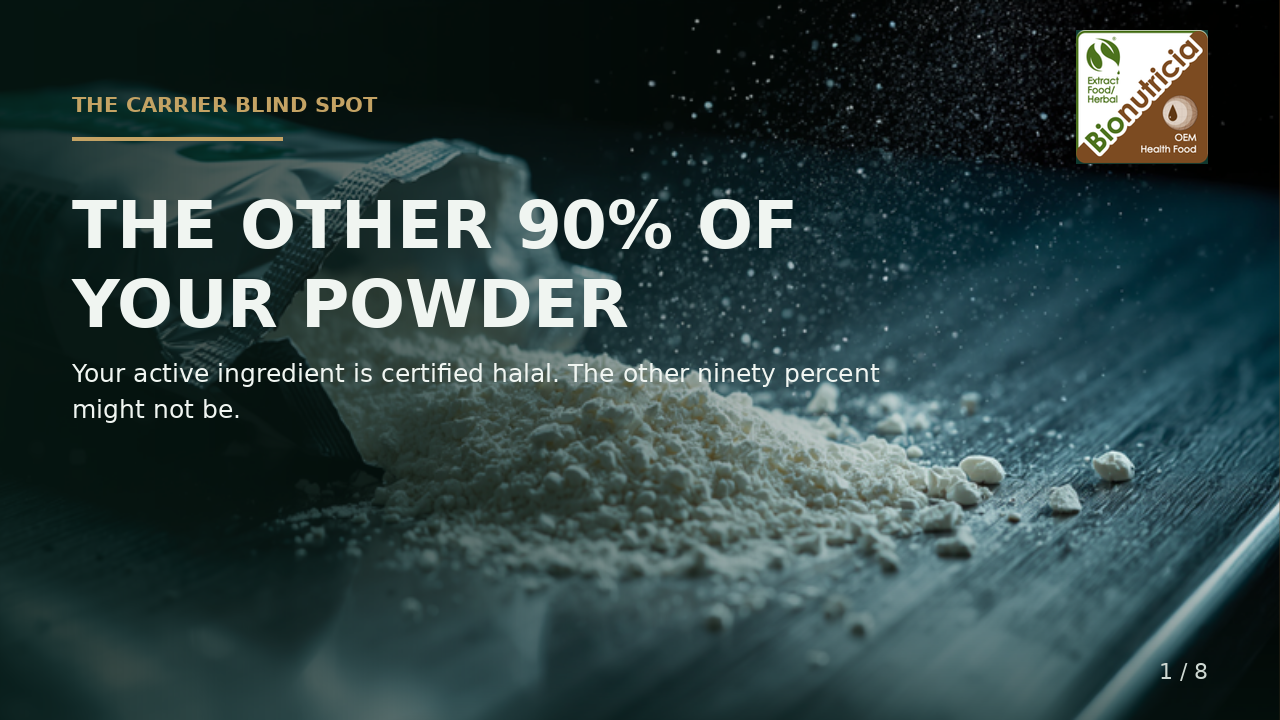
In a spray-dried supplement powder, the active ingredient is often the smallest thing in the sachet. The rest is carrier — emulsifier, anti-caking agent, flow aid, bulking agent. A halal certificate issued against the active does not cover any of it. This is the blind spot that quietly breaks halal, allergen and vegan claims on otherwise well-made products.
The ingredient everyone audits, and the ninety percent nobody does
Every serious buyer audits the active ingredient. They ask for the assay, the marker compound, the standardisation, the certificate. That is the right instinct — and it is also where most audits stop.
Here is the part that gets skipped. In a spray-dried powder, the active can be a small minority of what is actually in the sachet. The rest is carrier: the material that turns an oil or an extract into a free-flowing, dosable, shelf-stable powder. It is not filler in the pejorative sense — without it there is no powder. But it is material, it comes from somewhere, and it is going into your product.
If your halal, allergen or vegan claim rests only on the active ingredient, it is resting on the smaller half of the formula.
What the carrier actually does
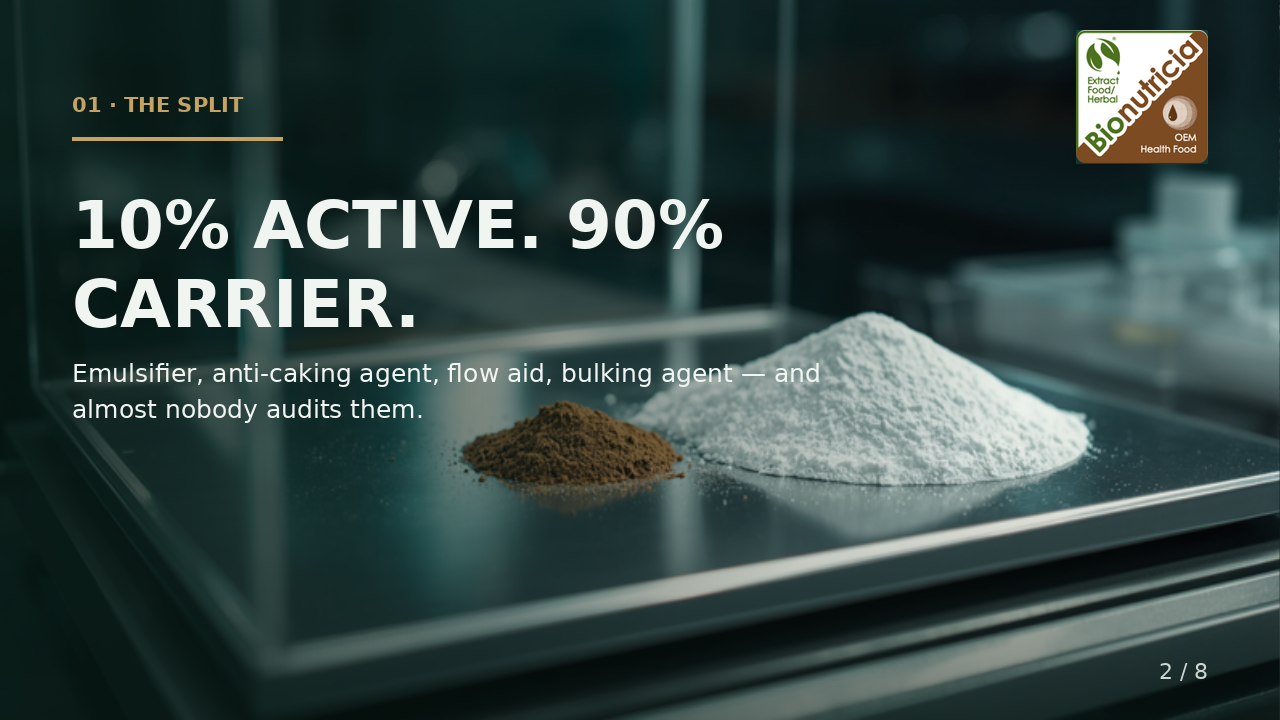
Open a typical powder specification and the carrier system is usually doing four jobs: encapsulating or emulsifying an oil phase so it does not weep or oxidise; keeping the powder pourable and dosable on a filling line; bulking a potent active so it can be blended and filled accurately; and protecting a sensitive active from moisture, light and oxygen.
Each of those jobs can be done by more than one material, and those materials differ in origin. That is the whole issue in one sentence. The functional requirement is identical; the origin is not.
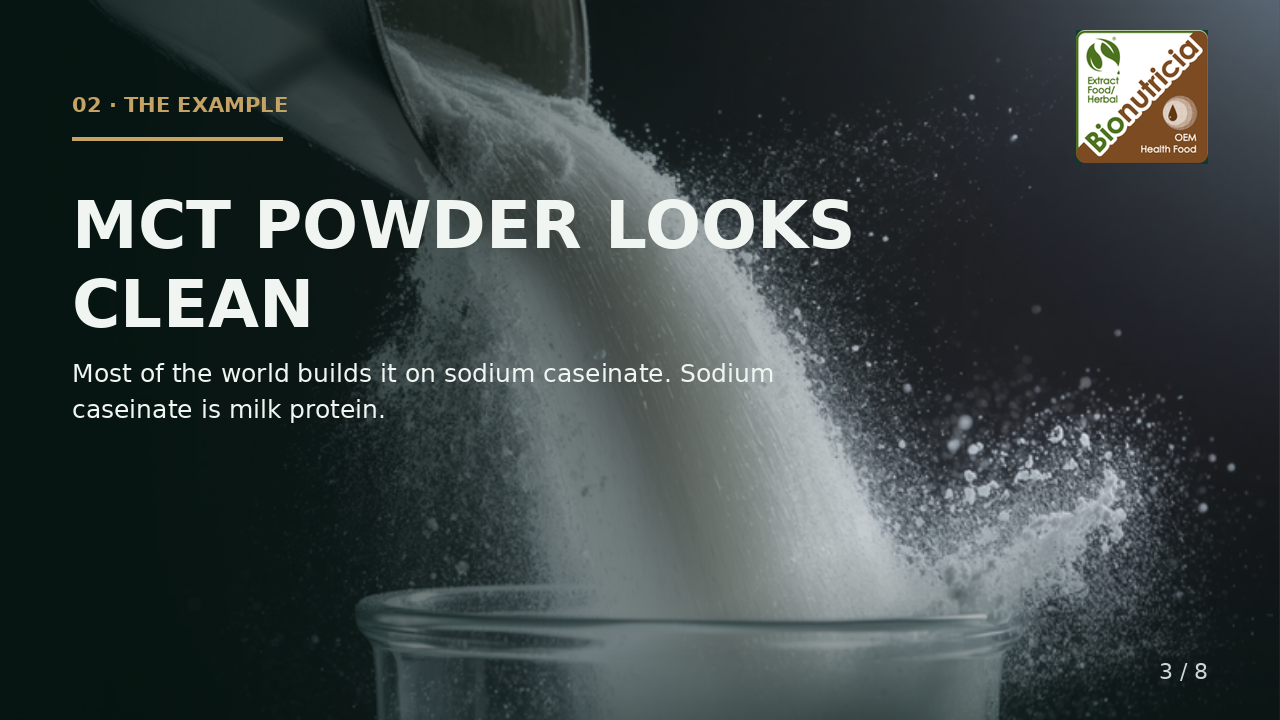
The example that catches the most brands: MCT powder
MCT oil powder is a good illustration because it looks so simple — a white, neutral, free-flowing powder made from medium-chain triglycerides. Nothing about it suggests a complication.
But an oil does not become a powder on its own. It has to be emulsified and spray-dried onto or into a carrier, and the industry default for that carrier, worldwide, is sodium caseinate — because it emulsifies extremely well and it is inexpensive.
Sodium caseinate is a milk protein. It is derived from casein, which is derived from milk. That is not a grey area or a processing-aid technicality; it is a dairy protein sitting inside a product many brands describe as plant-based.
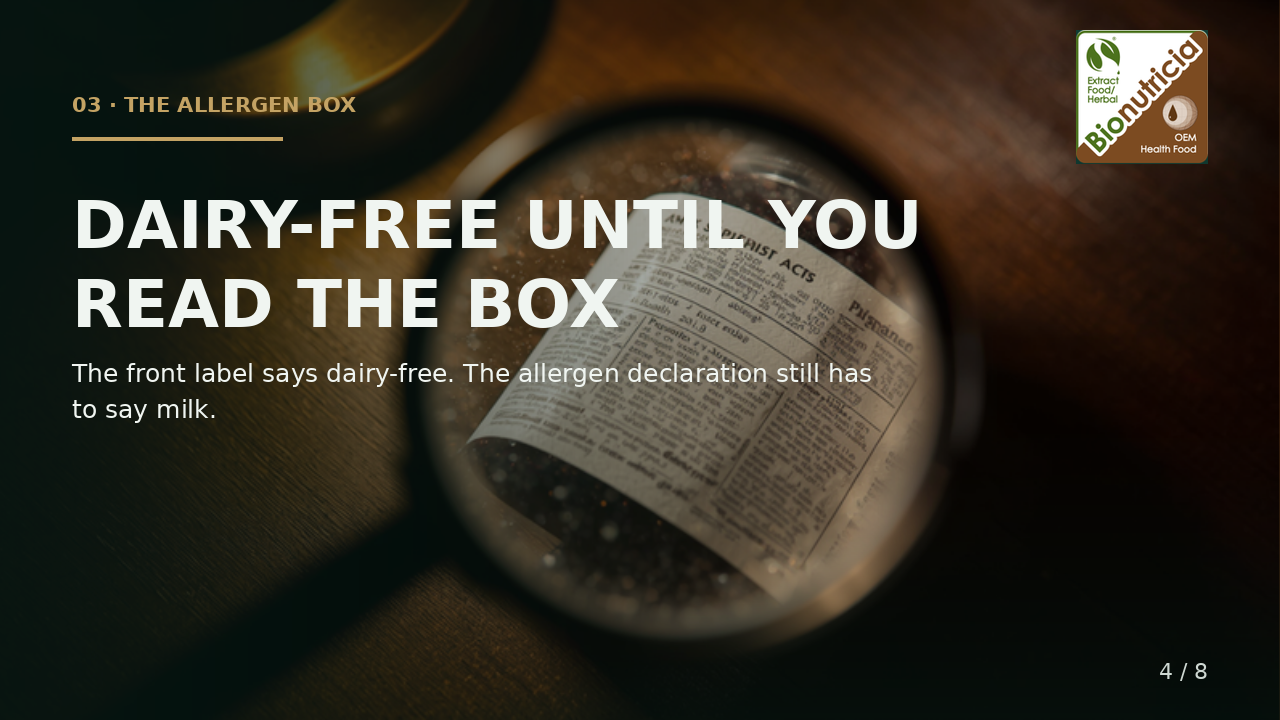
Where it surfaces: the allergen declaration
This is usually the moment a brand discovers the problem, and it is rarely cheap to fix by then.
The front of pack says dairy-free, or plant-based, or vegan. The allergen declaration on the back — a regulatory instrument, not a marketing one — has to declare milk, because there is milk protein in the formula. Two panels on the same pack, contradicting each other.
The consequence is quieter than a warning letter. A retailer running a vegan range, a distributor with a dairy-free listing, an export buyer completing an allergen matrix — one of them reads the declaration, and the SKU is delisted or the shipment is queried. The front-of-pack claim was never wrong about the active. It was wrong about the carrier.
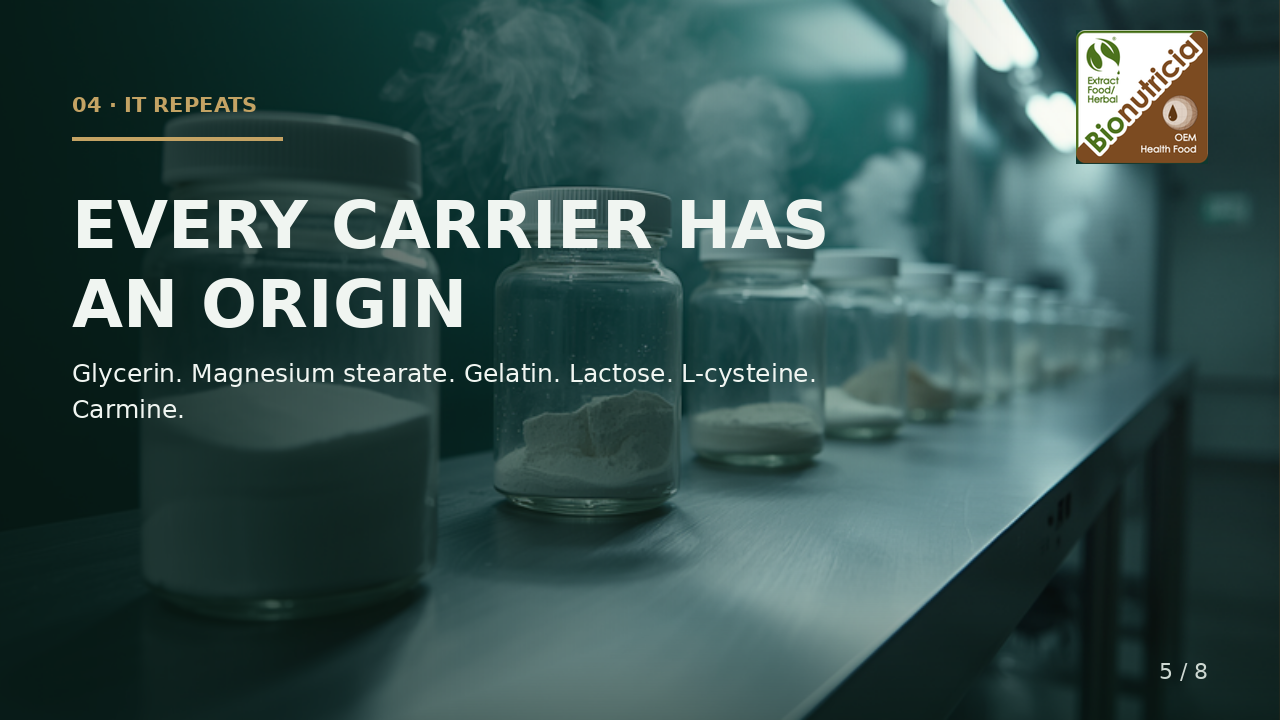
It is not one ingredient. It is a category
Sodium caseinate is the clearest example, not the only one. The same origin question runs through most of the excipient shelf.
- Glycerin — can be vegetable-derived or produced from animal tallow. Chemically identical; not equivalent for halal or vegan status.
- Magnesium stearate — a magnesium salt of stearic acid, and stearic acid can come from plant or animal fat.
- Gelatin — used in some dry powders as a carrier and protective matrix. Bovine or porcine origin matters enormously.
- Lactose — a very common diluent, and a milk sugar.
- L-cysteine — historically produced from keratin sources; synthetic and fermentation routes exist, but the route has to be specified.
- Carmine — an insect-derived colourant.
None of these are exotic. They are ordinary, well-behaved, widely used materials — which is precisely why they slip through. Nobody thinks to ask, because nothing about them looks like a risk.
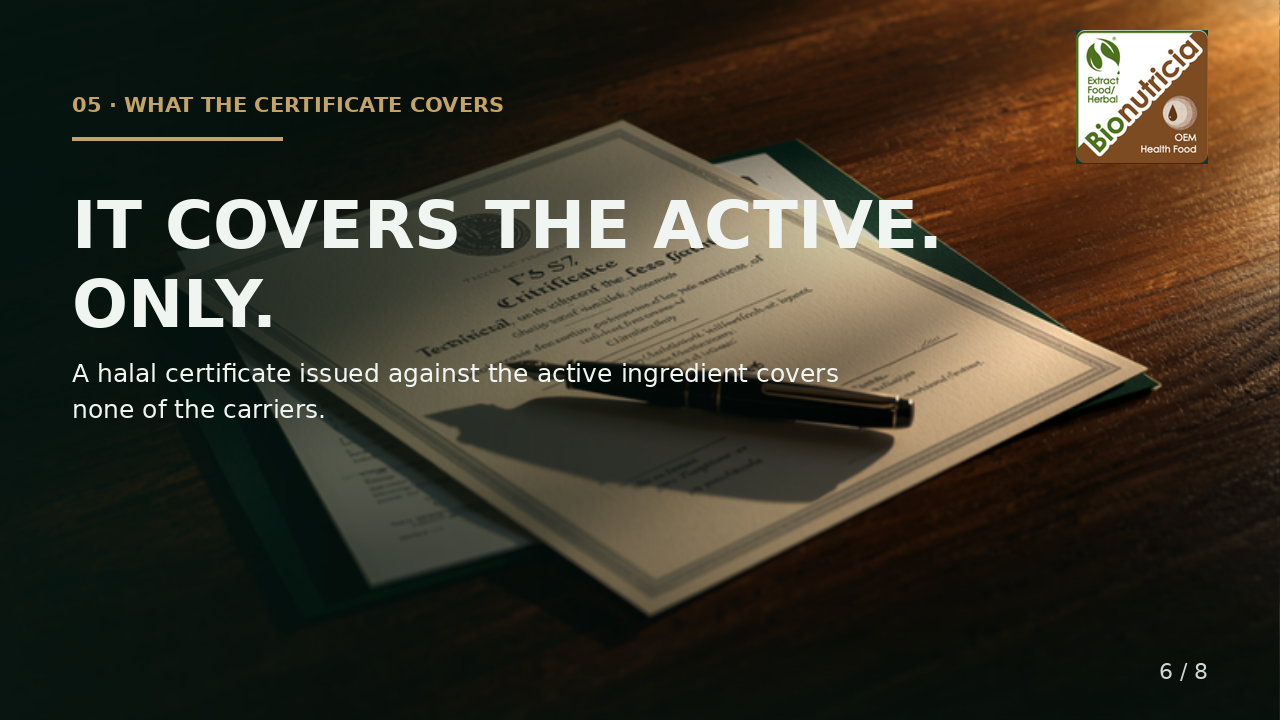
What a certificate actually covers
A certificate has a scope. It was issued against something specific — a named material, from a named producer, made at a named site.
So a halal certificate on your Tongkat Ali extract certifies that extract. It does not certify the maltodextrin it was carried on, the anti-caking agent added downstream, the emulsifier used to build the powder, or the flavour system blended in afterwards. Those are separate materials with separate documentation — and if nobody asked for that documentation, it is not in your file.
This is how a brand can hold a genuine, valid, current certificate for every active in the formula and still be unable to substantiate the claim printed on the box. Nothing was faked. The scope was simply narrower than the claim.
How we build around it
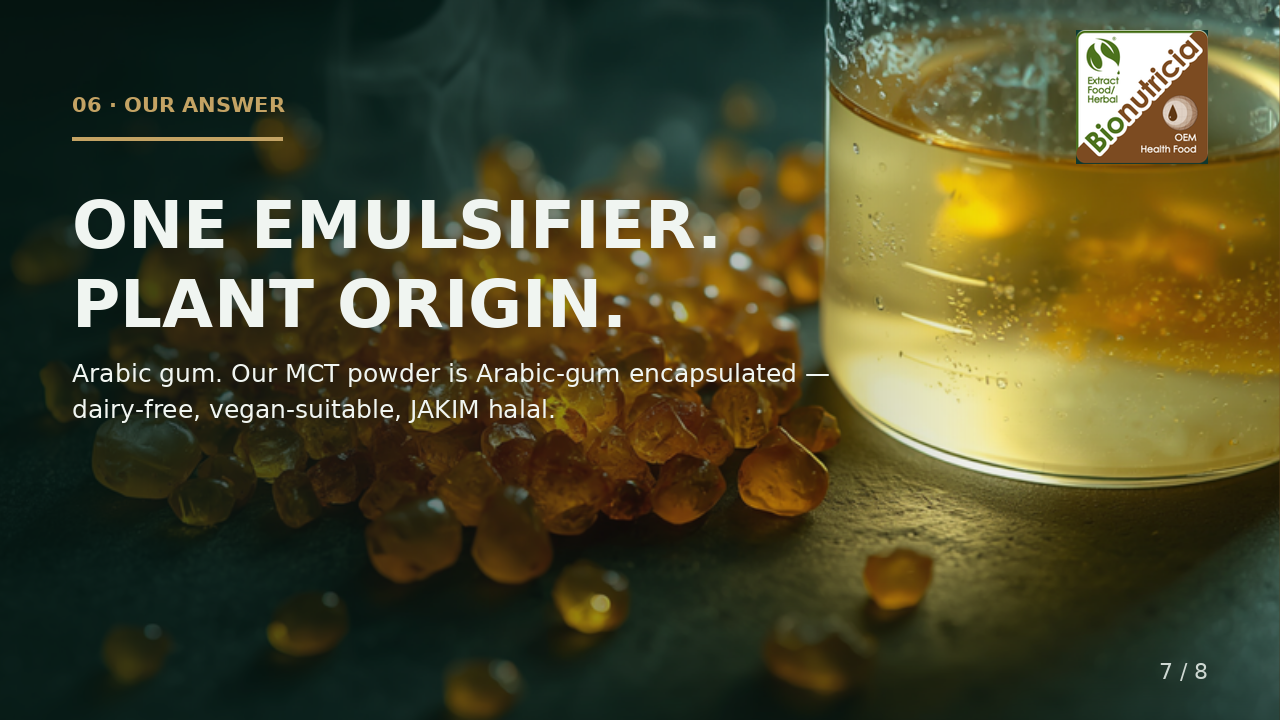
Our approach is to remove the variable rather than manage it. Arabic gum is the only emulsifier we use across our powders and emulsions — one material, one origin, plant-derived, consistent across every product we build.
That means our MCT powder is Arabic-gum encapsulated rather than caseinate-based. It is dairy-free, vegan-suitable and JAKIM halal, and the allergen declaration agrees with the front of pack instead of contradicting it.
There is a trade-off worth being straight about: caseinate is a very effective emulsifier and it is cheaper. Building on Arabic gum is a deliberate constraint. We take it because a single, plant-origin, fully documented emulsifier across the whole range is worth more to an export brand than the saving — particularly one shipping into markets where the allergen matrix and the halal file both get read carefully.
The rule that survives
Certify the formula, not the ingredient. The carrier is part of the formula.
Practically, that means one question put to whoever manufactures your product: what is the origin of every excipient in this formula, and can I have it in writing?
The answer matters, and so does how long it takes. A manufacturer who controls the carrier system knows the answer without going to look for it, because the decision was made deliberately and applies across the range. A manufacturer who has to chase it down the supply chain is telling you something too.
Frequently asked questions
Is sodium caseinate halal? Sodium caseinate is derived from milk, and milk is not inherently non-halal. The practical issues are that it still has to be certified — the processing aids and enzymes used to produce casein carry their own origin questions — and, separately, that it is a dairy allergen and is not vegan. So it can be a halal-compatible ingredient and still break a dairy-free or plant-based claim printed on the same pack.
Why do so many MCT powders use it, then? Because it works and it is inexpensive. Sodium caseinate is a very effective emulsifier for spray-drying an oil into a powder, which is why it became the global default. It does not perform badly — it performs well. The problem is that it quietly imports a dairy protein into products that are frequently marketed as plant-based.
What does Bionutricia use instead? Arabic gum, which is plant-derived. It is the only emulsifier we use across our powders and emulsions, so the origin answer is identical for every product we build. Our MCT powder is Arabic-gum encapsulated: dairy-free, vegan-suitable and JAKIM halal.
Does a halal certificate on my active ingredient cover the excipients? No. A certificate is scoped to the material it was issued against. If it names your extract, it certifies that extract — not the carrier it was spray-dried onto, the anti-caking agent added downstream, or the emulsifier used to build the powder. Each of those needs its own documentation in your file.
How do I check an existing product? Ask your manufacturer for a full formula breakdown with the origin of every excipient, not just the actives, and ask for it in writing. Then compare it against your front-of-pack claims and your allergen declaration. Glycerin, magnesium stearate, gelatin, lactose, L-cysteine and carmine are the usual places a contradiction appears.
Which excipients most often break a vegan claim? Sodium caseinate and lactose (both dairy), gelatin (bovine or porcine), carmine (insect-derived), and glycerin or magnesium stearate where the fat source is animal rather than plant. All of them are ordinary, widely used materials, which is exactly why they are easy to miss.
Is this a labelling problem or a formulation problem? Both, and they are connected. The label is where the contradiction becomes visible, but the decision that created it was made at formulation, when a carrier system was chosen without the claim in mind. Fixing it at the label stage means changing the claim; fixing it properly means changing the carrier.
What should I put in the manufacturing agreement? Specify the carrier system, not only the active. Name the permitted emulsifier and its origin, require origin documentation for every excipient, and require notification before any excipient substitution. A substitution made for supply reasons can change your allergen and halal position without anyone intending it to.
Request an OEM formulation quote →
RELATED POSTS
View all

The 10-Gram Problem: Why 2026’s Biggest Supplement Trend Doesn’t Fit in a Capsule
August 19, 2026 | by supersuper
The Formula They Only Take Once: Why Supplement Taste Decides the Reorder
August 11, 2026 | by supersuper
Article: Millet Consumption Reduces Cholesterol, Cuts Risk of Hyperlipidaemia and Obesity
October 5, 2024 | by bionutriciaadmin