


Water Activity vs Moisture Content: Why a “Dry” Supplement Powder Still Grows Mould
August 15, 2026 | by supersuper
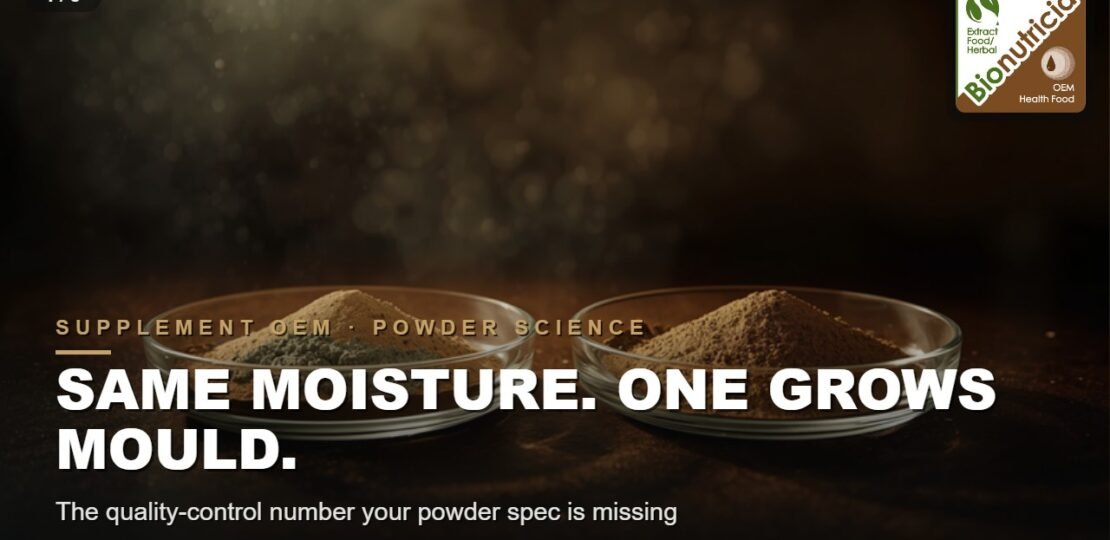
Two botanical powders can pass the exact same moisture specification — and only one grows mould. The number that decides is not moisture content but water activity (aw): the fraction of water microbes and chemistry can actually use. Here is what it means, the thresholds that matter, and why it belongs on every finished-powder spec.

Two Powders, Same Moisture — Only One Grew Mould
Put two botanical extract powders side by side. Both test at the same moisture content. Store them in the same warehouse. Months later, one is still free-flowing — the other carries a grey-green bloom. Nothing on the moisture certificate predicted it, because the moisture percentage was never the number that mattered. What separated the two powders is water activity (aw) — the measure of how much of that water is actually available to microbes and chemical reactions. It is one of the most under-read parameters on supplement spec sheets, and one of the quiet reasons finished batches fail in the field after passing every release test.
What Moisture Content Actually Measures
Moisture content — typically reported as loss on drying — answers one question: how many grams of water are in this powder, in total. A “moisture NMT 5%” line on a certificate of analysis says nothing about what that water is doing. Some of it is bound tightly to sugars, proteins, fibres and minerals. Some of it sits free at particle surfaces. A total tells you the size of the reservoir — not whether the tap is open. That is why two powders with identical totals can behave completely differently in storage.
Free vs Bound Water: What Water Activity Means
Microorganisms cannot use water that is bound to the powder matrix — they can only draw on the free, energetically available fraction. Water activity expresses exactly that, on a scale from 0 to 1 (it corresponds to the equilibrium relative humidity the powder generates in a sealed space, divided by 100). Every ingredient binds water differently — each has its own sorption isotherm — so a hygroscopic spray-dried extract and a crystalline excipient can hold the same total water at very different water activities. Same moisture, different risk. This is the single clearest reason a moisture spec alone cannot protect a formula.
Measuring Water Activity in Practice
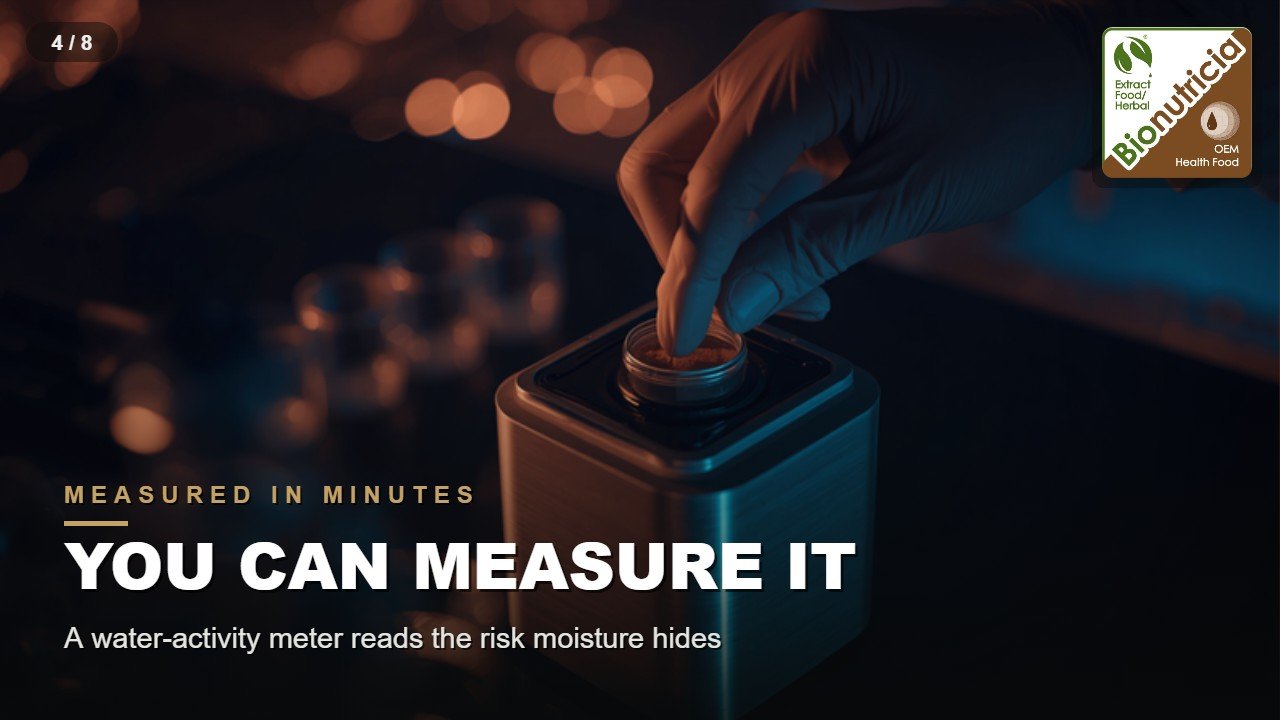
Water activity is measured directly: a small sample cup goes into a benchtop meter, the headspace equilibrates, and a dew-point or capacitance sensor reads the result — usually in a few minutes, non-destructively. In a well-run plant it sits beside loss on drying in release testing, and it is checked again during stability studies, because aw drifts as powders equilibrate with the air that reaches them. If a supplier can show moisture data but has never measured the water activity of the finished blend, the shelf-life estimate is resting on the wrong number.
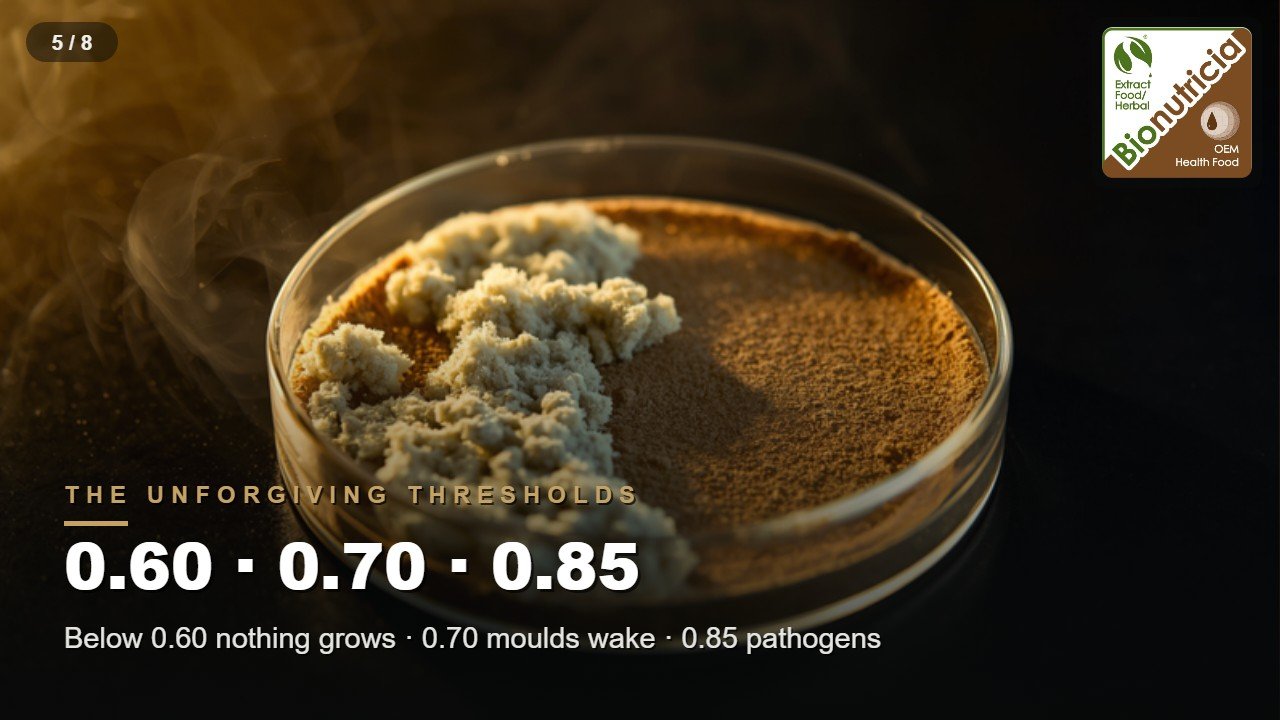
The Thresholds: 0.60, 0.70, 0.85
The microbiology of water activity is unusually clean. Below 0.60 aw, no microbial growth of any kind occurs — the practical floor for long-term dry-powder safety. Around 0.70, moulds begin to grow (only specialised xerophilic organisms manage below that). At 0.85, the line regulators use for shelf stability, bacterial pathogens can grow — above it, a product generally needs refrigeration or preservation. Well-dried supplement powders typically sit near 0.2–0.4 aw, which is why the danger is rarely how a powder leaves the dryer — it is what the powder picks up afterwards, in a humid plant, an open drum, or the wrong laminate.
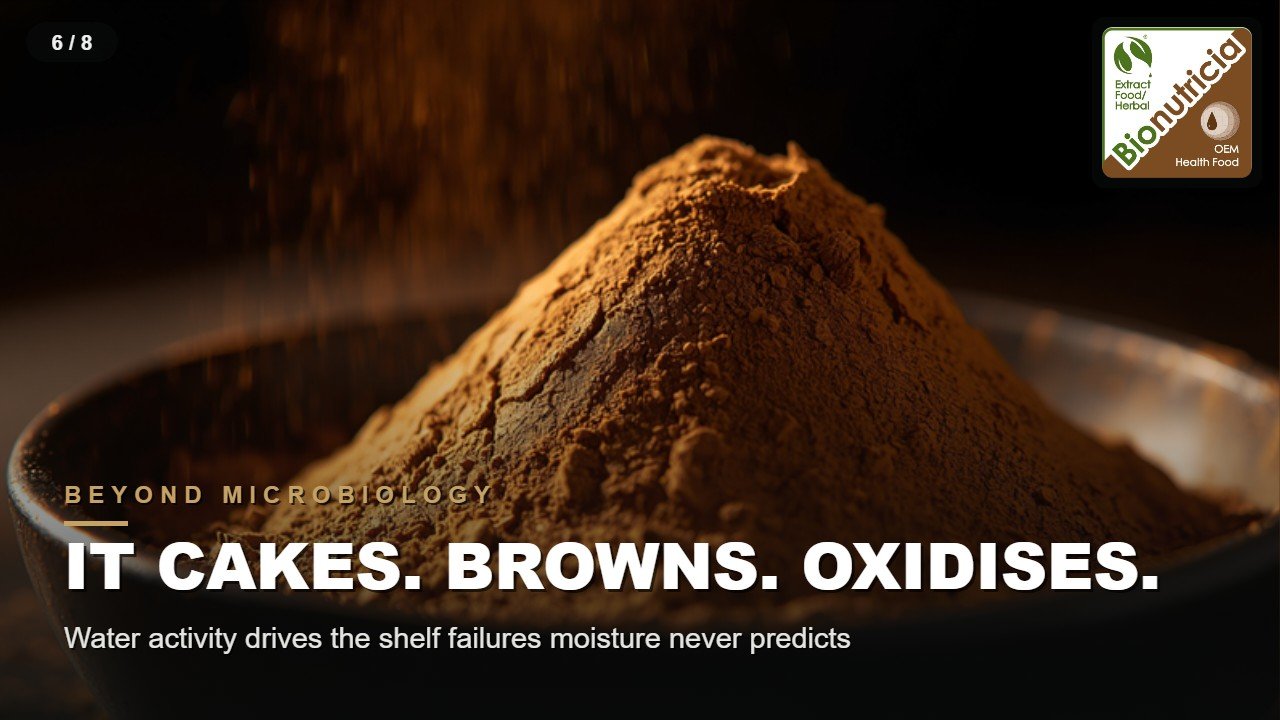
Beyond Mould: Caking, Browning and Oxidation
Water activity is not only a microbial number. As aw climbs, amorphous powders pass their glass transition and turn sticky — the start of caking, clumping and collapsed sachets. Maillard browning accelerates through the middle of the aw range, darkening powders and dulling flavour. Lipid oxidation follows its own curve, speeding up as free water mobilises catalysts. Enzymatic residues can reactivate. So even a batch that never approaches the mould threshold can cake into a brick, brown, or go rancid early — failures customers see long before any microbiological limit is broken.

Why Batches Pass Moisture Specs and Still Fail
Now the paradox resolves. A batch is released at moisture NMT 5% and a comfortable aw of 0.3. It is filled into a marginal film, shipped through tropical humidity, and stored for months — in Malaysia’s climate, the toughest ICH stability zone. Water vapour migrates through the packaging; the powder equilibrates upward; somewhere past 0.6–0.7 aw the first colonies find their footing, and the caking began well before that. The moisture certificate was accurate on the day it was printed. The specification simply never controlled the number that governs what happens next. That is the difference between testing a powder and engineering its stability — the same thinking behind real-time and accelerated stability programs.

Build the Spec Around Water Activity
The fix is not “dry it more” — over-drying wastes energy and can damage actives. The fix is to control the right number: set a finished-product water-activity limit (for most powder blends, a release target around 0.2–0.4 with a hard ceiling well below 0.60), verify it batch by batch, prove it holds through stability testing, and protect it with genuine barrier packaging — foil-laminate sachets and pouches with sealed, low-permeability formats, with desiccant strategies where the formula demands it. When a brand qualifies a manufacturing partner, one question separates powder science from paperwork: “What is the water activity of the finished product — and how do you hold it there?”
FAQ: Water Activity in Supplement Manufacturing
Is water activity the same as moisture content?
No. Moisture content is the total amount of water in a powder. Water activity (aw) is the fraction of that water which is free and available to microbes and chemical reactions. Two powders with identical moisture content can have very different water activities, because every ingredient binds water differently.
What water activity stops mould growing in supplement powders?
Moulds generally cannot grow below about 0.70 aw (only rare xerophilic species manage slightly lower), and no microbial growth of any kind occurs below 0.60 aw. Keeping a finished powder comfortably below 0.60 throughout its shelf life is the practical safety floor.
Why does a powder cake or harden even though it passed its moisture spec?
Caking is driven by water activity, not total moisture. As aw rises, amorphous particles pass their glass transition, surfaces turn sticky, and the powder bridges into lumps. A batch can pass a moisture test at release, absorb vapour through marginal packaging, and cake well before any mould appears.
How is water activity measured?
With a benchtop water-activity meter: a sample cup equilibrates in a sealed chamber and a dew-point or capacitance sensor reads the equilibrium relative humidity, reported as aw on a 0–1 scale. A reading takes minutes and is routine in release and stability testing at a properly equipped manufacturer.
What water activity should a supplement powder target?
Most well-dried supplement powders are released around 0.2–0.4 aw. The specification should also define a ceiling with safety margin below 0.60 across shelf life — which is as much a packaging requirement as a drying requirement, especially in hot, humid climates.
Formulating a powder, sachet or pouch beverage for a humid market? Bionutricia engineers water activity, stability and barrier packaging in from the specification stage. Talk to the technical team.
Explore our OEM formats: supplement sachet OEM manufacturer in Malaysia · chewable tablet supplement OEM manufacturer in Malaysia
RELATED POSTS
View all


Article: Resveratrol Cuts Hospitalization Rate for COVID Outpatients
October 5, 2024 | by bionutriciaadmin
Article: Food as Medicine: Black Elderberry (Sambucus nigra, Adoxaceae)
October 5, 2024 | by bionutriciaadmin