

Elderberry (Sambucus nigra) Extract OEM: Anthocyanin & Vitamin C Standardisation for Immune-Support Formats
September 8, 2026 | by supersuper
Direct answer: A commercial-grade elderberry (Sambucus nigra) extract for OEM should be standardised to two named markers on the CoA: total anthocyanins ≥3–5% w/w (calculated as cyanidin-3-glucoside, measured by the pH-differential method, AOAC 2005.02), with cyanidin-3-O-glucoside and cyanidin-3-O-sambubioside identified as the two dominant marker compounds, and vitamin C (ascorbic acid) content confirmed by HPLC, reported in mg per gram of extract rather than assumed from raw-fruit values. Always confirm the extract is made from ripe, heat-processed berries — raw or unripe Sambucus nigra fruit, leaves and stems contain cyanogenic glycosides (sambunigrin) that must be reduced to safe residual levels during extraction, and a CoA that does not state the processing method or a cyanogenic-glycoside ceiling is incomplete. Add the standard botanical panel: total plate count ≤10,000 CFU/g, yeast and mould ≤1,000 CFU/g, pathogens absent/25 g, and heavy metals within the usual ppm ceilings. For OEM formulation, elderberry is positioned as an anthocyanin- and vitamin-C-rich botanical for seasonal wellness and antioxidant SKUs — label copy should stay in structure/function language (“supports immune function,” “antioxidant support”) rather than disease-treatment claims. Bionutricia offers contract extraction of elderberry in standardised form, then spray-drying, blending and filling into finished formats at its Sungai Buloh facility under FSSC 22000 and JAKIM halal certification.
Why elderberry needs two markers, not one
Elderberry’s commercial value rests on two nutritive markers, not one: anthocyanin content (colour and antioxidant capacity) and a meaningful vitamin C content inherited from the raw fruit. A supplier quoting only a vague “elderberry extract” without naming both on the CoA is not offering a truly standardised ingredient — a correct spec states the anthocyanin percentage and the ascorbic acid content of the finished extract, not the raw fruit.
Anthocyanin standardisation: what the CoA should show
Fresh Sambucus nigra berries are naturally rich in anthocyanin glycosides, dominated by two compounds: cyanidin-3-O-glucoside and cyanidin-3-O-sambubioside, together the majority of total anthocyanin content in most European elderberry varieties. Published analytical work places dried-fruit anthocyanin content in a wide natural range (roughly 95–226 mg/100 g for cyanidin-3-glucoside, up to several hundred mg/100 g for cyanidin-3-sambubioside, depending on variety and handling) — exactly why standardisation, not raw dried powder, is the specification to ask for.
For a commercial standardised extract, request:
- Total anthocyanins ≥3–5% w/w, calculated as cyanidin-3-glucoside equivalent, by the AOAC 2005.02 pH-differential spectrophotometric method (the same method family used across Bionutricia’s other anthocyanin botanicals — roselle, butterfly pea).
- Cyanidin-3-O-glucoside and cyanidin-3-O-sambubioside individually identified and quantified by HPLC, so the pH-differential total can be cross-checked against a compound-specific fingerprint.
- Higher-purity grades (8–10%+ total anthocyanins) exist for concentrated antioxidant or premium-tier positioning, at a corresponding cost and yield trade-off.
Vitamin C standardisation: don’t assume the raw-fruit number carries over
Raw elderberries carry a genuinely useful vitamin C content — USDA reference data places raw fruit around 52 mg per 100 g (roughly 58% of the US Daily Value per cup). But that describes the raw fruit, not a processed, spray-dried or concentrated extract, where drying and concentration factor change the final ascorbic acid content per gram. A defensible CoA states the ascorbic acid content of the finished extract itself, by HPLC, not a raw-fruit figure carried over uncritically. For guaranteed label potency, co-formulating with a standardised ascorbic acid ingredient is more reliable than relying solely on the fruit’s native, heat-sensitive content.
Why raw elderberry is never the right input — the processing requirement
Unprocessed Sambucus nigra — unripe berries, leaves, bark and stems — contains cyanogenic glycosides (chiefly sambunigrin) and lectins that can cause nausea, vomiting and, in documented cases, more serious toxicity when consumed raw. Heat treatment substantially reduces cyanogenic glycoside content (roughly 44% in juice, 80% in tea, up to 96% in cooked preparations), which is why every commercial elderberry ingredient must be derived from ripe, heat-processed fruit, never raw berries, leaves or stems. A supplement CoA should state the plant part, confirm the heat/fermentation step, and ideally report a cyanogenic-glycoside ceiling. Bionutricia’s contract extraction applies controlled heat processing as standard for elderberry.
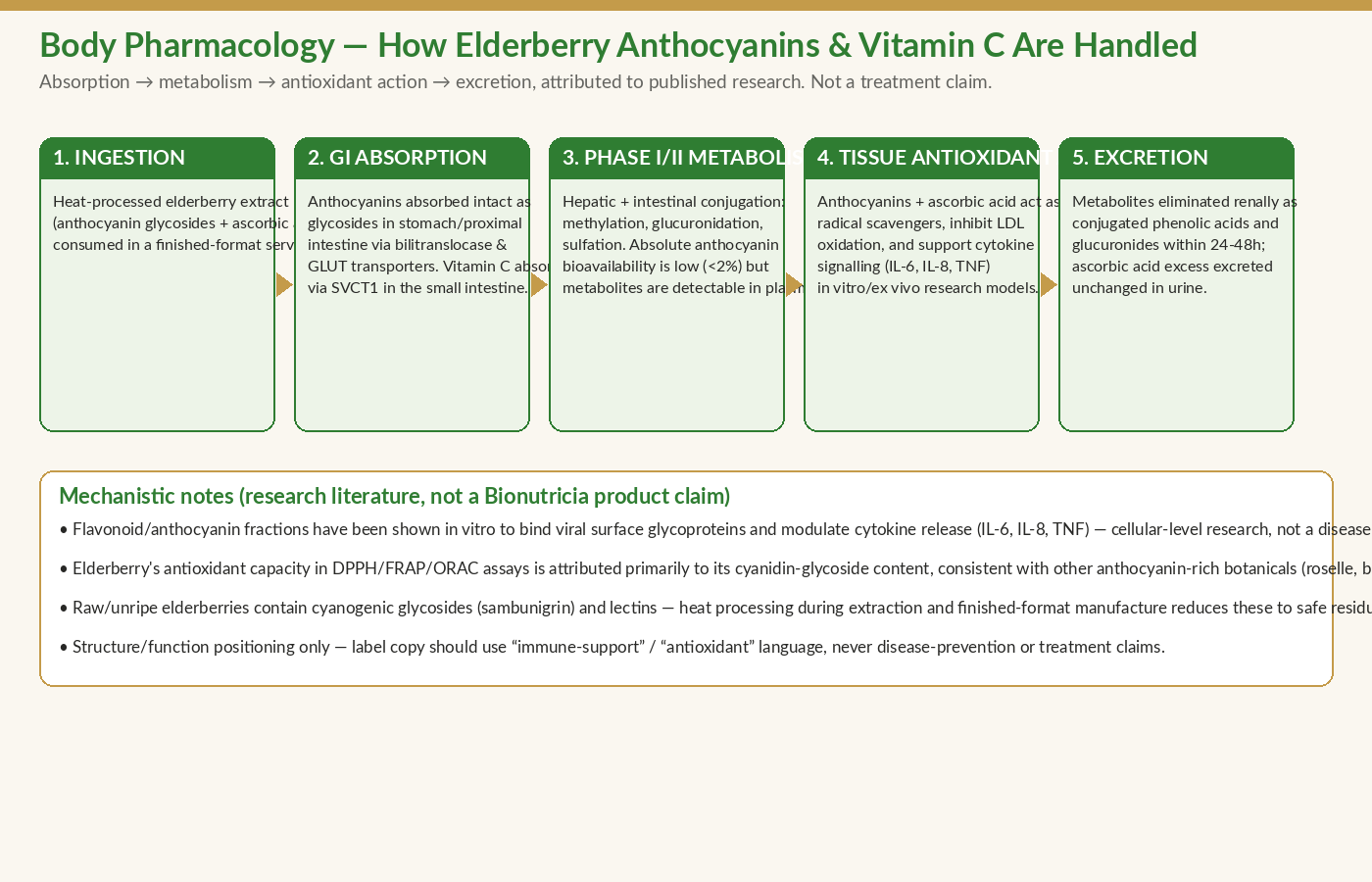
Pharmacology: how anthocyanins and vitamin C behave in the body
Anthocyanins are absorbed intact as glycosides, primarily in the stomach and proximal small intestine, via transport mechanisms including bilitranslocase and glucose transporters, then undergo extensive Phase I/II hepatic and intestinal metabolism — methylation, glucuronidation and sulfation — before entering circulation as conjugated metabolites. Absolute anthocyanin bioavailability is low (commonly cited at under 2% of ingested dose), but metabolites are consistently detectable in human plasma after intake, and research attributes elderberry’s measured antioxidant and cytokine-modulating activity to this metabolite pool. Vitamin C, by contrast, is absorbed via the SVCT1 active transporter in the small intestine. Both compound families support the same broad mechanism — radical scavenging and modulation of oxidative-stress and inflammatory signalling (including IL-6, IL-8 and TNF in cellular studies) — the basis for elderberry’s “antioxidant / immune-support” positioning. This is mechanistic background from published research, not a claim that any finished product treats or prevents illness.
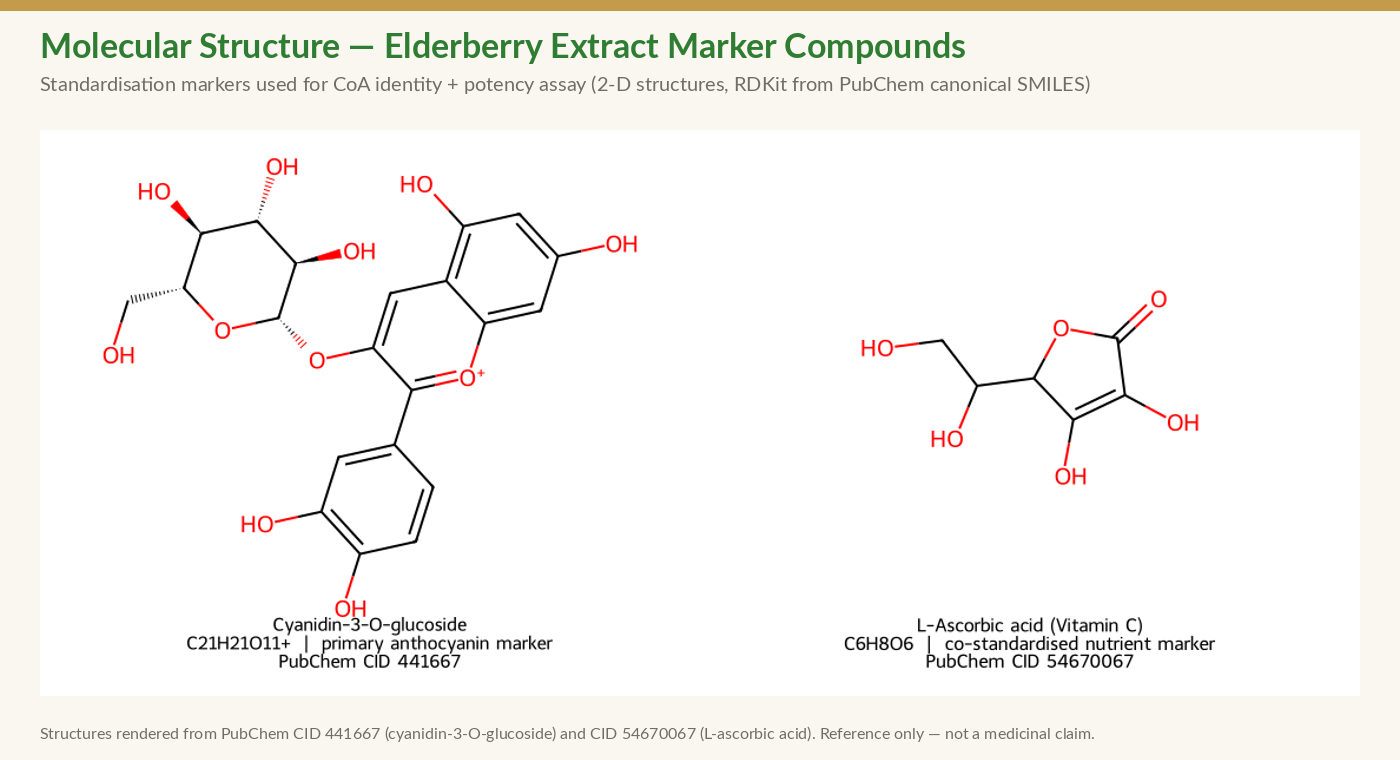
Molecular structure of the standardisation markers
The two compounds a formulator should see named on an elderberry CoA — cyanidin-3-O-glucoside (the primary anthocyanin marker) and ascorbic acid (the co-standardised vitamin C marker) — are shown below with their real chemical structures.
Cited clinical research
The most methodologically rigorous recent human trial on standardised elderberry extract is a randomised, double-blind, placebo-controlled study in 312 economy-class air travellers (Tiralongo, Wee & Lea, Nutrients, 2016). The number of people who caught a cold did not differ significantly between groups (17 placebo vs 12 elderberry, p=0.4), but the collective duration of cold episodes and collective symptom-severity score were both significantly lower in the elderberry group.
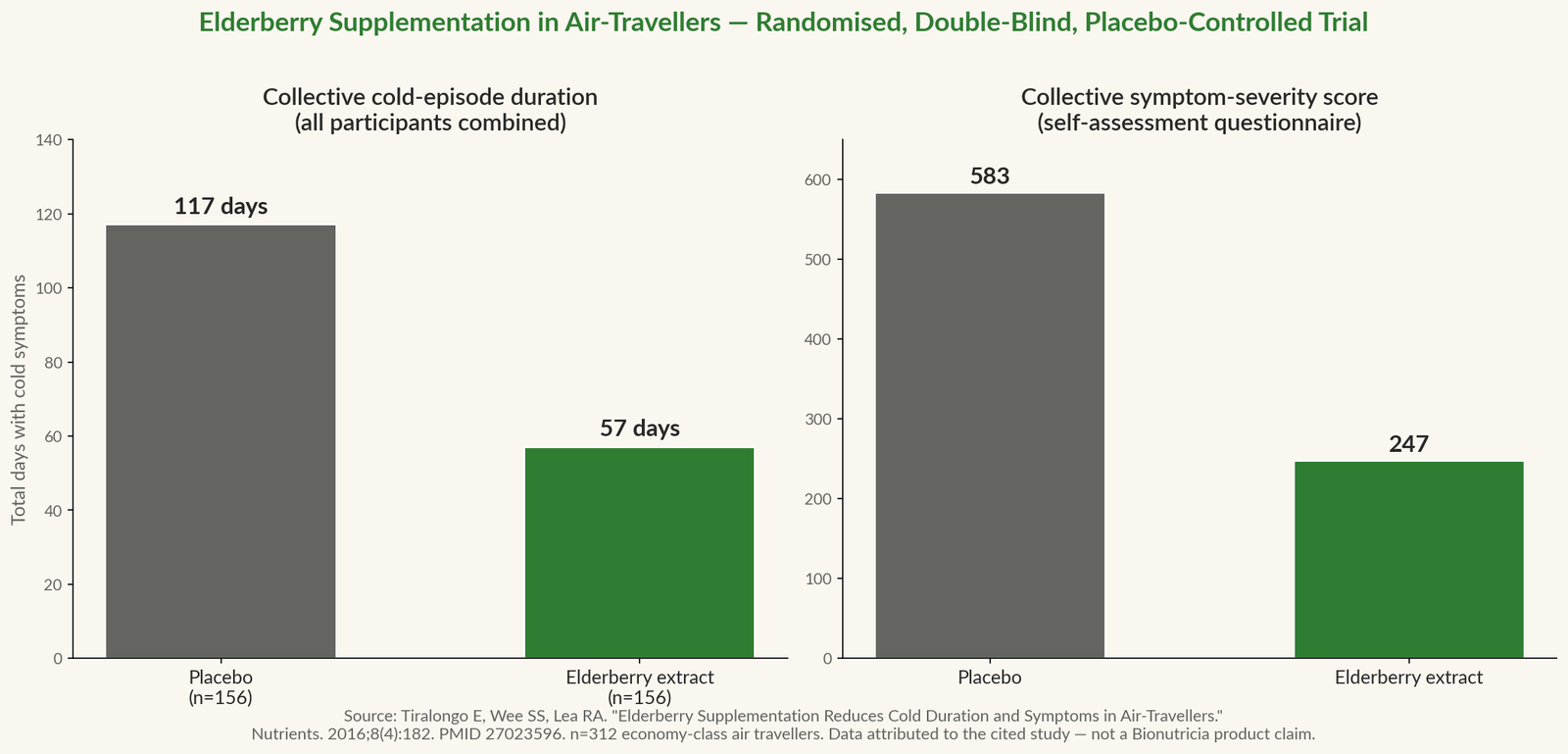
This data is attributed to the cited trial and describes outcomes in that study population — not a claim that Bionutricia’s elderberry extract, or any finished product made from it, treats, cures or prevents any condition. Earlier research on elderberry’s flavonoid activity provides mechanistic plausibility for the antioxidant/immune-support framing but should not be presented on-pack as a treatment claim.
Certificate of Analysis: full specification checklist
| Parameter | Typical specification |
|---|---|
| Botanical name | Sambucus nigra L. (European black elderberry) |
| Plant part | Ripe fruit only, heat-processed — never raw fruit, leaf, bark or stem |
| Total anthocyanins | ≥3–5% w/w as cyanidin-3-glucoside equivalent (AOAC 2005.02, pH-differential) |
| Marker compounds | Cyanidin-3-O-glucoside + cyanidin-3-O-sambubioside, quantified by HPLC |
| Vitamin C (ascorbic acid) | Reported per gram of finished extract by HPLC — not assumed from raw fruit |
| Cyanogenic glycosides | Ceiling confirmed post-processing; processing method (heat/ferment) stated |
| Moisture (powder) | ≤5.0% |
| Total plate count | ≤10,000 CFU/g |
| Yeast & mould | ≤1,000 CFU/g |
| E. coli / Salmonella spp. / S. aureus | Absent / 25 g |
| Heavy metals | Pb ≤2.0 · Cd ≤1.0 · Hg ≤0.1 · As ≤1.5 ppm |
Formats Bionutricia manufactures with elderberry extract
- Powder sachets — single-serve antioxidant/immune-support instant mixes, ambient-stable, easily blended with vitamin C, zinc or other complementary actives.
- Liquid sachets — seasonal wellness shots with elderberry’s natural deep-purple colour doing double duty as both active and visual cue.
- Gel sachets — texture-controlled delivery for a “syrup-style” consumer experience without the sugar load of a traditional elderberry syrup.
- Pouch beverages — larger-volume ready-to-drink format for café, gym and modern-trade wellness positioning.
- Chewable tablets — solid-dose format pairing standardised anthocyanin/vitamin C content with zinc or other immune-support co-actives.
- Liquid bottles — tonic and wellness-shot formats where elderberry’s colour and antioxidant story are the hero.
Elderberry also pairs naturally with vitamin C and zinc in a multi-ingredient seasonal-wellness SKU — see the full berry range below.
The berry range Bionutricia already has available for OEM formulation
Elderberry is far from the only berry in the house. Bionutricia’s ingredient inventory carries one of the broadest berry ranges of any Malaysian OEM — so a brand building a berry, antioxidant or vitamin-C-positioned line can formulate an entire multi-SKU range from a single JAKIM-certified facility and one CoA chain:
- Anthocyanin-rich berries — elderberry extract (10:1), bilberry extract standardised to 25% anthocyanins, blackcurrant, maqui berry, acai berry, lingonberry, chokeberry (aronia), blueberry, blackberry and redcurrant — as extract powders and fruit-juice powders.
- Vitamin C-dense fruit partners — acerola cherry, amla (Indian gooseberry, Phyllanthus emblica) and rosehip, the natural co-formulation answer to the vitamin C standardisation discussed above, plus sea buckthorn (fruit-juice powder and berry oil standardised to 30% omega-7).
- Functional berries — cranberry (standardised to proanthocyanidins and D-mannose), goji/wolfberry, hawthorn berry, golden berry, barberry, raspberry (including a 98% raspberry-ketone extract), strawberry and white strawberry, grape seed and grape skin extracts, and a ready mixed-berries extract blend.
- Matching berry flavour systems — cranberry, blackcurrant, blueberry, raspberry, strawberry, blackberry, grape and mixed-berry flavour powders are stocked alongside the actives, so the finished sachet or beverage can taste like the berry on the label.
Beyond the berry family, adjacent anthocyanin and antioxidant botanicals are also in the published range — roselle (hibiscus) calyx, mangosteen pericarp and butterfly pea flower. Ask the RFQ team which berry actives fit your target positioning — most briefs can be filled from inventory.
📚 Related guides
- How to Read a Supplement Certificate of Analysis (CoA): A Buyer’s Guide
- Natural vs Synthetic Colours in Supplements & Beverages
- Mangosteen (Garcinia mangostana) Pericarp Extract for Antioxidant SKUs
Frequently asked questions
What anthocyanin and vitamin C standardisation should I ask for in an elderberry extract for OEM?
Ask for total anthocyanins ≥3–5% w/w calculated as cyanidin-3-glucoside equivalent (AOAC 2005.02 pH-differential method), with cyanidin-3-O-glucoside and cyanidin-3-O-sambubioside individually confirmed by HPLC, plus ascorbic acid content of the finished extract reported by HPLC rather than assumed from raw-fruit reference values.
Is raw elderberry safe to use as a supplement ingredient?
No. Raw or unripe Sambucus nigra fruit, leaves and stems contain cyanogenic glycosides (sambunigrin) that must be reduced through heat processing before the material is safe for food or supplement use. A compliant elderberry extract is always made from ripe, heat-processed fruit, with the processing step confirmed on the CoA.
Does elderberry extract actually reduce cold symptoms?
A 2016 randomised, double-blind, placebo-controlled trial in 312 air travellers found significantly lower collective cold-episode duration and symptom-severity scores in the elderberry group than placebo, though the number of people who caught a cold did not differ significantly. This is evidence from one cited clinical trial — not a treatment or cure claim for any Bionutricia-manufactured product.
Can elderberry be combined with other actives in the same SKU?
Yes. Elderberry is commonly co-formulated with vitamin C, zinc or other antioxidant botanicals such as roselle or mangosteen pericarp in a single seasonal-wellness or antioxidant-positioned SKU, standardised and filled under one CoA chain.
What formats can Bionutricia manufacture with elderberry extract?
Powder sachets, liquid sachets, gel sachets, pouch beverages, chewable tablets and liquid bottles — Bionutricia does not manufacture capsules, softgels, gummies or hard tablets in any format.
Ready to develop an elderberry antioxidant SKU?
Vertically integrated elderberry extraction and finished manufacturing under FSSC 22000, GMP, HACCP, JAKIM Halal, US FDA and MeSTI certification. Standardised anthocyanin + vitamin C specification, full CoA stack, and powder-sachet, liquid-sachet, gel-sachet, pouch-beverage, chewable-tablet and liquid-bottle formats. Free formulation consultation and 24-hour RFQ reply.
Request a quotation · See our OEM services · View our certifications
WhatsApp: +60 16-661 8510
Article by Bionutricia R&D Team — in-house registered pharmacist, nutritionist, dietitian, and PhD biomedical scientist. Last updated: September 8, 2026.
RELATED POSTS
View all

Knowledge: Pandan (Pandanus amaryllifolius)
October 5, 2024 | by bionutriciaadmin

Knowledge: Green Tea (Camillia Sinensis)
October 5, 2024 | by bionutriciaadmin
Knowledge: Pineapple (Ananas Comosus)
October 5, 2024 | by bionutriciaadmin